16 years one-stop China custom CNC machining parts factory

Hey there I’m VMT Sam!
With 25 years of CNC machining experience we are committed to helping clients overcome 10000 complex part-processing challenges all to contribute to a better life through intelligent manufacturing. Contact us now
 319 |
Published by VMT at Sep 10 2026 | Reading Time:About 6 minutes
319 |
Published by VMT at Sep 10 2026 | Reading Time:About 6 minutes


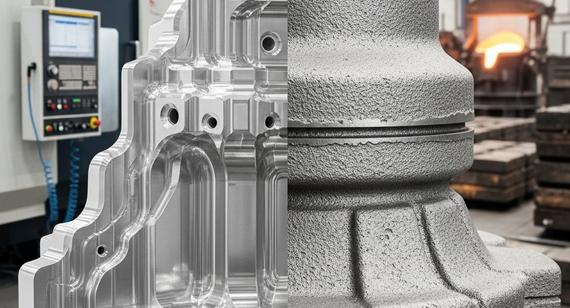
Modern manual machining originated around the 19th century with the appearance of manual boring and milling machines. As the word "manual" suggests, this processing method relies heavily on human operation, resulting in low efficiency and precision that heavily depends on the operator's skill level. However, starting in the mid-to-late 20th century, the emergence and development of computer technology led to the evolution of Computer Numerical Control (CNC) machine tools, integrating CAD (Computer-Aided Design) and CAM (Computer-Aided Manufacturing) software into CNC systems. Digital code means fewer human errors and reduced labor, leading to improved efficiency and precision.
So, what are the main pros and cons of CNC vs. manual machining? Do they align with your project requirements? What are their differences in precision, cost, flexibility, and speed? Read on to learn more about CNC machining vs. manual machining and make the best engineering decisions. At the end of this article, we will also analyze a case study where our factory provided high-precision 5-axis CNC machining services to achieve tight tolerances (±0.01 mm) and fast delivery times for complex drone components.
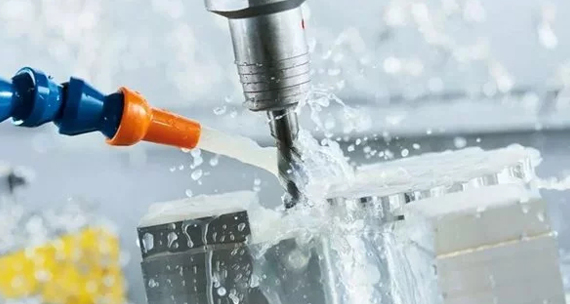
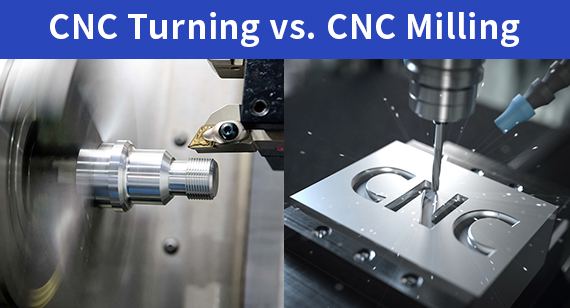
CNC machining is a modern subtractive manufacturing process in which computers control machining tools such as lathes, mills, routers, and grinders. By using pre-programmed software, CNC machines operate autonomously to shape raw materials like metals, plastics, or composites into high-precision components.
Evolving into the 21st century, CNC machine tools have developed into a wide variety of machine types. Some of the most common industrial applications include:
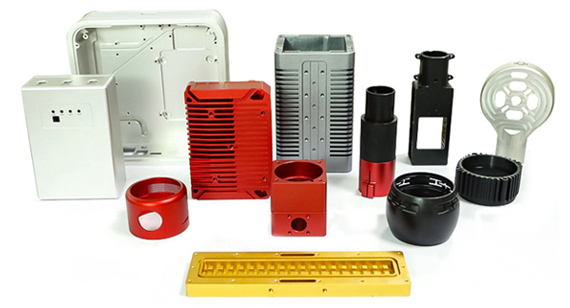
CNC machining offers exceptional precision, repeatability, and speed—qualities essential for industries such as aerospace, automotive, medical, and electronics manufacturing. It processes complex geometries with minimal human intervention, significantly reducing errors and scaling production. Thanks to its high level of automation, CNC machining services are particularly cost-effective for producing complex or high-volume CNC machined parts.
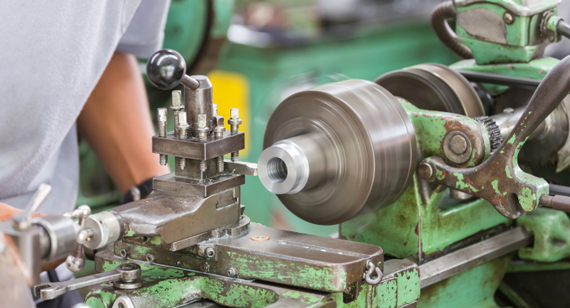
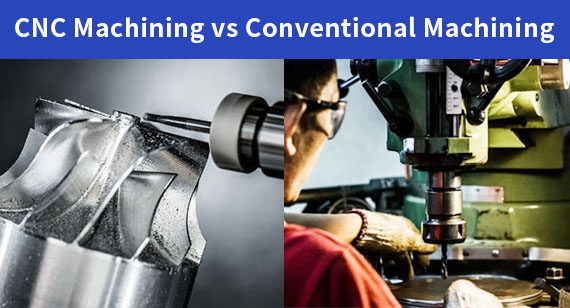
Compared to modern industrial manufacturing methods, manual machining is relatively traditional. You can still find vintage manual machines, which are useful for personal hobbies, initial prototype creation (such as making samples, simple fixtures, or single custom parts), and practical projects. Additionally, training schools often use manual machine tools to help technicians develop a practical "feel" for the material and machining process.
During manual machining, operators manually control machines such as traditional milling machines, lathes, and drill presses. Every movement, whether cutting, rotating, or positioning, is controlled by hand. As a result, dimensional precision depends heavily on the operator's skill level, and repeatability across multiple parts is limited.
Consequently, manual machining methods are typically reserved for processing simple geometries, initial prototyping, or quick on-the-fly modifications. In today's high-precision and volume-driven industrial manufacturing landscape, CNC machining is the industry standard, making manual machining far less common.
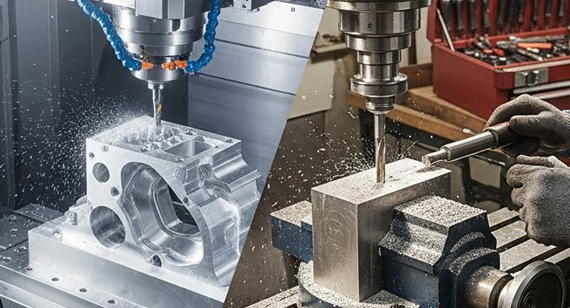
Overall, CNC machining leverages automation and software-driven precision, making it the ideal choice for complex, repetitive parts. In contrast, manual machining relies on the operator's skill level, retaining distinct advantages in low-volume prototyping and quick repair work.
| Category | CNC Machining | Manual Machining |
| Precision | High; micron-level consistent tolerances | Depends on operator skill; lower stability |
| Production Volume | Ideal for mass production | Best suited for single pieces or small batches |
| Labor Demand | Minimal; one operator can manage multiple machines | High; requires continuous supervision and manual control |
| Programming | Requires CAM software and G-code | No programming required |
| Speed | Faster for complex geometries and repetitive tasks | Slower, especially when handling complex features |
| Flexibility | Less flexible for quick changes or custom modifications | Highly flexible for on-the-fly adjustments |
| Setup Time | Longer initial setup involving CAD/CAM | Rapid setup for simple jobs |
| Safety | Safer; greater operating distance and auto-shutdown systems | More hazardous; requires hands-on operation |
| Tool Wear Tracking | Automatic feedback and compensation in modern machines | Relies on operator observation |
| Cost-Effectiveness | More cost-effective for long production runs | Lower initial investment; ideal for short-term use |
As shown above, CNC machining and manual machining each serve distinct priorities in manufacturing. CNC machining is favored for its scalability and high degree of automation, particularly in high-precision industries. Meanwhile, manual machining remains valuable due to its versatility, quick setup for small batches, and lower upfront costs.
In modern manufacturing, the choice between CNC machining and manual machining plays a crucial role in production efficiency, cost, and quality. Below, we will take an in-depth look at the specific advantages and disadvantages of each machining technology to help you make a more informed decision.
Advantages of CNC Machining
CNC machining—Computer Numerical Control—is a process that uses software-coded instructions to automatically control the operation of advanced machine tools. This technology has become the primary method for batch production of high-precision parts in modern industries like aerospace, automotive, medical, and electronics because it offers:
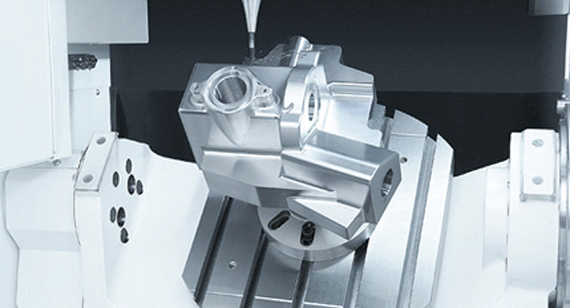
Regardless of batch size, CNC machines produce parts with extremely high accuracy, tight tolerances, and minimal deviation. This high degree of consistency is particularly vital in industries with stringent quality standards, such as medical or aerospace.
Once the design is programmed and the tooling is set up, CNC machines can run continuously with minimal human intervention, significantly shortening production lead times.
CNC machining services can process a wide range of materials, from metals like aluminum, brass, and titanium to plastics and composites. Whether milling, turning, or drilling, CNC machinery adapts quickly to different geometries and designs.
By using CAM (Computer-Aided Manufacturing) software to optimize cutting paths and tool usage, CNC machines minimize material waste, improving cost-effectiveness over time.
CNC technology enables complex geometries—including internal cuts, multi-axis shapes, and 3D contours—that are nearly impossible to achieve using manual methods.
Through automation, a single skilled operator can manage multiple machines simultaneously, significantly reducing labor expenses compared to manual setups.
Disadvantages of CNC Machining
In modern industrial manufacturing, CNC machining holds clear advantages over manual machining in almost every aspect, unless the following trade-offs come into play:
Initial capital investment for CNC equipment and software is substantial. For very low-volume projects, this capital expenditure is rarely justifiable for in-house purchasing. However, you can partner with an experienced CNC machining supplier to access advanced equipment cost-effectively.
CNC machines contain far more electronic components and moving parts than manual machinery, increasing long-term maintenance complexity and service costs.
Operating CNC equipment requires mastery of CAD/CAM software, G-code, and machining theory. Training is essential, and experienced CNC programmers can be costly or difficult to recruit.
Advantages of Manual Machining
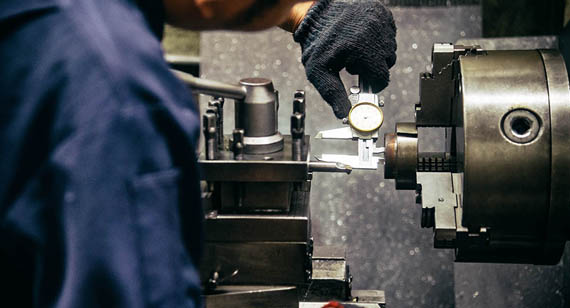
Although manual machining relies heavily on operator skill, it remains practical and useful in certain manufacturing scenarios:
Manual machining is well-suited for early-stage prototypes where design changes occur frequently. Operators can make quick on-the-fly adjustments without rewriting complex code.
By eliminating the need for CAD modeling or CNC programming, small-batch tasks can be completed faster and more economically through manual machining, saving both setup time and labor costs.
When machining solid billets or irregular workpieces, experienced machinists can use manual controls to feel the material response and adjust cutting depths or feed rates instantly.
Manual machinery is generally simpler and less expensive to maintain. With fewer electronic components, basic mechanical knowledge is usually enough to perform in-house repairs.
Manual machining builds foundational manufacturing skills. Operators gain a deep understanding of cutting dynamics, material behavior, and tooling—knowledge that transfers directly into CNC programming or advanced machining roles.
Disadvantages of Manual Machining
Despite its advantages, manual machining has clear limitations that make it less suitable for volume production or ultra-precise parts. Relying on the human factor introduces variables that are hard to control consistently:
Manual equipment lacks automation, meaning every step—from material loading and cutting to part flipping—must be done by hand. This significantly reduces throughput compared to CNC machining, especially on complex geometries.
Dimensional precision depends entirely on the operator's skill and focus. Even minor measurement or handling deviations can result in part defects or quality inconsistencies across a batch.
High-quality manual machining requires seasoned machinists. These practical skills take years to master, and as the workforce shifts toward automation, skilled manual machinists are becoming increasingly scarce.
Selection Criteria: CNC vs. Manual Machining
Evaluating machining costs requires balancing initial setup investments against ongoing operational efficiency:
Cost Comparison Breakdown
| Cost Factor | CNC Machining | Manual Machining |
| Equipment Investment | High ($30,000 to $200,000+) | Low ($5,000 to $15,000) |
| Hourly Operating Rate | $75 – $200 / hr | $35 – $60 / hr |
| Setup and Programming | Requires upfront CAM/G-code | No software programming needed |
| Unit Cost at Scale | Low (Automated production) | High (Manual labor per part) |
| Scrap Rate | Low (Controlled repeatability) | Higher (Operator dependent) |
| Maintenance | Specialized electronic/mechanical | Basic mechanical maintenance |
The application of CNC machining versus manual machining depends on several key factors, including project complexity, production volume, lead time, budget, and precision requirements. Let's explore their primary applications below:
Applications of CNC Machining
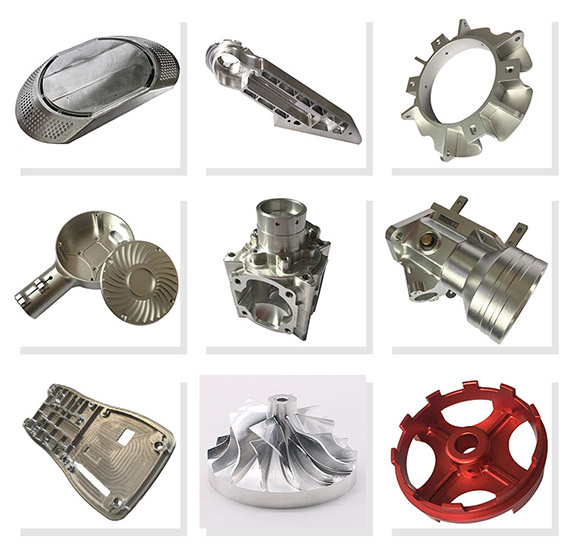
For projects that demand high precision, repeatability, and speed, CNC machining is typically the go-to solution. It is ideal for industries and tasks that require complex geometries, tight tolerances, or large production volumes.
Industrial Applications
Production of precision enclosures, brackets, heat sinks, and connectors for smartphones, tablets, laptops, and wearables.
Custom CNC machining enables rapid prototyping of new electronic products and efficiently produces housing components with complex geometries or high-precision tolerances. Additionally, the surface finishes achieved through CNC milling or turning help enhance product aesthetics—a critical factor influencing consumer preference.
Transmission housings, suspension components, braking systems, and gearboxes.
With the growing adoption of electric vehicles (EVs), CNC machining plays a crucial role in manufacturing battery enclosures, motor housings, and lightweight structural parts. The repeatability of CNC machining ensures every part meets exact specifications, which is essential for vehicle safety and performance.
Oil & Gas Industry:
Valve bodies, flanges, pump components, pistons, and downhole tools made from hardened alloys such as stainless steel, Inconel, and titanium.
Because these components operate in extreme environments with high operational risks, precision is paramount. CNC machining ensures the reliable operation of offshore rigs, refineries, and pipelines.
Surgical instruments, orthopedic implants, dental crowns, prosthetic components, and diagnostic equipment enclosures.
Medical devices demand extreme component accuracy and tight tolerance control. CNC machining services support rapid prototyping, allowing medical device manufacturers to bring innovative products to market faster while ensuring repeatability for critical components. As demand for personalized medical solutions grows, CNC machining remains indispensable for producing custom implants and patient-specific devices.
When rapid design iterations are required, CNC machining offers significant advantages. It allows engineers to modify CAD models directly and quickly produce functional prototypes. Thanks to its high accuracy, it also supports design verification and functional testing before committing to mass production.
Rapid Tooling Applications
CNC machining is frequently used to manufacture jigs, fixtures, and custom molds. It enables the quick production of these tooling components while maintaining the necessary strength and precision required for manufacturing.
Applications of Manual Machining
Manual machining is better suited for initial concept validation, sample fabrication, or simple shapes that do not require strict tolerances and benefit from flexible, real-time adjustments.
Small-Scale Projects
For small-batch prototypes, quick repairs, or proof-of-concept parts, manual machining can be more economical. Because it eliminates lengthy setup and programming phases, it is often faster for producing single-piece parts.
Custom Work and Personal Crafts
Manual machining is frequently the top choice for artisans, hobbyists, or machinists creating custom parts, specialized tools, or functional artwork. This hands-on approach allows for intuitive, on-the-fly modifications without needing CAD models or G-code programming.
Repair and Maintenance
Manual machining is particularly effective in repair shops and maintenance facilities. It allows machinists to modify or remanufacture damaged components without requiring full digital documentation, which is often unavailable for legacy systems or older machinery.
Ultimately, choosing between CNC machining and manual machining comes down to your specific application requirements. CNC machining offers high speed, superior precision, and excellent scalability suitable for industrial and commercial applications. On the other hand, manual machining provides greater flexibility and lower upfront costs, making it ideal for custom, low-volume, or straightforward machining tasks.
From Manual Prototyping to High-Precision 5-Axis CNC Mass Production
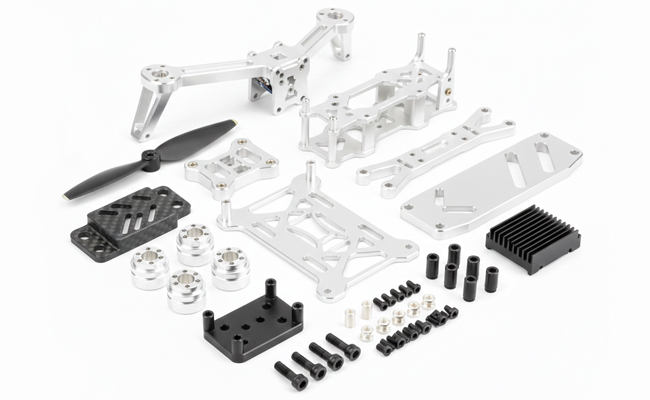
We recently collaborated closely with a design engineer from a commercial drone brand. The engineer, a machining hobbyist himself, frequently used his own vintage manual equipment ( a manual lathe and benchtop mill) to make early-stage drone accessory models and test preliminary design concepts. However, manual machinery could only deliver basic visual shape validation. It fell far short when it came to meeting the strict dimensional tolerances, surface finishes, and unit-to-unit consistency required for high-performance UAVs. For more intricate accessories featuring multi-axis contours and thin-wall geometry, manual equipment and hand operations reached their physical limits.
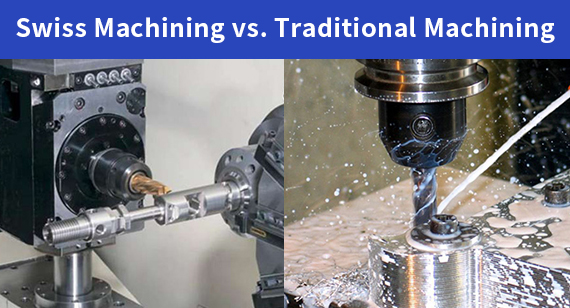
To turn these design concepts into flight-ready components, the client reached out to our team for professional prototyping and validation. For structural mounting brackets and landing gear connectors with simpler geometry, we implemented a combination of high-speed 3-axis CNC milling and Swiss-style CNC turning. This setup allowed for rapid fixture installation and efficient machining, stabilizing dimensional tolerances within ±0.02 mm and achieving a surface roughness of Ra 0.8 µm. This quickly helped the client complete their initial structural strength and assembly checks.
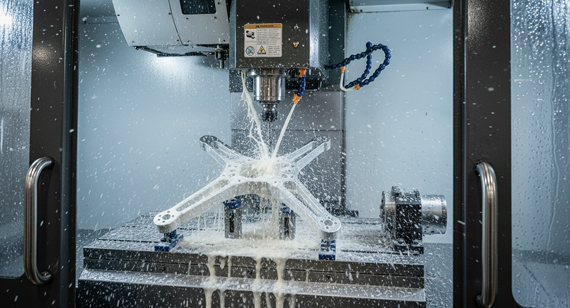
For the client's most complex component, an ultra-lightweight drone gimbal housing featuring deep cavities and intricate internal channels, manual machining was virtually impossible. To address this, we deployed our 5-axis CNC turn-mill composite center for the prototype run. By machining all complex features across multiple faces in a single clamping setup, we completely eliminated cumulative positioning errors caused by manual refixturing. The final part achieved the target high precision of ±0.01 mm while preserving structural strength.
The successful delivery of both prototype batches fully validated the feasibility of the client's design, meeting all strict weight and strength requirements. The client was extremely satisfied with our technical capabilities, response speed, and clear communication. Once the prototypes passed validation, the client awarded us the subsequent volume production orders for these drone parts. Today, we continue to maintain a strong, long-term partnership, serving as their primary manufacturing partner for ongoing product iterations.
Choosing VMT for your machining needs means partnering with a team dedicated to precision, cost-efficiency, and rapid execution. Whether you require initial design validation using manual methods, quick-turn CNC prototyping, or high-volume precision manufacturing, VMT delivers tailored manufacturing solutions that bridge the gap between early concepts and full-scale production.
Complete CNC Solutions: From Prototyping to Volume Production
VMT provides an end-to-end lineup of machining capabilities, including 3-axis, 4-axis, and advanced 5-axis CNC milling, Swiss-style lathe turning, and custom surface finishing. Our engineering team conducts thorough Design for Manufacturability (DFM) reviews on every project, helping clients optimize part geometries, reduce cycle times, and eliminate unnecessary material waste before cutting begins.
Streamlined Quote-to-Delivery Process
Why Engineers Choose VMT
From the moment you share your design to the final delivery of your parts, our team ensures clear communication, engineering expertise, and quality you can count on. If you’re ready to bring your concept to life with precision and confidence, VMT is your CNC machining partner—start your project today.
Choosing between CNC and manual machining comes down to balancing part complexity, production volume, precision targets, and overall project budget.
For early visual models, basic repairs, or single custom parts, traditional manual machining offers quick setup and low upfront costs. When your project demands scalable production, multi-axis geometries, consistent quality, and strict accuracy, transitioning to professional CNC machining services, such as those provided by VMT CNC machining factory, ensures maximum efficiency and competitive time-to-market.
Send your 2D drawings, 3D CAD models, material requirements, critical tolerances, surface-finish requirements, prototype quantity and production quantity. VMT will review manufacturability, machining strategy, inspection and quotation requirements.
All information and uploaded files are secure and confidential.
1 Tell us what you need
2 Get solution & quote
3 Approve production
Email: inquiry@vimetal.com.cn
1. Is CNC machining always better than manual machining?
Not necessarily. While CNC machining excels in high precision, complex multi-axis geometries, and high-volume consistency, manual machining is often faster and more cost-effective for simple one-off parts, quick fixture adjustments, basic repair work, or early visual proof-of-concept models that do not require tight tolerances.
2. What is the main cost difference between CNC and manual machining?
Manual machining has significantly lower initial equipment and setup costs because it requires no CAM programming or complex fixturing. However, CNC machining offers a much lower cost-per-part during medium-to-large production runs due to automation, faster cycle times, reduced labor dependency, and minimal scrap rates.
3. Can a manual machine achieve the same precision as a CNC machine?
A highly skilled machinist can achieve tight tolerances on a manual machine for simple features, but it requires substantial time and constant oversight. For complex 3D contours, multi-face alignment, and strict tolerances down to ± 0.01 mm across hundreds of identical parts, manual machining cannot match the repeatable accuracy of multi-axis CNC machinery.
4. When should I transition a prototype from manual machining to CNC machining?
You should transition to CNC machining as soon as your design requires functional stress testing, strict dimensional accuracy, complex features (such as deep cavities or thin walls), or when you plan to produce more than a few units. Transitioning early ensures your prototypes accurately reflect final production quality.
5. Why is manual machining still used in modern manufacturing?
Manual machining remains vital in toolrooms, repair shops, RandD labs, and educational facilities. It allows machinists to quickly turn or mill a part on the fly without waiting for CAD models or G-code programming, making it ideal for immediate maintenance and custom one-off fabrications.
6. How do you handle projects that require both prototyping and volume production?
Our CNC machining factory offers end-to-end machining capabilities. We help clients evaluate their designs through rapid prototyping, using quick-turn CNC or flexible machining methods for early validation, and smoothly scale up to high-speed 3-axis, 4-axis, or 5-axis CNC production runs with full quality control and ISO-certified consistency.
The technical information and manufacturing advice shared on the VMT website are for general guidance only. While we strive for accuracy, VMT does not guarantee that the processes, tolerances, or material properties mentioned are applicable to every specific project. Any reliance you place on such information is strictly at your own risk. It is the buyer's responsibility to provide definitive engineering specifications for any production orders. Final specifications and service terms shall be subject to the formal contract or quotation confirmed by both parties.


 +86 15099911516




 Read more