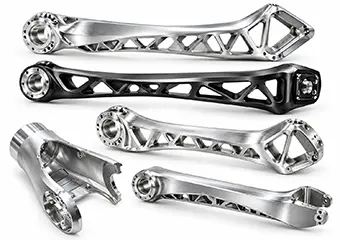
Upper Arm Links
Upper arm links connect major joints; VMT 3/4- or 5-axis mills lightweight pockets, controls end datums, and inspects interfaces for repeatable arm alignment.

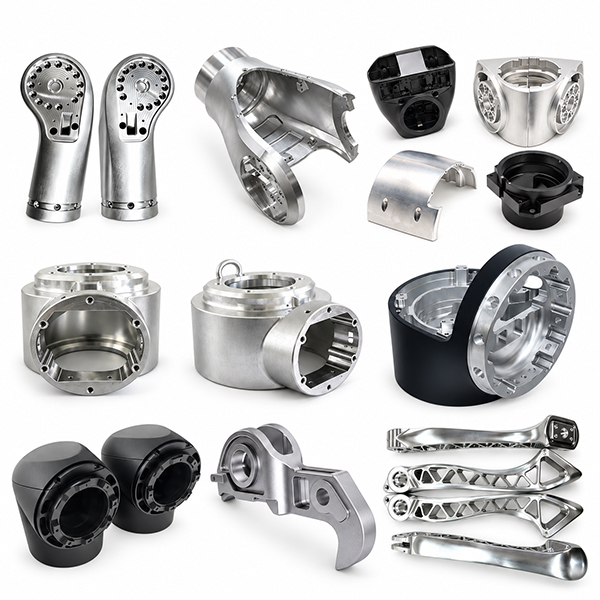
VMT provides custom CNC machined robot arm parts including links joint bodies wrist housings bearing supports motor mounts and flanges with DFM review multi-axis machining CMM inspection surface finishing and prototype-to-production support based on your drawings.
 Joint-Axis & Bearing-Fit Control for Reliable Robot Assembly
Thin-Wall Machining Strategies for Lightweight Robot Arm Structures
Multi-Axis Machining to Reduce Datum Transfer and Setup Errors
Finish-Aware Machining with Masking & Post-Finish Dimensional Inspection
100% Critical-Feature Inspection from Prototype to Repeat Production
1 DayPrototyping Machining
2 HoursQuick Quote
0 PcsMinimum Order Qualities
98%Yield


From lightweight arm links and joint bodies to wrist housings, bearing supports, motor mounts and structural interfaces, VMT manufactures custom robot arm components from your drawings and CAD models. We review weight, rigidity, functional datums, bearing fits, joint alignment, surface finishing and production repeatability before machining, helping you move from prototype validation to stable repeat production.
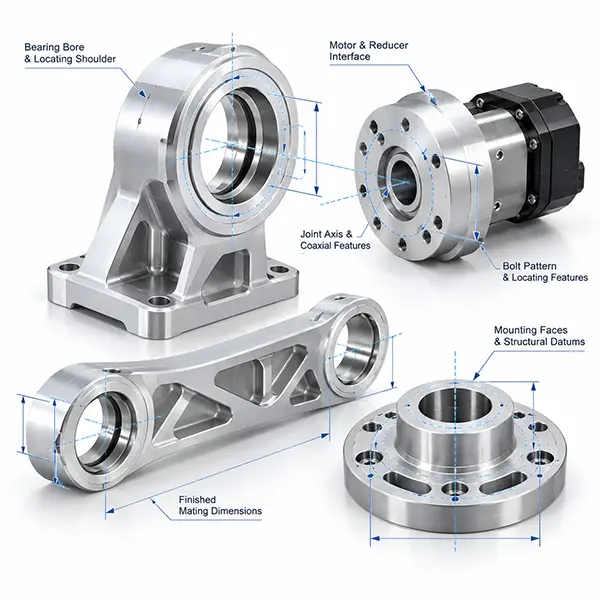
Robot arm components perform different structural and motion functions, so they should not be manufactured with one generic machining strategy. VMT reviews each part around its actual assembly role—load transfer, joint positioning, bearing support, motor alignment or structural connection—then plans machining, fixturing, inspection and finishing around the functional features defined in your drawing.
Upper arm links connect major joints; VMT 3/4- or 5-axis mills lightweight pockets, controls end datums, and inspects interfaces for repeatable arm alignment.
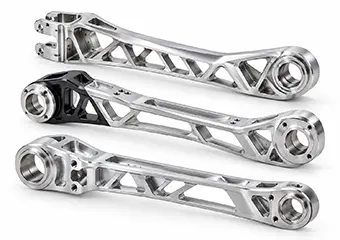
Forearm links reduce moving mass; VMT CNC mills pockets and end interfaces, controls thin-wall distortion, and inspects joint datums for consistent downstream assembly.
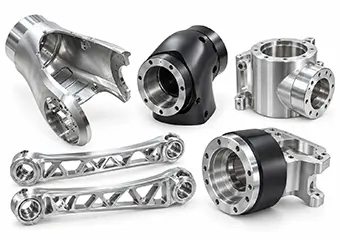
Shoulder joint bodies carry major axis loads; VMT multi-axis mills bearing and reducer interfaces, controls functional datums, and CMM-checks critical assembly relationships.
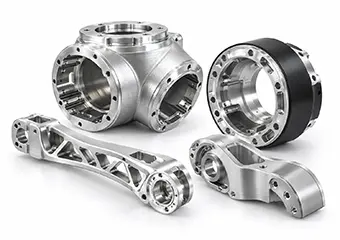
Elbow components transfer motion between arm stages; VMT mills or turn-mills related bores and faces, controls setup error, and inspects locating features before assembly.
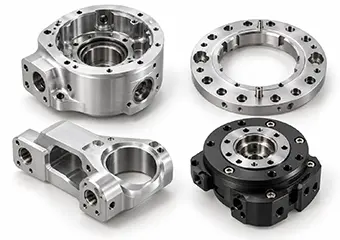
Wrist housings integrate compact end-axis features; VMT 5-axis machines angled cavities, controls multi-face datums, and CMM-verifies tool, bearing and actuator interfaces.
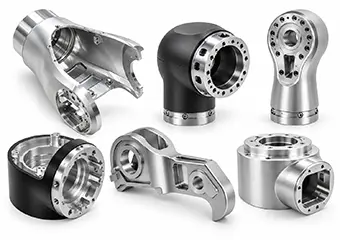
Joint housings locate bearings and reducers; VMT machines around one functional axis, controls bore fits and shoulders, and inspects coaxial relationships for stable rotation.
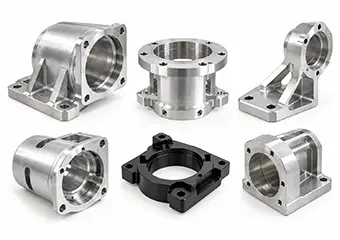
Motor and actuator mounts locate drive modules; VMT mills or turns pilots and faces, controls centerline relationships, and inspects mounting features for aligned installation.
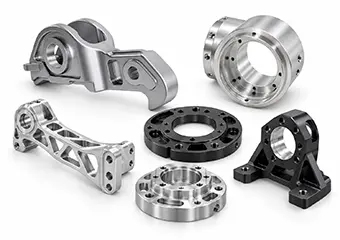
End-effector flanges connect tools to robot arms; VMT mills or turn-mills pilots and bolt patterns, controls face orientation, and inspects mounting repeatability.
A robot arm can contain parts that individually meet basic dimensions but still create assembly, alignment or motion problems when combined. The machining challenge is not only achieving individual tolerances—it is maintaining the relationships between lightweight structures, joint axes, bearing interfaces and multiple mounting datums throughout machining and finishing.
Deep pockets, ribs and thin walls can release stress and pull finished faces after roughing. VMT separates roughing, stabilization, semi-finishing and final cuts, then checks assembly datums after the structure has stabilized.
Bearing bores, reducer seats and pilots can all pass individual size checks yet still be misaligned. VMT machines from a functional datum strategy and verifies the related bores and faces by bore measurement and CMM.
Repeated repositioning can shift hole position, face orientation and interface relationships. VMT selects 3/4-axis, 5-axis or turn-mill routes to reduce unnecessary setups and protect the drawing datum structure.
A one-off sample may pass even when the process is not repeatable. VMT carries the approved setup logic into IPQC and final inspection and can inspect defined critical dimensions 100% when the project control plan requires it.
Not every dimension on a robot arm component has the same effect on performance. The most important features are usually those that locate bearings, define joint axes, position motors or reducers, and connect one structural section to another. VMT reviews these functional relationships during DFM, machining and inspection according to your drawing requirements.
An oversized, undersized or shifted bearing seat changes fit, preload and rotation. VMT machines the bore and shoulder as one functional fit, checks bore size and step location, and uses CMM where the bore relationship is datum-controlled.
When two bores or circular interfaces must rotate around one centerline, VMT plans the machining route around that axis and verifies the bore-to-bore or bore-to-pilot relationship rather than checking diameter alone.
Pilot diameters, mounting faces, bolt patterns and shaft-related features must locate the drive train together. VMT controls the pilot, face and hole relationship in one datum plan and verifies position and face geometry before assembly.
Flatness, parallelism, perpendicularity and position determine whether one arm section seats correctly against the next. VMT defines the functional datum early, supports the part during machining and inspects the mounting relationship after final cuts.
Bolts provide clamping, but pilots and dowel features usually establish true location. VMT separates clamping features from locating features during DFM so the machining and CMM plan follows the actual assembly method.
Anodizing, plating and coating can change the final condition of bearing seats, pilots, threads and mating faces. VMT identifies masking and allowance requirements before finishing and re-checks specified critical fits afterward.
Reliable robot arm components require more than selecting a CNC machine. VMT builds the manufacturing route around the part structure, functional datums, material behavior, critical interfaces and finishing requirements so machining and inspection work together from the first cut through final verification.
VMT reviews walls, pockets, datum flow, tool access, finish allowance and inspection access before release, with a common DFM response target of about 4 hours when project data is complete.
For heavily pocketed links and hollow bodies, VMT chooses support points, roughing direction, stabilization and final-machining timing according to the remaining stiffness instead of finishing all critical features too early.
VMT selects 3/4-axis milling, Swiss machining, 5-axis machining, turning or turn-mill according to feature access and datum relationships rather than sending every complex-looking part to the most expensive machine.
Critical bores, faces and positions can be checked during machining when later operations depend on them, so a wrong datum or drifting fit is found before coating or additional machining makes the scrap more expensive.
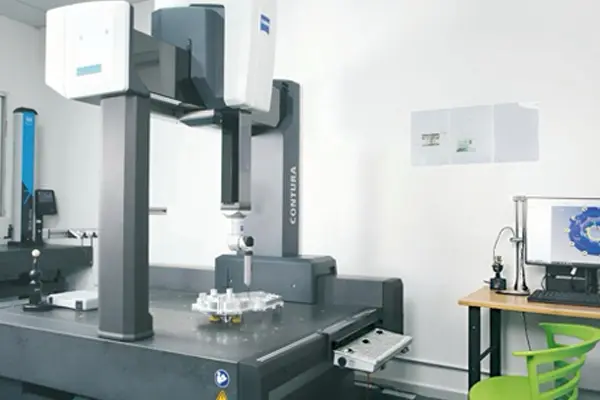
When position, perpendicularity, coaxiality or multi-datum relationships control assembly, CMM is used to verify the relationship rather than relying on individual caliper dimensions.
VMT reviews coating buildup, masking and contact areas before finishing, then re-checks drawing-defined critical fits after anodizing, plating or other processes when final assembly depends on them.
Before machining begins, VMT reviews the drawing and 3D model to identify risks that may affect dimensional stability, tool access, finishing, inspection or production cost.
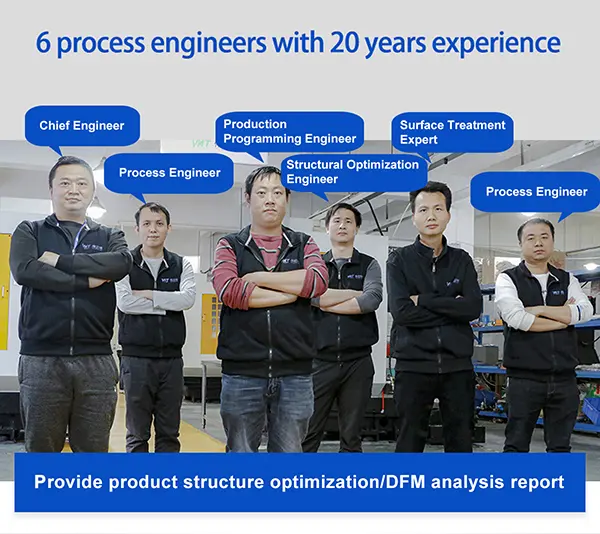
A useful DFM review should not redesign your robot arm unnecessarily. Its purpose is to identify manufacturing risks early and help your team decide where machining control adds real value.
Robot arm parts vary from simple mounting plates to complex joint and wrist structures. VMT selects the machining process according to feature access, datum relationships, material, required accuracy and production quantity rather than using the same CNC method for every component.
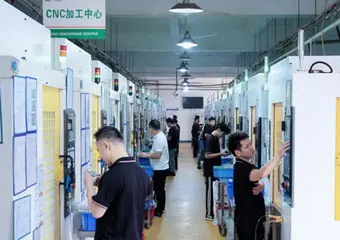
For links, plates, brackets and accessible housings, 3/4-axis milling combines economical pocket machining with multi-side feature control while reducing avoidable setup changes.
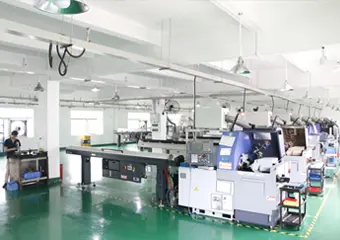
For slender shafts, pins, sleeves and compact rotating interfaces, Swiss machining supports long small-diameter geometry with published VMT tolerance capability to ±0.01 mm.
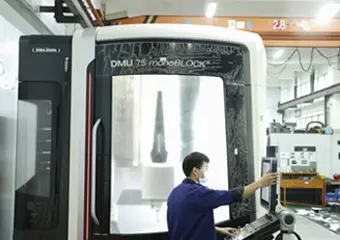
For wrist housings and complex joint bodies, 5-axis machining reduces re-clamping and helps keep angled and multi-face interfaces related to the same datum structure.
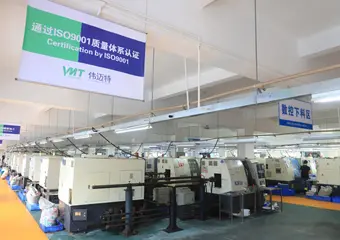
For output flanges, bearing carriers and circular interfaces, turning establishes concentric geometry first and live-tool milling adds holes, flats and side features.
Robot arm components are usually accepted based on more than overall length or hole diameter. VMT plans inspection around the critical features identified in your drawing and DFM review.
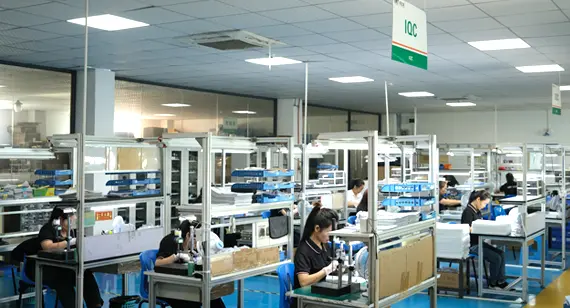
VMT combines material verification, first-article inspection, IPQC, final inspection and CMM according to the part's critical characteristics, instead of waiting until final inspection to discover a bad datum chain.
The first controlled setup is checked for bearing bores, locating features, mounting faces, threads and drawing-defined geometry before the same process is repeated across the order.
When a later cut depends on an earlier bore, face or datum, VMT checks the feature before continuing so a drifting dimension is stopped before more machining and finishing cost is added.
CMM is used when the functional relationship between features matters more than one isolated size, allowing robot joint and mounting geometry to be verified against the drawing datum system.
For specified critical seats, pilots, threads and mating areas, VMT can re-check final dimensions after finishing when the coating condition affects assembly.
Robot arm development rarely moves directly from CAD to full production. Joint interfaces, weight distribution, cable clearance, bearing fits and assembly relationships often need to be verified through several design iterations.
Validate geometry, assembly clearance, joint movement, bearing fit, motor and reducer interfaces, cable routing and structural weight.
Focus machining and inspection around joint-axis relationships, bearing fits, mounting-face alignment and finished dimensions after surface treatment.
Establish fixture strategy, machining sequence, tooling, in-process inspection points, finishing requirements and final inspection criteria.
Carry approved drawings, machining methods, fixture references, inspection requirements and finishing instructions into repeat orders.
The goal is not only to make the first robot arm component correctly, but to establish a manufacturing route that can be repeated when your project moves forward.
The best material for a robot arm component depends on more than strength alone. Moving mass, stiffness, fatigue, wear, corrosion, finishing, machining stability and cost all influence the final choice. VMT can review material options based on the function of each component rather than applying one alloy across the entire arm.
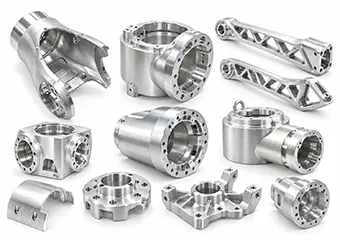
6061-T6 suits arm links, housings and brackets, combines low weight with stable machinability, anodizes well, and helps control cost for repeat structural parts.
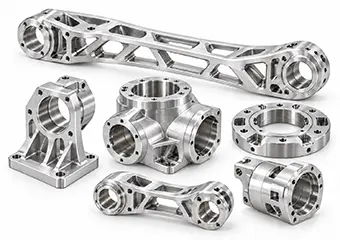
7075-T6 suits joint housings, wrist parts and high-load links, adds strength and stiffness, supports anodizing, and reduces weight compared with oversized lower-strength structures.
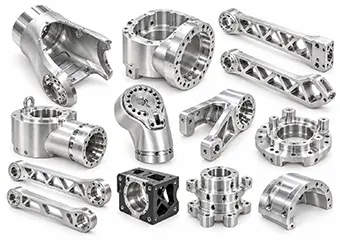
6082-T6 suits structural links, mounts and industrial robot parts, provides useful strength and corrosion resistance, anodizes well, and balances rigidity with practical machinability.
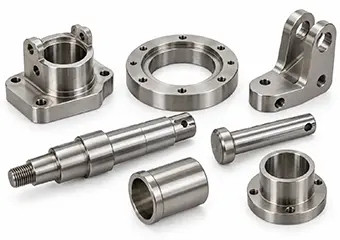
304/316 suits shafts, pins, bushings and interfaces, provides corrosion resistance and durability, supports passivation, and improves service reliability in moisture or chemical exposure.
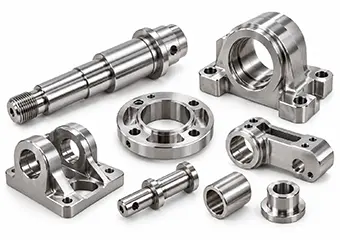
17-4PH suits pivot shafts, bearing supports and high-load pins, adds higher strength and hardness, supports passivation, and improves load stability and wear life.
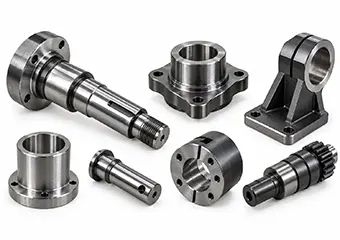
4140/42CrMo suits joint shafts, pins and gear supports, combines high strength with heat-treatment flexibility, supports black oxide or plating, and improves wear resistance.
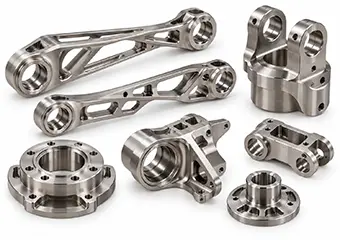
Titanium Grade 5 suits premium lightweight joints and high-value robotic parts, combines strength with corrosion resistance, supports precision finishing, and reduces moving mass.
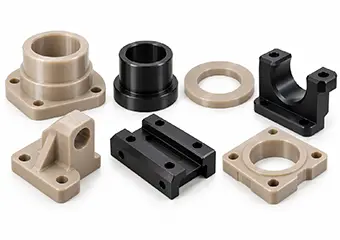
POM/PEEK suits bushings, spacers, cable guides and internal supports, lowers friction and mass, needs limited finishing, and simplifies non-metal contact or insulating interfaces.
Surface finishing can affect more than appearance. Corrosion resistance, wear, friction, electrical contact, branding and final dimensional fit may all depend on the finishing route. For robot arm components with bearing seats, threads or precision mating features, finishing requirements should be defined before machining is released.
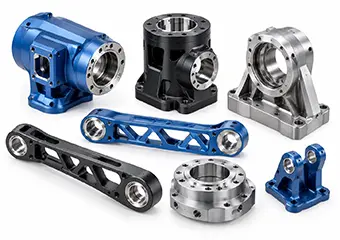
For aluminum links, housings and brackets, Type II anodizing adds corrosion protection and color while critical bores, threads and mating faces are reviewed for final fit.
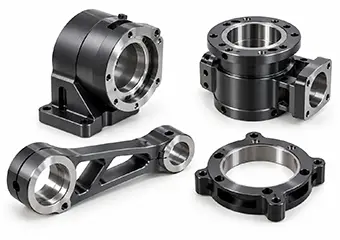
For wear-exposed aluminum components, hard anodizing increases surface hardness and durability while coating buildup is reviewed on bearing fits, pilots and moving interfaces.
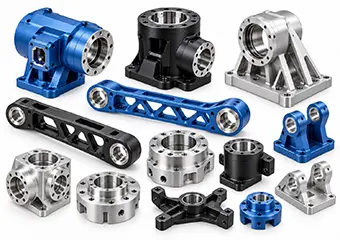
For visible arm components, bead blasting plus anodizing creates a uniform matte appearance while VMT protects functional areas through masking and handling control.
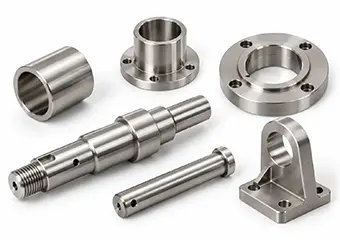
For stainless shafts and interfaces, passivation improves corrosion resistance without heavy coating buildup, helping preserve precision fits and clean assembly surfaces.
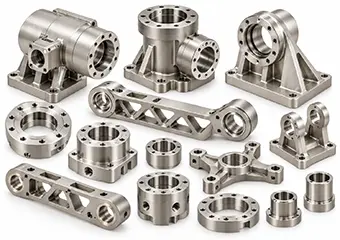
For precision interfaces and selected steel parts, electroless nickel adds corrosion and wear protection with more uniform coverage on complex geometry and internal features.
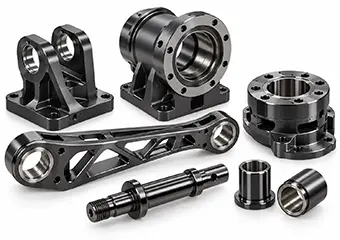
For wear-critical interfaces, PVD or DLC can improve surface hardness and friction behavior while maintaining a premium dark or metallic appearance on suitable substrates.
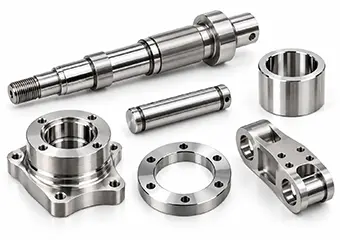
For close-contact, sliding or sealing areas, precision grinding and polishing refine surface condition and dimensional consistency where machined finish alone is insufficient.
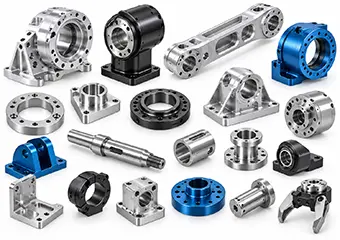
For part numbers, orientation marks and branding, laser marking adds permanent identification after machining and finishing without changing the function of key interfaces.
VMT machines drawing-defined mechanical components for different robot arm architectures. The geometry and manufacturing priorities vary by application, but lightweight structures, controlled joint interfaces and repeatable assembly remain common requirements.
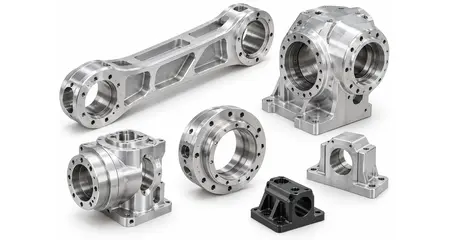
Industrial robot arms use machined links, joint bodies, wrist housings, bearing supports and drive interfaces where stiffness, alignment and repeat production are central sourcing requirements.
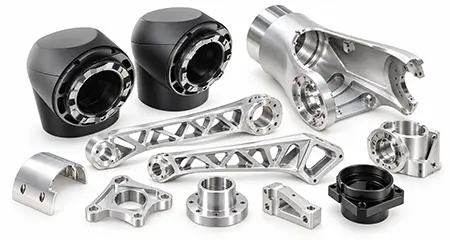
Collaborative robot arms use compact joints and lightweight structures where reduced moving mass, multi-face precision and controlled cosmetic finishing influence both performance and integration.
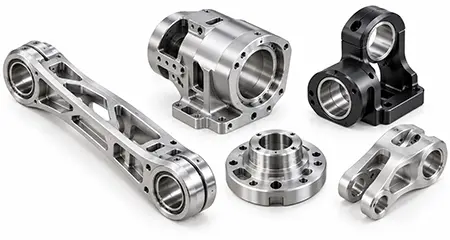
Humanoid arm development can require compact actuator interfaces, lightweight links and wrist components where strength-to-weight balance and rapid design iteration are important.
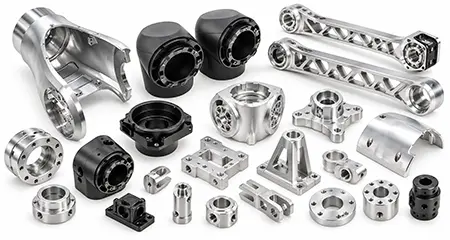
Research platforms often need flexible quantities and frequent revisions, making drawing review, quick DFM feedback and adaptable prototype machining more important than a fixed mass-production route.
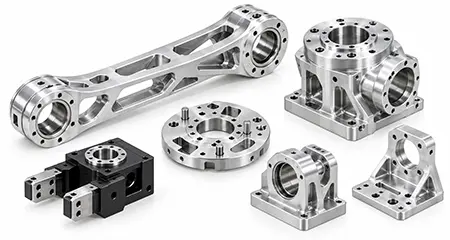
Custom handling arms use application-specific links, mounts and end interfaces designed around payload, motion range, gripper integration and repeatable installation on the production line.
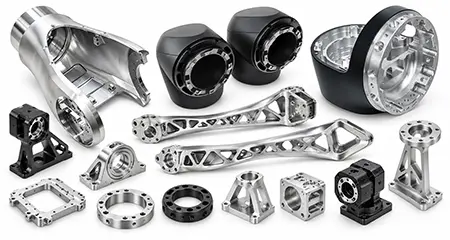
Vision and inspection arms use lightweight structures and stable sensor interfaces where repeatable mounting and low moving mass help maintain the intended measurement or imaging position.
A European collaborative-robot manufacturer sent VMT a 7075-T6 aluminum joint module combining a harmonic-drive seat, encoder mounting face and curved internal wire-routing channel in one monolithic housing.
The bearing seat and encoder bore had to hold 0.01 mm concentricity across a 400 mm envelope while the housing remained under 180 g so the cobot's payload budget was not compromised.
The bearing and encoder features had to stay aligned while a curved internal wire-routing channel was machined burr-free so cable insulation would not be damaged during assembly.
VMT used a single-setup 5-axis route: rough the harmonic-drive seat and encoder bore leaving 0.3 mm stock, semi-finish the encoder face in the same setup, finish both bores with the same boring bar, then finish-mill the curved wire channel with a custom-profile end mill. In-process probing was used to correct tool-wear drift before it reached the final dimensions.
CMM inspection confirmed 0.008 mm concentricity and Ra 0.4 on the critical bearing seat, while the wire-routing channel passed 100% visual burr inspection. After the first 200-unit validation batch, the customer placed a six-month blanket order, and the single-setup route reduced fixturing cost by about 40% compared with the previous multi-operation process.
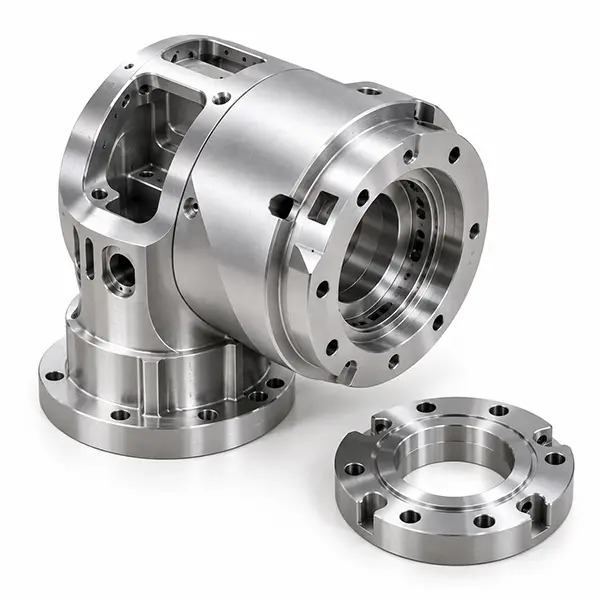
Robot arm sourcing often involves more than finding a supplier that can machine the geometry. VMT combines engineering review, multiple CNC processes, in-process inspection and finishing coordination so the customer can manage fewer process handoffs while protecting assembly-critical features.
Thin walls, deep pockets, critical fits and finishing risks are reviewed before machining so the customer can correct the route before material, tooling and machine time are committed.
VMT can allocate milling, turning and other CNC capacity across mixed robot-arm component families instead of forcing links, housings, shafts and flanges through one process bottleneck.
Each component is matched to the route that fits its geometry: links and plates to milling, complex wrist bodies to 5-axis, circular interfaces to turning and slender pins to Swiss machining.
IQC, IPQC, FQC and OQC are combined with CMM support so critical features can be checked before, during and after machining rather than only at shipment.
Anodizing, passivation, nickel, PVD/DLC, grinding and marking are reviewed together with masking and finished fits so surface treatment does not undo the machining work.
Once the prototype and process are approved, fixture references, inspection points and finishing requirements can be retained as the quantity grows instead of rebuilding the route for every repeat order.
VMT supports drawing-defined arm links, shoulder and elbow bodies, wrist housings, joint housings, bearing supports, motor and actuator mounts, end-effector flanges, shafts, pins and structural connectors. Because one robot arm can include milled, turned and slender precision parts, VMT can combine 3/4-axis milling, 5-axis machining, turning, turn-mill and Swiss machining under one engineering review instead of treating every part as the same process.
6061-T6 is a practical choice for many links and housings because it balances weight, machinability and anodizing. 7075-T6 is better suited where higher strength or stiffness is needed at low mass. 6082-T6 is useful for structural industrial parts, while 304/316, 17-4PH and 4140/42CrMo fit shafts, pins and wear interfaces. Titanium Grade 5 and POM/PEEK are selected when weight, corrosion, friction or insulation justify their higher material cost.
7075 is not automatically better. If the part is a general structural link or housing, 6061 often reduces material and machining cost while offering good anodizing response. 7075 becomes more valuable when higher strength or stiffness is needed without increasing section size. VMT reviews load, wall thickness, pocket depth, finish and cost together rather than choosing the alloy from strength alone.
5-axis machining is most useful on wrist housings, integrated joint bodies and parts with angled or multi-face features where repeated re-clamping would increase datum-transfer error. VMT's published 5-axis capability reaches up to ±0.01 mm, but the real decision is whether 5-axis reduces setups or protects feature relationships enough to justify the cost. Simpler links and brackets are often more economical on 3/4-axis equipment.
VMT reviews wall thickness, pocket depth and support points before cutting, then separates roughing, stabilization, semi-finishing and final machining so critical interfaces are not finished while the part is still releasing stress. Where geometry allows, assembly-critical features can be reviewed to ±0.005 mm, and the final result is verified against the drawing rather than relying on a generic “tight tolerance” claim.
VMT checks bearing bores as part of a fit and datum system. Bore gauges or suitable dimensional tools verify the diameter, while CMM is used when the important requirement is position, coaxiality, perpendicularity or the relationship to another interface. The process can also include first-article and in-process checks so a drifting bore is found before later machining or finishing adds more cost.
Yes. Anodizing changes the finished surface condition and can affect bearing seats, pilot diameters, threads and locating holes. VMT reviews coating buildup and masking before machining is released, coordinates the finishing route, and can re-check drawing-defined critical fits after treatment. This is especially important when a part has both visible anodized surfaces and precision assembly interfaces.
Yes. VMT supports prototype and low-volume robot arm components with DFM review before machining, multiple CNC routes for mixed component families and CMM support for critical geometry. Early prototypes can remain flexible for design revisions; once the design is approved, the fixture logic and inspection points can be retained for pilot and repeat production instead of starting again from zero.
Designing robot arm components for CNC machining requires more than choosing a strong material or specifying tight tolerances. Weight, rigidity, joint alignment, bearing interfaces, surface finishing, inspection and production quantity all influence the final manufacturing strategy.
Robot arm links are frequently pocketed, ribbed or hollowed to lower moving mass, but every removed section changes local stiffness during clamping and cutting. The practical design question is therefore not simply how much material can be removed, but where material can be removed without making the bearing, joint or mounting interfaces unstable. Deep pockets beside thin walls, long unsupported faces and abrupt section changes are common areas where machining stress can move the geometry after roughing. VMT reviews the wall structure before production, then plans fixture support, roughing direction, stabilization and final machining around the remaining stiffness. This allows weight reduction to be treated as a manufacturing problem as well as a structural-design problem.
Robot arm drawings can contain many dimensions, but only a smaller group normally controls motion and assembly: bearing bores, pilots, locating shoulders, dowel holes, motor or reducer interfaces and the mounting faces that relate one arm stage to the next. If every dimension is made unnecessarily tight, cost rises without automatically improving the robot. If the truly functional relationships are not identified, the part can still fail assembly even though individual dimensions pass. VMT reviews the datum chain during DFM so machining and inspection follow the way the part actually locates in the robot. Where geometry and process allow, critical dimensions can be reviewed to ±0.005 mm, while general features follow the drawing or specified tolerance standard.
There is no single best robot-arm material. 6061-T6 is often the practical baseline for links and housings because it combines machinability, low weight, anodizing response and cost. 7075-T6 becomes useful when the part must carry more load or stay stiffer without increasing section size. 6082-T6 is another structural aluminum option for industrial parts. Shafts and pins may need 304/316 stainless, 17-4PH or 4140/42CrMo depending on corrosion, wear and strength. Titanium Grade 5 makes sense only when its strength-to-weight advantage justifies the higher machining cost, while POM and PEEK are more appropriate for low-friction, insulating or lightweight internal components. The material should therefore be selected around the part function, not around one alloy being “better” than another.
Surface treatment changes more than appearance. Type II anodizing, hard anodizing, passivation, electroless nickel, PVD/DLC, grinding, polishing and laser marking can all influence corrosion, wear, friction, electrical contact and final dimensional fit. A common failure occurs when a bearing seat or pilot is correct before finishing but no longer fits after the coating process. VMT therefore reviews masking areas, finish buildup and post-finish inspection before release. For assembly-critical bores, threads and mating faces, the customer should identify whether the stated dimension applies before or after finishing so the machining allowance and inspection point are clear.
A feature is only useful if it can be measured consistently. Simple diameters may be checked directly, while position, perpendicularity, coaxiality and multi-datum relationships are better suited to CMM. VMT combines incoming inspection, first-article inspection, IPQC and final inspection within its quality-control flow so critical features can be checked at the stage where the result is still actionable. If the part has a feature that will later become difficult to access because of another operation or surface treatment, the measurement point should be planned before production rather than discovered during final inspection.
Prototype machining proves fit, motion, clearance and the basic interface logic. Repeat production introduces additional risks: fixture repeatability, tool wear, batch consistency and finishing variation. A method that succeeds once is not automatically a stable production process. After prototype approval, VMT can carry the approved setup references, machining sequence, critical inspection points and finishing requirements into pilot and repeat production. The objective is to avoid a situation where the first sample is good but later parts require repeated adjustment to assemble.
A useful RFQ should include the 3D CAD model, dimensioned 2D drawing, material, quantity, finish, project stage and the features most important to fit or motion. It also helps to state which surface locates the next arm section, which bore carries the bearing, which pilot locates a reducer and which dimensions must be correct after finishing. That assembly context allows the supplier to focus DFM, machining and inspection on the features that can actually stop the project rather than simply pricing every dimension at the same level of control.
The main cost drivers are usually deep pockets, thin walls, repeated multi-face setups, tight tolerances on non-functional geometry, expensive material used where it is unnecessary and finishing requirements that are not coordinated with critical fits. Process choice also matters: a part that can be produced reliably on 3/4-axis equipment should not automatically be moved to 5-axis, while a multi-face joint body that requires repeated re-clamping may actually cost less overall when machined in fewer setups. Good DFM separates the cost that protects function from the cost created by avoidable complexity.
Send your 2D drawings or 3D CAD models together with material, quantity, finish and critical tolerance requirements. VMT can review the component structure, machining risks, functional interfaces and inspection requirements before quotation.
STEP / STP / IGES / DWG / DXF / PDF supported.

 2024-08-02
The manufacturer is strongly recommended. In the past few years of cooperation we have ordered several machined products from aluminum and stainless steel. These products are manufactured in compliance with tolerance requirements and require product finish. Now I have ordered another one. The service is excellent and any questions can be answered and resolved in time.
 2021-05-13
The dimensions are all customized according to my drawings no tolerance issues and the parts are delivered on time. I am very satisfied with it.
 2021-04-06
I pay much attention to the surface treatment aspect of this product. I was a little worried about the cooperation at the beginning. I am very satisfied with the product now and hope to cooperate for a long time.
 2022-09-22
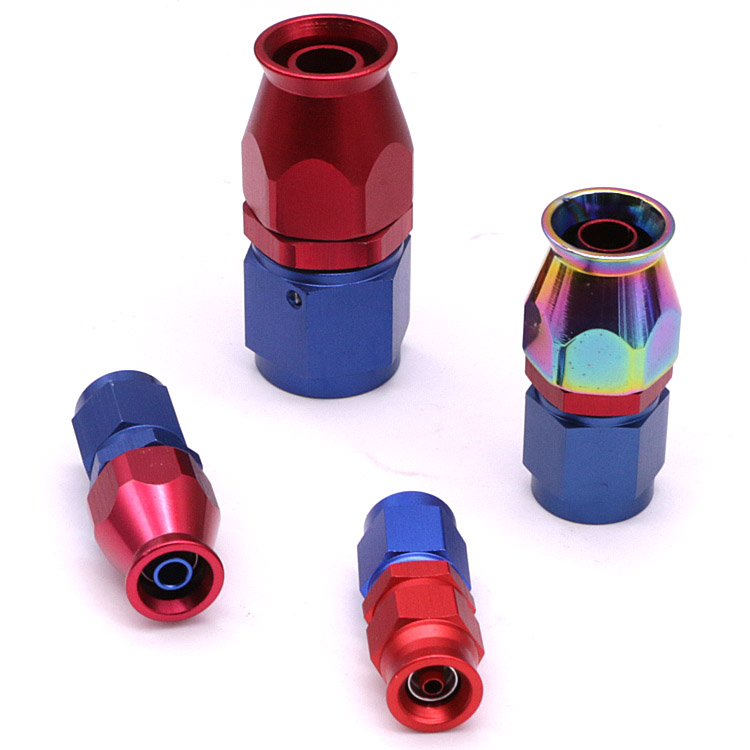
AN8 Straight PTFE Hose End Fitting for PTFE Fuel Line Fitting Adapter Black Blue Red


 +86 15099911516