16 years one-stop China custom CNC machining parts factory

Hey there I’m VMT Sam!
With 25 years of CNC machining experience we are committed to helping clients overcome 10000 complex part-processing challenges all to contribute to a better life through intelligent manufacturing. Contact us now
 338 |
Published by VMT at Feb 28 2026 | Reading Time:About 2 minutes
338 |
Published by VMT at Feb 28 2026 | Reading Time:About 2 minutes


At a quick glance, you might find it impossible to distinguish between 440C stainless steel and 304 stainless steel. They both possess that classic metallic luster associated with “typical stainless steel appearance". However, beneath the surface, these two stainless steels are worlds apart. Their chemical structures and composition, mechanical properties, ways of increasing strength and hardness, and cost profiles are quite different.
While 304 stainless steel is performed better in aspects of corrosion resistance, formability, and machinability, as well as with famous quality of "food-grade" and easy-to-clean property, 440C stainless steel is way more advantaged in its high hardness, high strength, and wear resistance caused by heat treatment. Choosing the wrong one can lead to premature part failure or unnecessary manufacturing costs.
Read on to explore the core differences in the 440C vs 304 stainless steel debate.
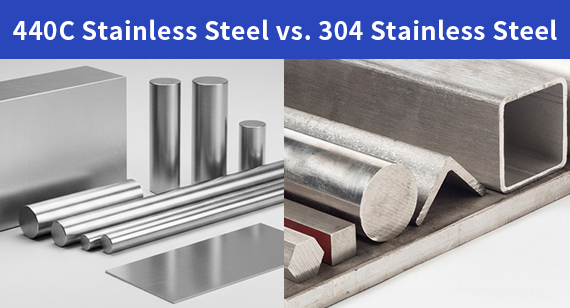
440C is a high-carbon martensitic stainless steel. Its primary composition includes high levels of Chromium (16-18%) and Carbon (0.95-1.20%). This martensitic structure makes stainless steel 440C increase its highest hardness up to 60 HRC once heat-treated, while also take advantages in good edge retention, high strength in hardened conditions. But for disadvantages of 440C stainless steel, it has low ductility, bad weldability, and more susceptible to corrosion than austenitic grades like the most typical 304 stainless steel. From its advantages of good strength and hardness, you can find some typical uses of 440C stainless steel including ball bearings, high-quality cutlery (knives), surgical instruments, and valve components, etc.
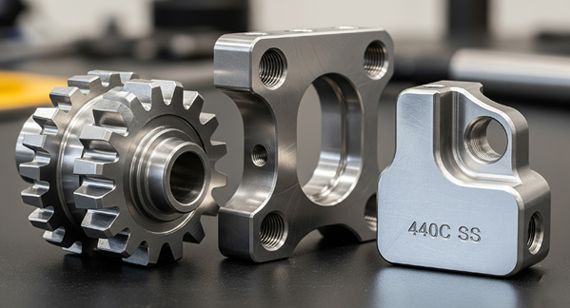
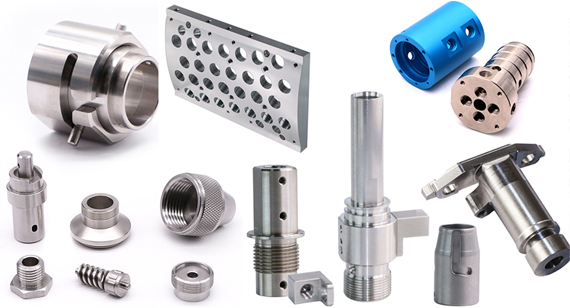
304 stainless steel is the most common grade of austenitic stainless steel (often referred to as 18/8 or 18/10 stainless steels) which contains high amounts of Chromium (18-20%) and Nickel (8-10.5%). This combination creates a stable austenitic structure and better corrosion resistance. In its annealed state, 304 stainless steel is in the softest state with good ductility, that is, machinability and formability is best in this time. But it cannot be hardened by heat treatment, only strengthened by cold working like cold rolling, forging, etc. Uses like kitchen appliances, food processing equipment, architectural paneling, mild-chemical containers thanks to 304's good corrosion resistance and formability, while other common industrial parts like fasteners can also be made by this material.
The fundamental difference of their microstructure and composition is that: 304 is Austenitic(contains high Nickel) , while 440C is Martensitic(high Carbon, low/no Nickel).
The presence of Nickel in 304 allows it to maintain an austenitic structure, which provides ductility and corrosion resistance. The high Carbon content in 440C allows it to undergo a martensitic transformation during quenching, which is the source of its immense hardness.
For detailed chemical composition of 440C vs 304 stainless steel, please check in below table:
Table 1: Chemical Composition of 440C vs 304 Stainless Steel
| Element |
440C Stainless Steel (%) |
304 Stainless Steel (%) |
| Carbon (C) |
0.95 – 1.20 (Very High) | ≤ 0.08 (Very Low) |
| Chromium (Cr) |
16.0 – 18.0 | 18.0 – 20.0 |
| Nickel (Ni) |
- | 8.0 – 10.5 |
| Manganese (Mn) |
≤ 1.0 | ≤ 2.0 |
|
Silicon (Si) |
≤ 1.0 | ≤ 0.75 |
| Iron (Fe) |
Balance | Balance |
304 stainless steel is the better one in corrosion resistance as it contains higher Chromium and Nickel. Chromium promotes 304 stainless steel to form a more robust passive oxide layer while expensive alloy element Nickel further improve 304' corrosion resistance. Thus, 304 stainless steel can perform well in atmospheric corrosion and most organic or mild chemicals. 440C stainless steel is less-performed in corrosion resistance as it contains so much carbon (which is prone to rust if contacts air and humid or chemicals). But for both 440C and 304 stainless steel, surface treatment of passivation and rust-preventative oiling(oiling is not for food-contact products) are two most recognized methods to prevent parts' corrosion resistance.
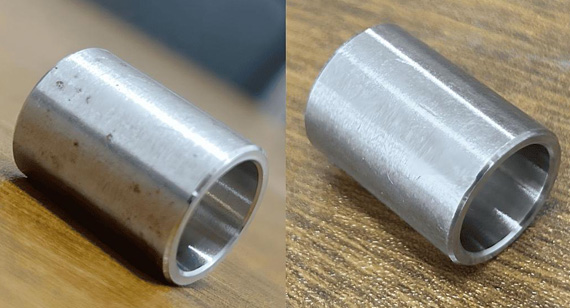
This is because of their structure of austenitic 304 and martensitic 440C:
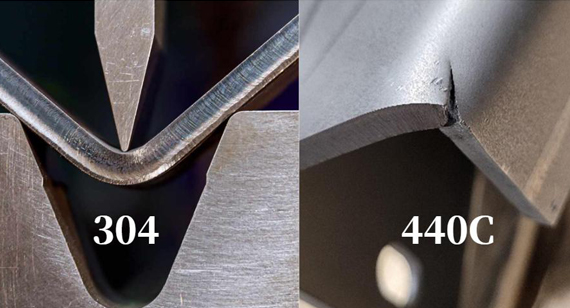
Ductility refers to a material's ability to deform plastically without breaking. With an elongation of 40~60%, 304 stainless steel is highly ductile. It can be stretched, drawn, and bent into complex shapes without cracking. But for 440C stainless steel, elongation is only 10% – 15% even in its annealed state(softest). If you try to bend a 440C rod, it is more likely to snap than to deform. This makes it unsuitable for applications requiring high impact or structural flexing.
440C stainless steel is designed for heat treatment. Through a process of heating, quenching, and tempering, the internal structure transforms into martensite. This is how it achieves its signature hardness. 304 stainless steel cannot be hardened by heat treatment because of 304 stable austenitic structure caused by Nickel content. The only way to increase the strength of 304 is through cold working (work hardening), such as cold rolling or drawing.
As we said before, 440C is heat treatable and far harder than cold-worked 304 stainless steel. Another noted thing is that 440C' high carbon content make it harder than 304 even in their annealed states.
Table 2: Hardness Comparison of 440C vs 304 Stainless Steel
| Material State |
Rockwell Hardness |
Brinell Hardness (HB) |
Note |
| 304 (Annealed) |
70 – 90 HRB | ~120 – 170 | The softest, most formable state. |
| 304 (Cold Worked) |
20 – 35 HRC | ~230 – 320 | Becomes much stiffer. |
| 440C (Annealed) |
90 – 98 HRB | ~220 – 270 | Softest state for machining. |
| 440C(Hardened & Tempered) |
58 – 60 HRC | ~600 – 650 | Maximum wear resistance; very brittle. |
While both are "strong," they exhibit strength differently. 440C has much higher tensile and yield strength than 304, meaning it can withstand much higher loads before permanently deforming or breaking. For strength comparison data of 440C vs 304 stainless steel:
Table 3: Strength Comparison of 440C vs 304 Stainless Steel
| Property |
304 (Annealed) |
304 (Cold Worked) |
440C (Annealed) |
440C (Hardened & Tempered) |
| Tensile Strength |
~515 MPa | Up to 1,200+ MPa | ~760 MPa | ~1,860 – 1,970 MPa |
| Yield Strength |
~205 MPa | ~600 – 900 MPa | ~450 MPa | ~1,600 – 1,860 MPa |
Machinability and CNC Machining: 440C vs 304
Machinability defines the ease with which a metal can be cut, shaped, or finished using machine tools. Using AISI 1212 carbon steel as the industry standard benchmark (100%), both alloys present distinct challenges: even in their annealed states, 304 stainless steel has a machinability rating of approximately 45%, while 440C stainless steel sits slightly lower at 40%.
It seems that 304 appears easier to machine, but you may not overlook its "sticky" characteristic; Tool gumming can happen, where the material adheres to the cutting edge, degrading the surface quality. 440C stainless steel also presents a machining challenge, largely due to its higher hardness and strength(so you must first machining 440C and then heat treat it).
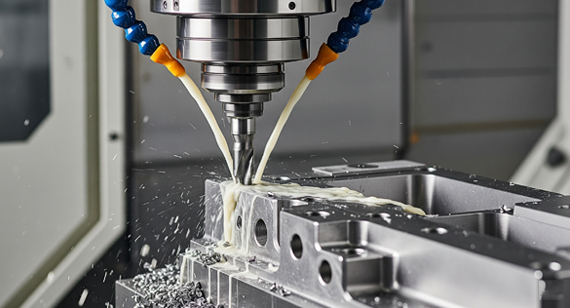
In modern manufacturing, the machinability is most critical during CNC machining which refers to the semi-automated process of cutting, drilling, and grinding stainless steel, where computer programs control the tool paths; accuracy and repeatability of parts can be ensured. Below table summarized noted methods when CNC machining 440C and 304 stainless steel:
Table 4: CNC Machining Tips: 440C vs 304 Stainless Steel
| Feature |
304 Stainless Steel Strategy |
440C Stainless Steel Strategy |
| Tooling Choice |
Use sharp, positive-rake carbide tools to "shear" the material. | Use high-abrasion resistant coated carbide (TiAlN or AlTiN). |
| Feed Rates |
Keep the tool moving; never dwell. Use heavy, constant feeds to stay under the work-hardened layer. | Moderate feeds; focus on chip evacuation to prevent re-cutting abrasive chips. |
| Spindle Speed |
Lower speeds to manage heat generation and reduce the rate of work hardening. |
Moderate speeds; 440C can handle slightly higher SFM than 304 in the annealed state. |
| Coolant Use |
High-pressure flood coolant is mandatory to dissipate heat and lubricate the cut. | Flood coolant is used primarily to wash away abrasive carbide particles. |
| Post-Op Strategy |
Usually finished directly from the machine. | Must be machined "oversize" (+0.1mm) to allow for grinding after heat treatment distortion. |
Formability: How Do They Shape Up?
304 stainless steel is the industry standard for formability. High ductility allows 304 stainless steel to be transformed into complex shapes like kitchen sinks, curved architectural panels, and deep-drawn canisters. It can undergo severe deformation at room temperature while maintaining its structural integrity. 440C stainless steel exhibits very poor formability. Because it is designed for hardness rather than flexibility, it is inherently brittle.
Weldability Comparison: 440C vs 304
304 is generally more stable in price but can be expensive due to the Nickel content. 440C raw stock is often slightly more expensive due to its high carbon and alloying composition which makes the production of 440C stainless steel become more complex. For processing cost, 440C is significantly more expensive to process into a finished part. Because it requires secondary heat treatment and often precision grinding after hardening to achieve final dimensions. 304 parts are typically finished straight off the CNC machining.
Below table shows equivalents of 440C vs 304 stainless steel globally for your quick check:
Table 5: Equivalent Materials of 440C vs 304
| Region |
440C Equivalent |
304 Equivalent |
| UNS (USA) |
S44004 | S30400 |
| AISI (USA) |
440C | 304 |
| DIN (Germany) |
1.4125 | 1.4301 |
| JIS (Japan) |
SUS440C | SUS304 |
| EN (Europe) |
X105CrMo17 | X5CrNi18-10 |
| GB (China) |
110Cr17 | 06Cr19Ni10 |
| AFNOR (France) |
Z100CD17 | Z6CN18-09 |
| BS (UK) |
440S10 | 304S31 |
| GOST (Russia) |
95Kh18 | 08Kh18N10 |
304 Stainless Steel Applications:
Here lists a few of 304’ uses examples and these applications thanks to SS304 good corrosion resistance, good formability, “food grade” and easy-to-clean property.
440C Stainless Steel Applications:
Here showcases some use examples of 440C stainless steel, and these are due to 440 C‘ high hardness and wear resistance.
Aerospace: Precision ball bearings and races.
The choice between 440C vs 304 stainless steel comes down to your primary requirement. If your project demands corrosion resistance, weldability, and easy forming, 304 is a good material. However, if your application requires extreme hardness, wear resistance, and high mechanical strength, 440C is the superior choice. Other factors like material price and processing cost, detailed mechanical properties or usage environments for your design or manufacturing needs, you may take careful into consideration.

A robotics manufacturer partnered with VMT CNC Machining Factory to produce custom 440C stainless steel bearing races. The specifications required a hardness of 58-60 HRC, a dimensional tolerance of ±0.01mm, and a surface finish of Ra 0.4μm. The primary challenge was managing thermal distortion during the quenching process; machining to final size before heat treatment would cause the parts to exceed tolerance limits due to material expansion and contraction.
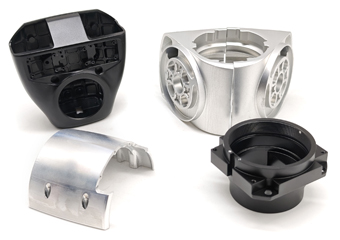
To resolve this, VMT implemented a specialized three-stage protocol. We first performed CNC turning on annealed 440C blanks, leaving a 0.15mm grinding allowance. After vacuum heat treatment achieved the target hardness, we utilized CNC cylindrical grinding with CBN (Cubic Boron Nitride) wheels. This precision step removed the remaining hardened material, corrected heat-treat distortion, and secured geometric accuracies that standard milling could not reach.
By utilizing VMT’s precision grinding capabilities, we achieved a consistent surface finish of Ra 0.4μm, significantly reducing friction and heat generation during operation. Quantitatively, the 440C components passed 100% of the coordinate measuring machine (CMM) inspections with a final tolerance variance of only 0.01mm. Furthermore, our optimized grinding allowance strategy reduced material waste and secondary rework, resulting in a 15% reduction in total production time and providing the client with a high-durability solution that effectively eliminated their previous issues with premature component wear.
Is 440C stainless steel food grade?
Generally, no. While it can be used in food processing for cutting blades, its lower corrosion resistance means it can rust if not dried properly. 304 is the standard "food-grade" stainless steel.
Does 440C rust easier than 304?
Yes. 440C stainless steel has a higher carbon content and no nickel, making it more prone to surface oxidation (rust) than 304 stainless steel especially in humid or salty environments.
Can I use a magnet to tell the difference?
Yes. A magnet will stick strongly to 440C stainless steel. t will not stick to 304 stainless steel.
Which is better for a pocket knife?
440C stainless steel is much better for a knife because it can be hardened to hold a sharp edge. 304 stainless steel is too soft and will become dull more quickly than 440C stainless steel.-
Why is 440C harder to weld?
The high carbon content causes the formation of brittle structures during the rapid cooling of a weld, leading to immediate or delayed cracking.
Is 304 cheaper than 440C?
In terms of the total "finished part" cost, 304 is usually cheaper because it doesn't require the expensive heat treatment and precision grinding steps that 440C requires.


 +86 15099911516




 Read more