16 years one-stop China custom CNC machining parts factory

Hey there I’m VMT Sam!
With 25 years of CNC machining experience we are committed to helping clients overcome 10000 complex part-processing challenges all to contribute to a better life through intelligent manufacturing. Contact us now
 310 |
Published by VMT at Feb 19 2026 | Reading Time:About 2 minutes
310 |
Published by VMT at Feb 19 2026 | Reading Time:About 2 minutes


Many high-volume industrial components begin their life through a process known as cold forming. Whether it is the general fasteners, electronic parts, or the intricate gears and valves for automotive industry, this cold forming plays a vital role in producing high-strength parts with good utilization of metal material. This article will introduce the cold forming processes, suitable cold forming metal materials, its difference from sheet metal fabrication and hot forging, and why you may need CNC machining for secondary refining your cold form parts.
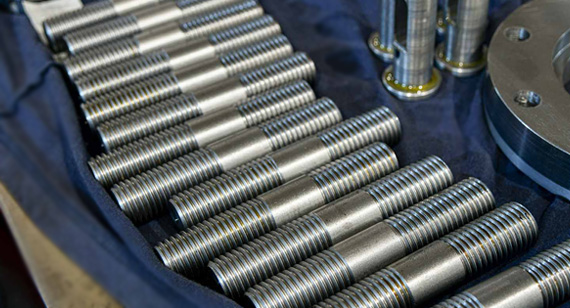
Cold forming is a high-speed metalworking process where metal is shaped at or near room temperature; That is, metal cold forming utilizes massive hydraulic or mechanical pressure to force the metal into a specific shape(General Cold Forming Process). This cold deformation makes the metal’s crystalline structure is rearranged, and achieved advantages that:
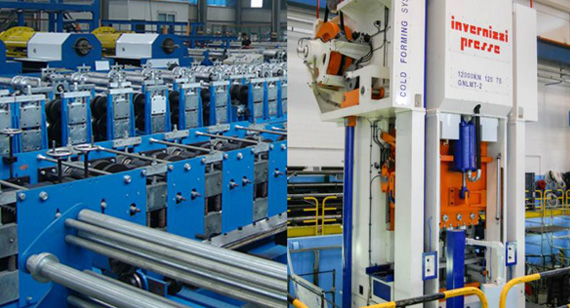
Cold forming metal into parts is a general term to call this manufacturing method. But actually, the cold forming includes many detailed processing ways. You can find these processing ways in below table:
Table 1: Processing Ways of Cold Forming
| Process Way |
Operation Method |
Typical Applications (Examples) |
| Cold Heading |
Striking the end of a metal wire or bar to increase its diameter/volume (upsetting). | Bolts, screws, rivets, and specialty cold formed fasteners. |
| Cold Extrusion |
Forcing metal through a die orifice or around a punch under high pressure. | Gear shafts, hollow cylinders, and automotive pistons. |
| Cold Rolling |
Passing metal between rollers or moving dies to displace material into a specific profile. | Threaded rods, splines, and long structural profiles (cold roll forming). |
| Cold Bending |
Applying force to sheet, strip, or tubing to create an angular displacement. | Structural brackets, frames, and piping systems. |
| Cold Drawing |
Pulling a metal rod or wire through a tapered die to reduce its cross-section. | High-precision wire, tubing, and bright steel bars. |
| Cold Stamping |
Using a press and die set to cut or shape sheet metal into 2D or 3D forms. | Car body panels, appliance housings, and metal brackets. |
| Cold Spinning |
Rotating a metal disc or tube at high speed while a tool presses it against a mandrel. | Cones, hemispheres, and cookware (pots/pans). |
The main difference between the top three processes (Heading, Extrusion, Rolling) and the bottom three (Bending, Stamping, Spinning) is the degree of material displacement:
Is Sheet Metal Fabrication the Same as Cold Forming?
Although sheet metal forming (bending/stamping) belongs to sheet metal fabrication, sheet metal fabrication and cold forming are different. Besides bending/stamping, sheet metal fabrication uniquely refers to work on flat, thin metal sheets and this can also include laser cutting, punching, welding, and surface finishing (like powder coating) the metal sheets( You start with a 2D plane of a fixed thickness). But for cold forming, it focuses on using high pressure to force metal (usually wire or bars) to flow into a new 3D shape.
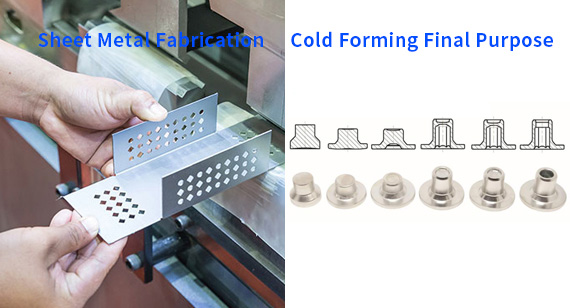
The concepts of "cold forming" and "cold forging" are often used interchangeably. While both processes involve the cold working of steel and other alloys without the application of heat, they differ primarily in the complexity of the part and the nature of the metal flow.
Cold forming is a broad "umbrella" term that encompasses various operations such as heading, bending, and extruding. It is most commonly associated with the production of long, symmetrical parts like cold formed fasteners, bolts, and rivets. On the other hand, the cold forging process typically refers to more intense, three-dimensional deformation. Cold forging operations are used to create complex, heavy-duty components—such as gears, pistons, and hollow cylinders—where the metal must undergo significant volumetric changes.
While cold forged parts are generally more complex in geometry, both methods share the same primary benefit: strain hardening. Because the metal is deformed while cold, the internal grain structure follows the contour of the part, resulting in a finished product that is significantly stronger than a part machined entirely from a standard bar. Whether you require the high-speed output of a cold heading process or the structural density of cold forging, both techniques provide a robust foundation that can be further perfected through secondary CNC machining.
Cold forming relies on a metal's ductility—its ability to plastically deform without breaking or cracking at room temperature. Metals with a Face-Centered Cubic (FCC) crystal structure, such as copper and aluminum(1000-6000series), are generally the most suitable because their atoms can shift positions more easily. Carbon steel, stainless steel, and brass can also be cold formed into parts. But their cold forming easy or difficult mainly depends on their different grades. Below table shows the metals that can be cold formed and common cold formed parts examples:
Table 2: Suitable Metals for Cold Forming
| Material |
Why it is suitable |
Common Cold Formed Parts |
| Carbon Steel |
Excellent balance of formability and strength; very cost-effective. | Bolts, nuts, rivets, and automotive seat frame components. |
| Alloy Steel |
Higher strength and wear resistance after heat treatment. | High-tensile fasteners, engine valves, and transmission shafts. |
| Stainless Steel |
Excellent corrosion resistance; maintains strength at high temps. | Medical implants, marine hardware, and aerospace fasteners. |
| Aluminum Alloys |
Lightweight with a high strength-to-weight ratio; highly ductile. | Heat sinks, electronic housings, and lightweight automotive pins. |
| Copper & Brass |
Superior electrical and thermal conductivity; extremely easy to form. | Electrical connectors, terminals, and plumbing fittings. |
| Material |
Why it is suitable | Common Cold Formed Parts |
Unlike cord forming achieved parts manufacturing through massive hydraulic or mechanical pressure to force the metal into a specific shape; CNC Machining is cutting, drilling, or milling a whole piece of material into the needed shapes, and this process controlled by computer programs to achieve much high precision of the parts(±0.01mm tolerance). Cold forming parts(±0.1mm tolerance) indeed save the material and cost compared to CNC Machining, but if there are more tight tolerance requirements, you may choose CNC Machining for secondary machining.
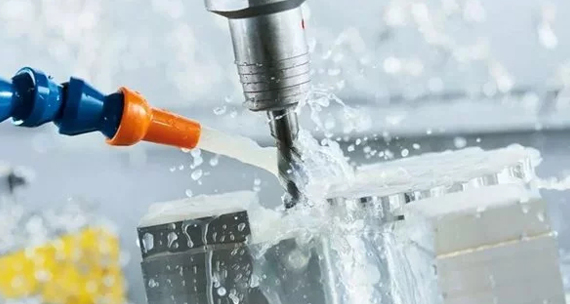
Key Advantages of Secondary CNC Processing:
By integrating CNC machining with your cold-formed components, you get the best of both aspects: a part that is structurally superior with precision met, and produced at a lower cost.
In summary, cold forming is a high-efficiency manufacturing process that deforms metal at room temperature to create high-strength, high-volume components. Many metals like carbon steel, aluminum alloys, copper, and brass stainless steel are very good for large batch of parts manufacturing; while whether you choose the cold forming process or not depends on your ultimate parts requirements such as strength and precision.

A client from the automotive industry approached VMT CNC Machining Factory to perform secondary CNC machining on high-volume stainless steel cold-formed shoulder bolts. While the initial cold-forming process successfully created the "near-net shape" and significantly reduced raw material costs, it fell short of the final engineering requirements. Specifically, the cold-heading process could not achieve the critical shoulder diameter tolerance of ±0.01mm. Additionally, the design required a high-precision radial cross-hole in the head and a surface roughness of Ra 0.8 to ensure low-friction performance during final assembly.
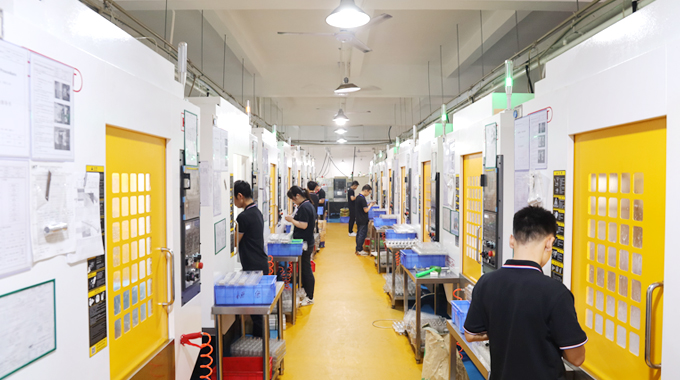
To address these stringent precision demands, the VMT technical team developed a specialized secondary machining workflow. We utilized high-performance 4-axis CNC Swiss-type lathes equipped with automatic loading systems to perform secondary clamping and finishing on the cold-formed blanks. By employing custom high-hardness PCD (Polycrystalline Diamond) tooling for high-speed micro-cutting, we successfully mitigated the precision fluctuations typically caused by the work-hardening of stainless steel. Furthermore, we utilized CNC live tooling to complete the radial drilling and chamfering in a single setup, ensuring perfect symmetry and positional accuracy relative to the central axis.
By implementing VMT’s secondary CNC machining solution, the first-pass yield for the 50,000-piece batch rose from the client's projected 85% to an outstanding 99.8%. Critical dimensional tolerances were consistently maintained within ±0.01mm, and the surface finish met all specifications. Ultimately, the client received parts that perfectly satisfied their precision assembly needs while achieving a 35% reduction in total unit cost compared to a full CNC turning process. This hybrid approach delivered the perfect synergy of high-volume efficiency and high-end precision.
What is the meaning of cold forming?
Cold forming is a manufacturing process where metal is shaped at room temperature using high-pressure dies. Instead of cutting material away, the metal is forced to "flow" into the desired geometry, preserving material and increasing strength.
What is an example of cold forming?
A common example is the production of a standard steel bolt. A piece of wire is cut to length and then "headed" in a cold forming press to create the hexagonal head and the shank, followed by thread rolling to finish the piece.
What is the difference between hot forming and cold forming?
Hot forming involves heating the metal above its recrystallization temperature to make it easier to shape, which is ideal for very large or complex parts. Cold forming happens at room temperature, providing better surface finishes, tighter tolerances, and increased hardness through work hardening.
What are the fundamentals of cold forming?
The fundamentals rely on the material’s plasticity, the precision of the die design, and the immense pressure applied by the forming press. Success depends on the metal's ability to deform without fracturing while maintaining structural integrity.
Can stainless steel be cold formed?
Yes, many grades of stainless steel (like 304 and 316) are excellent for cold forming. However, they work-harden much faster than carbon steel, requiring high-tonnage equipment and specialized tooling to achieve the desired shape.
What are the advantages of cold forming?
Because cold forming produces no metal scrap, it requires less reprocessing, along with the associated costs of transportation, fuel, and labor—most of which are environmentally friendly.


 +86 15099911516




 Read more