16 years one-stop China custom CNC machining parts factory

Hey there I’m VMT Sam!
With 25 years of CNC machining experience we are committed to helping clients overcome 10000 complex part-processing challenges all to contribute to a better life through intelligent manufacturing. Contact us now
 597 |
Published by VMT at Jul 28 2026 | Reading Time:About 6 minutes
597 |
Published by VMT at Jul 28 2026 | Reading Time:About 6 minutes


Understanding metal strength is crucial in many industries, from automotive and aerospace to construction and medical devices. Metal strength refers to the ability of a material to withstand various forces without plastic deformation or fracture. Whether you're working in CNC machining, metal fabrication, or any mechanical design field, having a solid grasp of metal strength properties helps in selecting the right materials for your project. Factors such as tensile strength, yield strength, compressive strength, and impact resistance all play a key role in determining a metal's overall performance in real-world applications.
The strength of a metal not only impacts the durability and safety of engineering parts and equipment but also directly influences how it can be machined, shaped, and welded. This guide will explore the different types of metal strength, the strongest metals used in industry, processes for strengthening metals, and provide practical graphs and charts for comparison. With a focus on CNC machining, we'll also discuss how understanding metal strength affects the precision and durability of custom CNC machining parts.
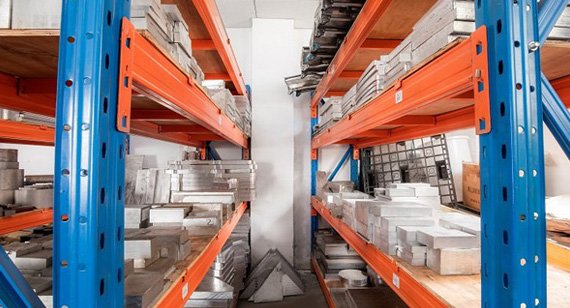
Before diving into specific metals and their strengths, it's essential to understand the key properties that define metal strength. These properties help determine how a metal will behave under stress, how it can be processed, and its suitability for various applications. The most important strength-related properties of metals include yield strength, tensile strength, compressive strength, and impact strength.
These different types of metal strength are dictated by the way the load is applied, and each one drives a different set of application requirements. An automotive suspension arm or a torque-carrying shaft, for instance, needs high yield strength so it will not deform permanently under load. A heavy-duty gear needs very high tensile strength so the tooth will not fracture. A vehicle chassis or an enclosure frame needs high impact strength so it will not crack or deform when a sudden shock load hits it. And a part like a hydraulic plunger has to resist both pulling and crushing, which means it needs high compressive strength and high tensile strength together.
Yield Strength
Yield strength is the stress at which a material begins to deform plastically. Before reaching the yield point, the material will deform elastically, meaning it can return to its original shape when the stress is removed. Once the yield point is exceeded, the material will deform permanently. Yield strength is a critical property in structural and mechanical design, because it governs how safely a metal performs in real engineering service. When you design automotive or heavy machinery components that must not twist or deform under load, you use the yield strength figure to calculate the maximum allowable load and set your safety factor — that calculation is what keeps the part safe in service.
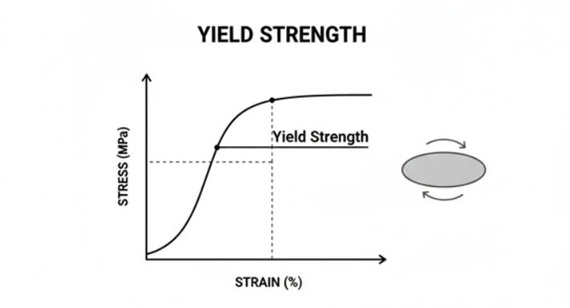
For example, knowing the yield strength of a metal allows you to determine how much force can be applied during machining or forming processes without causing permanent deformation. Yield strength is particularly important in applications such as aerospace or automotive, where structural reliability is paramount. Think of automotive parts like a vehicle frame rail or an anti-collision beam that has to hold its shape under heavy load, or common mechanical gears and drive shafts that must not twist out of true in service.
Ultimate Tensile Strength (Tensile Strength)
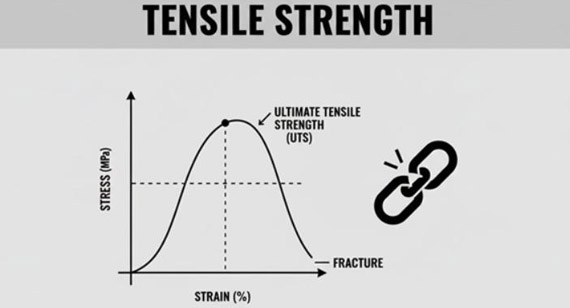
Ultimate tensile strength, often shortened to tensile strength, is the maximum stress a material can withstand while being stretched or pulled before breaking. Unlike yield strength, tensile strength refers to the point of fracture. This property is particularly important in materials that need to endure stretching forces, such as high-strength bolts used in heavy machinery, lifting shackles and rigging hardware, and pressure vessels, piping, and their related fittings.
Tensile strength helps in determining how strong a material is in tension, and it's an essential factor in choosing metals for load-bearing applications. In custom CNC machining, tensile strength will guide decisions regarding material selection for parts that need to withstand tension without failure.
Compressive strength refers to the ability of a material to withstand loads that reduce its size. This is the opposite of tensile strength, which deals with stretching. Metals with high compressive strength, like steel or tungsten, are commonly used in structures like bridges, columns, and foundations where heavy loads are applied. Compressive strength is also a vital consideration in CNC machining parts, especially when designing components that will endure pressure or weight.
In metal CNC machining, compressive strength must be taken into account to ensure that parts like support brackets, frames, or mechanical bases don't fail under pressure. Materials like stainless steel and titanium are often used because they offer high compressive strength.
Impact Strength
Impact strength, also known as impact toughness, is the ability of a metal to absorb energy and resist shock or impact without fracturing. This property is particularly important in applications where metals are subjected to sudden forces, such as in automotive crash components or heavy machinery. A metal with high impact strength can withstand sudden stress or impact, making it highly durable in demanding environments.
In CNC precision machining, understanding impact strength helps ensure that the machined components can resist cracks or breaks in dynamic or high-stress environments, such as in aerospace or military applications.
Knowledge of metal strength is essential for various reasons. It ensures that materials are chosen wisely for different applications, optimizing safety, durability, and cost-efficiency. From designing complex mechanical systems to selecting the best materials for custom CNC machining parts, understanding metal strength helps to predict how materials will behave under different conditions and stressors.
Mechanical/Structural Design
In any mechanical or structural design, metal strength defines the limits of what a component can handle. A part that doesn't have the necessary strength can lead to structural failure, which could cause significant damage, financial loss, or even harm to users. For example, in a CNC machining factory, components such as brackets, gears, and frames need to meet specific strength requirements to function effectively in their intended environments.
By understanding the specific strength requirements of your design, you can select metals that meet those needs without being over-engineered, which could lead to unnecessary costs.
Material Selection
When working on CNC prototype machining or production, selecting the right material based on its strength properties is crucial. Each project requires materials with specific properties. For instance, a material with high tensile strength is necessary for parts subjected to stretching (typical high-tensile precision parts include drive bolts, turbine engine blades, and precision springs), while compressive strength is crucial for load-bearing structures (typical high-compressive precision parts include precision bearing balls, hydraulic plungers, and optical instrument bases). This informed selection of materials ensures not only the performance but also the longevity and safety of the product.
Durability and Safety
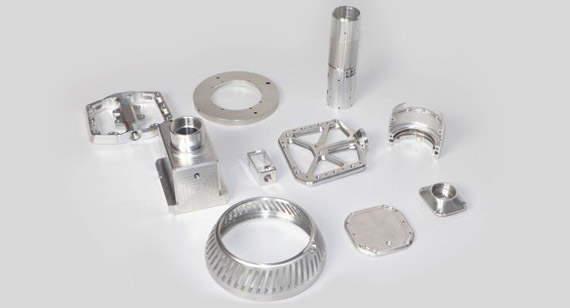
Strength directly correlates with the durability and safety of metal parts. For example, metals used in aerospace and automotive applications must endure both sustained pressure or stress and extreme conditions without failure. In CNC machining services, understanding metal strength helps you create parts that meet the highest safety standards while maintaining functionality over time. Choosing the right high-strength metal lets you set a defined limit on the stress the part can carry and on the risk of eventual failure, which is what secures the durability and safety of the engineering component and the equipment it goes into.
Not all metals are created equal when it comes to strength. Different metals are favored in industries that demand high-performance parts, from aerospace to military applications. Strong metals provide the backbone for durable and reliable components. Let's explore the strongest metals commonly used in CNC machining and metal fabrication.
Titanium
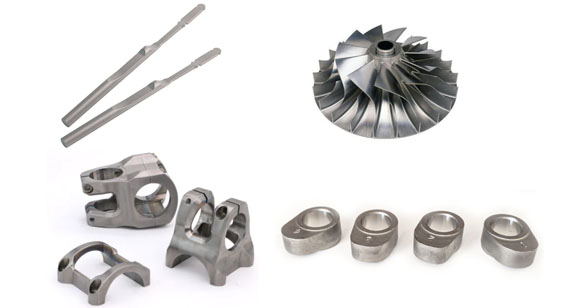
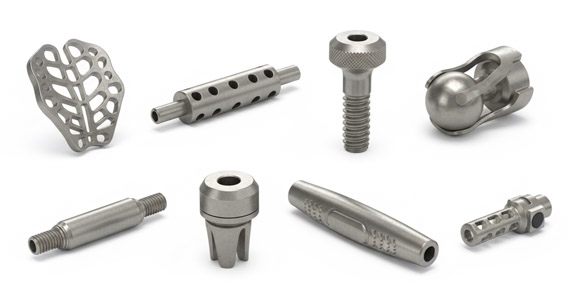
Titanium is known for its high strength-to-weight ratio, corrosion resistance, and ability to withstand extreme temperatures. Despite being lighter than steel, titanium offers comparable strength, making it an excellent choice for aerospace components (engine mount brackets, airframe fasteners), medical implants (spinal fixation screws, hip stems), and high-performance automotive parts (connecting rods, turbocharger wheels). CNC machining services often employ titanium for custom parts that require both strength and light weight.
Worth separating the two families here. Commercially pure titanium (CP grades such as Grade 2) is chosen more for its ductility and corrosion resistance, which puts it mostly into piping and tubing applications and a smaller share of implants. The bigger share of custom work goes to titanium alloys that carry small additions of other elements — Ti-6Al-4V (Grade 5) being the common one — for parts that need strength and light weight at the same time.
Chromium
Chromium is highly resistant to corrosion and is often used to harden steel alloys. It is also a key component in stainless steel, providing durability and resistance to wear. Chromium's strength makes it suitable for plating on other metals to improve their wear resistance, commonly used in automotive parts and tools.
Tungsten
Tungsten is one of the strongest metals in terms of tensile strength. It has the highest melting point of any metal, making it ideal for high-temperature applications such as in aerospace and defense. Tungsten is difficult to machine, but its exceptional strength makes it indispensable in high-performance environments.
As a primary alloying element, tungsten also gives us a whole family of tungsten-bearing tool steels. T1 high speed steel (roughly 18% tungsten) and M2 (a molybdenum-tungsten grade carrying about 6% tungsten) are the ones you see most, and they typically go into precision cutting tools, milling cutters, drills, taps, and cold-work punches and dies that have to hold an edge under load.
Steel
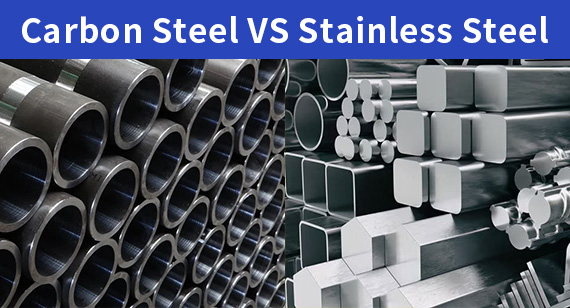
Steel is fundamentally an iron-based material, and what you add to that iron base decides what you get. Add carbon and you land in low, medium, or high carbon steel, which covers all sorts of gears, springs, and other high-strength components. Add at least 10.5% chromium plus other alloying elements and you get stainless steel, far more corrosion resistant, with several grades that also reach high strength. Add tungsten or other carbide-forming elements and you get tool steel, which goes into cutting tools, punches, dies, and molds that have to survive repeated high-stress contact. That combination of tensile strength, yield strength, and cost-effectiveness is why steel dominates construction, automotive, and heavy machinery, and it is also a popular choice for CNC machining parts thanks to its versatility and machinability.
Inconel
Inconel is a superalloy made primarily of nickel and chromium, known for its ability to maintain strength under extreme conditions such as high heat and corrosive environments. It is often used in gas turbines, jet engines, and chemical processing equipment. CNC machining of Inconel requires precision due to its toughness, but its strength-to-weight ratio makes it highly valuable in demanding industries.
Carbon Steel
Carbon steel is a strong, durable material widely used in construction, automotive, and heavy machinery industries. It is known for its high tensile strength and relatively low cost, making it an economical choice for many CNC machining projects. When heat-treated, carbon steel can become even stronger, improving its wear resistance and toughness.
Stainless Steel
Stainless steel is favored for its corrosion resistance and strength. It's commonly used in medical devices, food processing equipment, and construction. Stainless steel's ability to resist wear and its aesthetic appeal make it a top choice for CNC precision machining of parts that require both strength and a clean appearance.
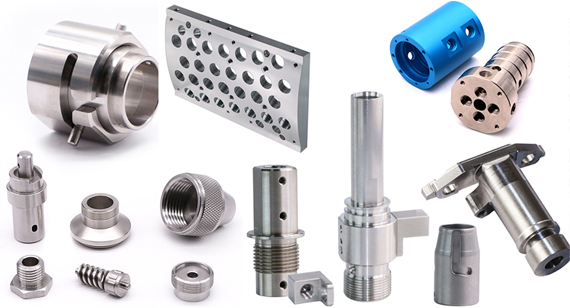
Not all stainless behaves the same on the strength side. Martensitic stainless can be hardened by heat treatment, and along with precipitation-hardening grades, duplex, and super duplex, these are the high-strength families. Austenitic and ferritic stainless cannot be hardened by heat treatment, so they sit a step lower on strength — but they still cover everyday requirements, and austenitic 304 is the most popular stainless steel of the lot. Everyday stainless enclosures and brackets — camera mounts, drone mounts, electronic housings and electronic brackets — very often land on 304. It is inexpensive, the strength is adequate, and the corrosion resistance is good.
Various methods can enhance the strength of metals, allowing you to tailor materials for specific applications. From heat treatments to alloying, these techniques improve the overall performance of metals, making them more durable and more resistant to fatigue, impact, and deformation.
Solution Strengthening and Alloying
Solution strengthening involves adding elements such as carbon, chromium, or nickel to a base metal to enhance its mechanical properties. Alloying is the process of combining two or more metals to create a material that inherits the strengths of each element. For example, adding chromium, molybdenum, and nickel to plain carbon steel produces alloy steels such as 4140 or 4340, where tensile strength climbs from roughly 400–500 MPa to well over 1000 MPa once heat treated.
Heat Treatment
Heat treatment is used to modify the structure of metals, improving their strength and durability. The following are common heat treatment methods:
Some metals respond to heat treatment very well. The 6000-series aluminium alloys, martensitic stainless steels, and medium and high carbon steels are all heat treatable, and their strength can be raised substantially this way.
Strain Hardening or Cold Working
Strain hardening, or cold working, strengthens metals by deforming them at room temperature. This process increases the density of dislocations in the metal's structure, enhancing its strength. It is the route you take with metals that cannot be hardened by heat treatment — non-heat-treatable aluminium alloys and austenitic stainless, for instance. Roll, draw, or compress 304 stainless or a 3000-series aluminium and the internal crystal structure gets distorted and locked up with dislocations, and the material comes out significantly stronger. The gain is real but bounded: cold working will not reach what a proper heat treatment delivers on a hardenable alloy.
Strength and hardness are often confused but are distinct properties. Strength refers to a material's ability to withstand forces without breaking or deforming, while hardness is a measure of how resistant a material is to surface indentation or scratching. A metal can be very hard but not necessarily strong in tensile applications. For example, glass is very hard but brittle, whereas steel offers a balance of both hardness and strength.
The following chart compares the tensile strength, yield strength, and compressive strength of common grades used in CNC machining and fabrication. Values are typical for the stated condition and vary with heat treatment, section size, and supplier; confirm against the mill certificate before you design to them. Note that for ductile metals the compressive yield is essentially equal to the tensile yield — these alloys deform rather than crush, so they have no true brittle compressive failure point.
| Metal / Grade | Condition | Yield Strength (MPa) | Tensile Strength (MPa) | Compressive Strength (MPa) |
| Ti-6Al-4V (Grade 5) | Annealed | 830 | 900 | ~970 |
| Chromium (pure) | As-cast | 370 | 690 | ~1400 |
| Tungsten (pure) | Sintered / worked | 750–1000 | 980–1510 | ~3400 (brittle) |
| Low carbon steel A36 | Hot rolled | 250 | 400–550 | ~250 |
| Medium carbon steel 1045 | Cold drawn | 450–530 | 585–700 | ~450 |
| High carbon steel 1095 | Quenched & tempered | 570–930 | 830–1200 | ~570 |
| Inconel 718 | Aged | 1035 | 1240 | ~1035 |
| Stainless 304 (austenitic) | Cold worked (1/4 hard) | 515 | 690–860 | ~515 |
| Stainless 440C (martensitic) | Hardened & tempered | 1900 | 1970 | ~1900 |
| Duplex stainless 2205 | Annealed | 450–550 | 655–760 | ~450 |
| PH stainless 17-4PH | H900 | 1170 | 1310 | ~1170 |
| Aluminium 6061-T6 | Age hardened | 276 | 310 | ~276 |
| Aluminium 5052-H32 | Cold worked | 195 | 230 | ~195 |
| Brass C36000 (free-cutting) | Half hard | 310 | 400 | ~310 |
| Aluminium bronze C95400 | As-cast | 205 | 515 | ~205 |
| Phosphor bronze C51000 | Hard | 550 | 620 | ~550 |
| Copper C11000 (ETP) | Hard drawn | 310 | 345 | ~310 |
Metal strength is not only a service-life question — it changes what happens at the spindle. Take two aluminium grades that look interchangeable on a drawing: 6061-T6 (276 MPa yield, 310 MPa tensile) and 7075-T6 (503 MPa yield, 572 MPa tensile). Machine a thin-walled drone camera mount from each and they behave differently.
On precision: the lower-strength 6061 gives under clamping and cutting load. A 1.5 mm wall pushed by a side-milling cut will deflect, and the wall thickness you measure off the machine drifts from the wall thickness you programmed. 7075 resists that deflection, so it holds tighter tolerances on thin features and keeps flatness on mounting faces.
The trade-off is cutting force: the stronger alloy demands more spindle power and puts more load on the tool, so we drop the depth of cut, raise the feed, and take more passes to keep the tool from deflecting. Higher-strength alloys also carry more locked-in residual stress from rolling or forging, which is why we rough, stress-relieve, then finish rather than cutting a critical part in one shot — otherwise the part relaxes after machining and walks out of tolerance days later.
On durability: the finished mount sees vibration and repeated landing shocks, which is fatigue loading, not static loading. The higher-yield 7075 mount tolerates a higher stress amplitude before it starts cracking at the fillets, so it survives longer in the same duty cycle. That said, 6061 has better corrosion resistance and weldability, and it costs less. So the real decision is: what stress is the part actually seeing, what tolerance does it have to hold, and what does the environment do to it? Send us the drawing and the duty conditions and we will tell you which side of that trade-off your part belongs on.
Challenge
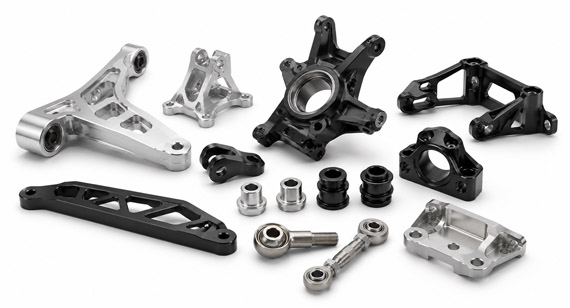
An automotive manufacturer came to us after a failed validation round. Their first supplier was a CNC shop with limited material knowledge, so they simply machined the chassis bracket in the grade the customer had specified on the print — a 6061-T6 aluminium. The parts came out dimensionally acceptable, but they did not survive testing: impact testing showed cracking at the fillet radii under shock load, and tensile testing on the load path came in below the required figure. The program stalled.
Engineering Review and Solution
Our engineers reviewed the load case rather than the print. The part was carrying both a sustained static load and repeated shock input, which meant the original alloy was under-specified on both counts. We recommended moving to 7075-T651 for the strength headroom, and reworked two design details with the customer: opening the fillet radii from 1.5 mm to 3 mm to kill the stress concentration where the cracks had initiated, and slightly thickening the rib on the primary load path. Because 7075 carries more residual stress and cuts harder, we planned the process around it — rough all faces with generous stock left on, stress-relieve, then finish in soft jaws with light depths of cut and high feed so the thin sections would not deflect against the cutter.
Results
The result: first-article parts held flatness within 0.03 mm across the mounting face and all critical dimensions inside a ±0.02 mm band, with no post-machining distortion measured after a week on the shelf. Impact testing passed with margin, tensile results cleared the requirement, and the customer released the part to production with us and has since moved two more chassis components across.
Metal strength is a fundamental consideration in CNC machining, material selection, and engineering design. Whether you're working with titanium for aerospace components or carbon steel for industrial machinery, understanding the unique strength properties of each metal ensures that your parts meet the required performance standards. From tensile strength to impact resistance, these properties guide material choices and machining processes, ensuring optimal results in your project.
Discuss Your High-Strength Metal Par
At VMT, we specialize in CNC precision machining and offer a wide range of metalworking services. Whether you need parts made from titanium, stainless steel, or carbon steel, our expertise in CNC machining parts and surface treatments guarantees the highest quality components. With over 16 years of experience, we offer custom CNC machining services that meet the demands of diverse industries, from aerospace to medical devices.
Send your drawings, material grade, load conditions, tolerance requirements, heat-treatment specifications, surface requirements, and batch size. VMT will review your project and provide a practical machining solution and quote.
All information and uploaded files are secure and confidential.
1 Tell us what you need
2 Get solution & quote
3 Approve production
Email: inquiry@vimetal.com.cn
Q: Is Titanium Stronger Than Steel?
Titanium has a higher strength-to-weight ratio than steel, making it lighter but comparably strong. However, certain steels can outperform titanium in specific strength categories.
Q: What is the Difference Between Strength and Hardness of Metals?
Strength refers to a metal's ability to withstand forces without deformation, while hardness measures resistance to surface indentation or scratching.
Q: What Does Strength Mean in Metals?
Strength in metals refers to their ability to withstand stress without breaking or deforming. It includes properties like tensile strength, yield strength, and compressive strength.
Q: What is the Difference Between Strength, Impact Toughness, and Toughness of Metals?
Impact strength is one category of metal strength, and it is what we call impact toughness: the energy absorbed in an impact fracture divided by the original cross-sectional area, reported in J/cm². Toughness is the broader idea — the total energy a material absorbs and the plastic deformation it undergoes before fracture — so it leans toward ductility rather than a single measured strength value.
Q: What Are the Strongest Metals?
Tungsten, titanium, and Inconel are some of the strongest metals commonly used in CNC machining and fabrication.
Q: Is Metal Strong?
Yes, metals are strong materials, but their strength varies depending on type and treatment. For example, tungsten is incredibly strong, while aluminum is lightweight but less strong in comparison.
Q: How is the Strength of Metals Measured?
Metal strength is measured through tests like tensile tests for tensile strength, compressive tests for compressive strength, and impact tests for toughness.
Q: What is the Weakest Metal?
Lead is one of the weakest metals, known for its low strength but high malleability and density.
Q: Which is Stronger, Iron or Titanium?
Titanium is stronger than iron when considering strength-to-weight ratio, but pure iron has lower tensile strength compared to alloys like steel.
The technical information and manufacturing advice shared on the VMT website are for general guidance only. While we strive for accuracy, VMT does not guarantee that the processes, tolerances, or material properties mentioned are applicable to every specific project. Any reliance you place on such information is strictly at your own risk. It is the buyer's responsibility to provide definitive engineering specifications for any production orders. Final specifications and service terms shall be subject to the formal contract or quotation confirmed by both parties.


 +86 15099911516




 Read more