16 years one-stop China custom CNC machining parts factory

Hey there I’m VMT Sam!
With 25 years of CNC machining experience we are committed to helping clients overcome 10000 complex part-processing challenges all to contribute to a better life through intelligent manufacturing. Contact us now
 162 |
Published by VMT at Jun 05 2026 | Reading Time:About 4 minutes
162 |
Published by VMT at Jun 05 2026 | Reading Time:About 4 minutes


With a thermal conductivity of approximately 230 W/(m·K), pure aluminum (1050/1060-O) boasts the highest thermal performance among all aluminum alloys. If heat dissipation were the sole criterion, pure aluminum would be the ultimate heat sink material. However, anyone with thermal management design experience knows that pure aluminum has a yield strength of only 30–50 MPa—pliant enough to bend with bare fingers. This means it cannot serve as a standalone structural component. Furthermore, it is notoriously "gummy" during CNC machining, leading to poor surface finishes, and its cosmetic consistency after anodizing is far inferior to that of 6000-series alloys. So, practical engineering ultimately seeks several balanced dimensions: thermal performance, mechanical strength, manufacturability, and cost-effectiveness, etc.
In this guide, we break down the thermal conductivity of aluminum across various popular aluminum grades, and you can gain some manufacturing and material choice and alternative suggestions. At the very end, we will also share a case study on how our factory helps clients perfectly balance precision tolerances, surface finish aesthetics, and strict thermal specs.
| Aluminum Alloys |
Thermal Conductivity (W/m·K) |
Yield Strength (MPa) |
Brinell Hardness (HB) |
Core Manufacturing Process |
Relative Cost |
| 1060 |
220–230 | 30–50 | 19 | Stamping, Spinning, Simple Bending | ★ |
| 6063-T5 |
200–210 | 110–160 | 60 | Extrusion, CNC Machining (Machinable but slightly sticky) | ★★ |
| 6061-T6 |
155–170 | 240–276 | 95 | CNC Machining (Preferred), Extrusion, Forging | ★★ |
| 7075-T6 |
130–150 | 460–572 | 150 | CNC Machining, Aerospace Structural Components | ★★★ |
| ADC12 / A380 |
92–100 | 150–170 | 80–86 | High-Pressure Die Casting (HPDC) | ★ |
What Drives the Variance in Aluminum Thermal Conductivity?
Pure aluminum (such as 1050 and 1060) boasts the highest thermal performance because its crystal lattice is free from impurity atoms that disrupt heat transfer. However, for practical thermal structural components, manufacturers must introduce alloying elements and apply heat treatments (such as T6 solutioning and aging) to boost mechanical strength.
Take 6061-T6 aluminum vs. pure aluminum as an example. 6061 integrates elements like magnesium, silicon, and zinc into the aluminum matrix. These solute atoms lock into the atomic lattice, pinning dislocations and drastically hardening the metal. The trade-off, however, is that they scatter the free electrons responsible for conducting heat, causing the thermal conductivity of aluminum to drop.
The same principle explains why die casting aluminum (ADC12) exhibits a much lower thermal rating. Packed with a high percentage of silicon, its microstructure contains coarse silicon phases that physically disrupt the continuous thermal paths within the aluminum matrix. Despite this thermal penalty, die casting offers a massive manufacturing advantage: it enables the high-volume production of complex, thin-walled, 3D integrated structures at an incredibly low per-part cost. This avoids the need for extensive hardware assembly while mitigating the interfacial thermal resistance typically caused by multi-part joints.
When designing cooling components, material selection cannot be isolated from the manufacturing process. In fact, material, process, and performance must be evaluated simultaneously. Because different aluminum grades possess distinct levels of ductility and hardness, each aligns with a specific fabrication method. Also, thermal conductivity is one of the important factors.
1. Prototype and Low-Volume Production: Why 6061-T6 CNC Machining is the Good Choice?
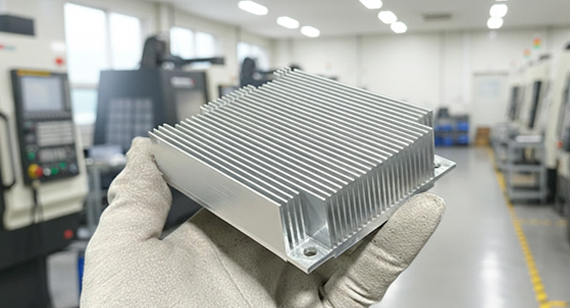
6061-T6 aluminum offers ideal hardness, excellent machinability, and relatively good thermal conductivity. It not only ensures high machining efficiency but also delivers superior surface flatness and tighter tolerances via precision CNC machining.
Consequently, 6061-T6 CNC milling is the premier choice for low-volume runs, high-precision applications, prototyping phases, and premium thermal assemblies with flexible budgets.
But one cons of 6061 is that its material and processing costs cannot compete on price with high-volume 6063 aluminum extrusions. In addition, pure aluminum and 6063 aluminum are much softer and more ductile. When subjected to high-speed CNC cutting, they tend to become "gummy" and stick to the tool, leading to burrs and built-up edge (BUE), which results in a rough surface finish. Therefore, they are generally not the best for precision machining.
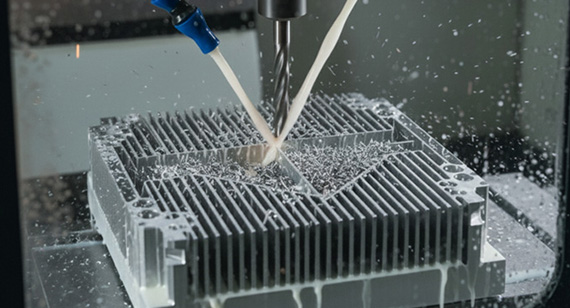
2. High-Volume Mass Production: Why 6063 Aluminum Extrusion Excellent?
6063 aluminum exhibits outstanding thermoplasticity and ductility. When extruded at high temperatures above 450°C, its excellent flowability allows it to be forced through precision dies to create complex 2D profiles—such as ultra-thin cooling fins (down to 0.5 mm) with high aspect ratios—in a single pass.
Compared to CNC machining, aluminum extrusion largely reduces material waste and provides a highly efficient, cost-friendly production route.
If your project requires standard pin-fin or comb-shaped heat sinks, has a high production volume, and can tolerate standard extrusion tolerances (as ultra-precise tolerances like 0.01 mm are unattainable here, except apply a second CNC machining), 6063 extrusion offers the best price-to-performance ratio.
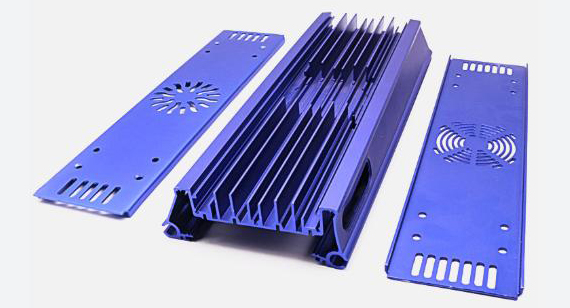
3. Ultra-High-Volume Manufacturing: Why ADC12/A380 High-Pressure Die Casting is Recommended
ADC12 and A380 are casting aluminum alloys specifically engineered for the foundry process. Their defining characteristic is a high silicon content (9%–12%), which grants the molten metal exceptional fluid mobility at high temperatures.
By leveraging high-pressure die casting (HPDC) with ADC12/A380, you can choose these two to integrate cooling fins, motor housings, mounting brackets, and even internal fluid channels into a single, one-piece net-shape casting. (Among all traditional casting methods, die casting offers the best dimensional accuracy and repeatability, which is recommended).
But how do you compensate for its lower thermal conductivity (~100 W/m·K)? Just offset this by engineering roughly 15% more surface area into the die-cast heat sink design.
Ultimately, for ultra-high-volume projects, choosing economical die casting (paired with ADC12/A380) yields massive structural complexity and cost advantages—even though its dimensional tolerance (typically 0.02–0.05 mm) cannot match the ultra-precision of CNC machining (0.01 mm) or the linear consistency of extrusion (0.02 mm).
Surface treatments—most commonly anodizing—are typically applied to aluminum heat sinks for corrosion resistance or cosmetic appeal. However, any surface treatment inherently deposits a layer of material onto the aluminum substrate that has a significantly lower thermal conductivity than the metal itself. The only real variable is the thickness of this layer.
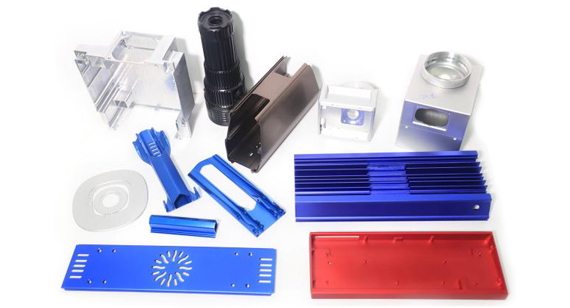
The Thermal Cost of Anodizing Aluminum
The aluminum oxide layer generated by anodization has a thermal conductivity of only 15-30 W/(m·K), which is roughly 1/10th that of the aluminum substrate. However, when evaluating its actual impact on heat dissipation, the key factor is layer thickness: Type II (conventional) anodizing produces a film thickness of just 10-25μm (0.01-0.025 mm), while Type III (hardcoat) anodizing generally tops out at 50-115μm.
For example, calculating with a 6061-T6 substrate ( 167 W/(m·K)) and an oxide film ( 20 W/(m·K)), a 25μm anodized layer introduces a thermal resistance of approximately 1.25×10⁻⁶ m²·K/W. Compared to the total thermal resistance of a typical heat sink assembly (which scales around 10⁻³ to 10⁻² ), this increase is under 0.1%—making it entirely negligible in practical engineering.
Therefore, the critical question is not "Does anodizing hurt heat dissipation?" but rather "Where is the anodizing applied?"
Two Practical Solutions to Avoid Interface Thermal Resistance
1. Selective Masking
Prior to the anodizing process, custom masking plugs or chemical-resistant tapes are applied to cover the contact area of the heating element. Because the anodizing electrolytes cannot touch the masked aluminum, this specific zone remains in a pure, bare aluminum state. Post-anodizing, the masking material is removed, leaving a pristine surface ready for thermal paste application.
Process Risk Warning: The primary risk in selective masking is edge seepage. If the chemical bath leaks past the masking edge, it leaves an inconsistent oxide ring around the perimeter of the contact interface. Experienced manufacturing facilities manage masking, anodization, and quality control (QC) within a closed-loop system under one roof, ensuring any seepage issues are caught internally rather than failing at the client's Incoming Quality Control (IQC) stage.
2. Chemical Conversion Coating (Alodine / Chromate Conversion)
When an entire component requires corrosion protection but an anodized film is too thick to tolerate, a chemical conversion coating (often referred to as Alodine) serves as a lightweight alternative. An Alodine film is incredibly thin—on the scale of 0.1-1μm (20 to 200 times thinner than anodizing)—and maintains a respectable thermal conductivity of 50-100 W/(m·K).
This combination of an ultra-thin layer and decent thermal conductivity means its impact on interfacial thermal resistance is lower than the typical batch-to-batch variance of most thermal pastes. However, because chemical conversion coatings offer less wear resistance and salt spray protection than anodizing, they are best suited for cooling components housed within enclosed chassis or internal surfaces not subject to mechanical wear.
When aluminum’s properties fall short, engineers look to alternative materials. Here is an analysis of copper, magnesium alloys, and synthetic thermal graphites.
1. Copper (C11000, Thermal Conductivity ~390 W/m·K)
With a thermal conductivity 2.3 times higher than 6061-T6 and 1.9 times higher than 6063-T5, copper is the most conductive commercial metal next to silver. However, copper’s density is 3.3 times that of aluminum ( 8.94 vs 2.70 g/cm³ ). A copper heat sink weighs over three times more than an identical aluminum one, which often disqualifies it from aerospace, portable electronics, and automotive weight-reduction applications. Copper also has poor machinability; its high ductility leads to gummy chips and rapid tool wear, pushing CNC machining costs 2–3 times higher than aluminum.
Best Practice: Instead of replacing aluminum entirely with copper, use a hybrid approach: an aluminum heat sink with localized copper reinforcement. This is achieved by embedding copper heat pipes inside extruded aluminum fins or vacuum-brazing a copper baseplate directly beneath the high-heat source. The copper base rapidly absorbs localized heat flux, while the phase-change heat pipes or the copper-aluminum brazed interface diffuse the heat across the large surface area of the aluminum fins. This hybrid architecture leverages the high conductivity of copper and the low density of aluminum, offering the best of both worlds.
2. Magnesium Alloys (AZ91D) and Thermal Graphite Sheets
The thermal conductivity of magnesium alloy AZ91D is only 51-78 W/(m·K)—significantly lower than aluminum. Yet, it holds a strong position in consumer electronics cooling due to two specific physical traits:
Thermal graphite sheets are another common solution in ultra-thin devices. They offer a phenomenal in-plane (XY axis) thermal conductivity of 400-1,500 W/(m·K) (far exceeding copper), but their through-plane (Z axis) conductivity is limited to 5-15 W/(m·K). This anisotropic property makes graphite ideal for large, thin applications like smartphones and ultrabooks. The graphite sheet flattens a concentrated hot spot into a broad surface area, transferring the heat to the device's midframe (usually aluminum or magnesium) to dissipate into the environment.
3. Quick Decision Reference Matrix for Thermal Management
| Design Requirement |
Recommended Solution |
| Peak thermal conductivity needed; weight is not a constraint | Pure Copper (C11000), CNC Machined |
| High thermal performance required alongside lightweighting | 6063-T5 Extrusion + Embedded Copper Heat Pipes |
| Complex geometry needed for mass production | ADC12 Die Casting (designing 15–20% extra surface area margin) |
| Lightweighting + intermittent cooling cycles required | AZ91D Magnesium Alloy (ideal for consumer electronics) |
| Ultra-thin profile + planar heat spreading required | Synthetic Thermal Graphite Sheet + Aluminum/Magnesium Midframe |
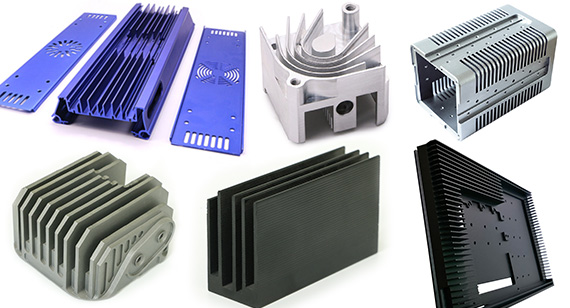
An industrial laser manufacturer required a custom heat sink for a new continuous-wave (CW) laser diode module. The module’s diode array generated a highly concentrated thermal load of approximately 120 W. Under forced-air cooling conditions at an ambient temperature of 25°C, the design specified that the heat sink must maintain the diode substrate temperature below 45°C. The custom design featured a multi-fin structure measuring 150×100×35 mm, comprising 34 fins with a thickness of 1.2 mm, a spacing of 2.0 mm, and a fin height of 28 mm.
The Core Challenge: Precision Machining Overcomes Material Limitations
From a material perspective, 6061-T6 aluminum—with a thermal conductivity of 167 W/(m·K)—was fully capable of handling the thermal load. However, the manufacturing process posed a massive bottleneck: machining fins that are 1.2 mm thin and 28 mm tall required high-speed milling across 34 high-aspect-ratio cantilever thin-wall structures. Every pass of the cutting tool subjected the fins to severe vibration.
This high-frequency chatter leaves permanent visual imperfections on the fin surfaces and causes surface roughness to deteriorate significantly. In real-world forced-air cooling scenarios, convective heat transfer efficiency is incredibly sensitive to microscopic surface roughness. Testing shows that a variance between Ra 3.2 µm and Ra 0.8 µm can result in a 3–5°C temperature discrepancy. If the chatter marks caused by machining vibrations were left unresolved, the heat sink would suffer from increased boundary-layer fluid resistance, leading to thermal failure.
The Solution: Advanced Fixturing and Toolpath Optimization
Innovative Support Fixturing (Fixturing Control):
The CNC milling sequence was re-engineered. First, initial slots (5 mm deep) were machined into the aluminum blank between the intended fins. Custom-molded, removable nylon support strips were then inserted into each slot. These inserts firmly supported each thin fin from its root, compressing the effective cantilever length from 28 mm down to 23 mm. This simple adjustment boosted the structural rigidity of the fins by roughly 60%. As the tool milled deeper layer-by-layer, the vibration amplitude of the fins was successfully suppressed to less than 1/3 of the unsupported state.
Micro-Diameter Tooling + Symmetrical Toolpaths (Toolpath Optimization):
During precision machining, the axial depth of cut was strictly limited to AP = 2 mm using a 1.5 mm diameter solid carbide end mill. Instead of conventional unidirectional milling, the toolpath was programmed symmetrically along the centerline of each fin. As a result, material removal on both sides of the fin was perfectly synchronized during each pass. The opposing radial forces physically canceled each other out, ensuring the fin experienced only vertical compressive stress and eliminating any deflection caused by lateral bending forces.
The Results
Thanks to these advanced process optimizations, all 34 thin-walled fins were machined without a single instance of fracturing or bending deformation. The final surface roughness of the fins stabilized at an excellent Ra 0.6–0.9 µm, paired with a flatness tolerance of 0.04 mm.
In subsequent thermal performance testing (equipped with a 40 CFM fan), the custom heat sink successfully maintained the laser diode substrate temperature at 41°C—a full 4°C below the client’s strict 45°C threshold. Impressed by this exceptional thermal performance and flawless surface quality, the client transitioned this prototyping project directly into a long-term production contract of 500 units per month.
Through this article, you can learn that: 1060 aluminum (pure aluminum) offers peak thermal conductivity but is too soft to withstand structural machining. 6063 aluminum provides an exceptional balance of thermal ratings and extrusion performance but lacks the strength required for complex precision CNC components. 6061-T6 aluminum stands out as the premium choice for precision machined heat sinks. Meanwhile, ADC12/A380 excels in die casting, compensating for lower thermal conductivity by offering incredible geometric freedom and high-volume economies of scale. As for copper and magnesium, careful trade-offs between thermal density and weight are required. If you still have questions about manufacturing heat sinks, cooling enclosures, or thermal structural components, feel free to contact VMT for a comprehensive DFM review and quotation. From rapid prototyping to mass production, VMT Shenzhen direct-managed CNC precision machining factory can provide you with one-stop services.
Q1: Is aluminum a good thermal conductor?
A: Yes. Among commonly used industrial metals, aluminum’s thermal conductivity ranks just behind silver, copper, and gold. Compared to stainless steel, aluminum's heat dissipation efficiency is an entire order of magnitude higher. Additionally, aluminum has only 1/3 the density of copper, boasts an extremely high specific strength, exceptional machinability, and low cost, making it the most widely used comprehensive material for heat sink applications worldwide.
Q2: Which is better for a heat sink, aluminum or copper?
A: It depends on your design constraints. In terms of pure thermal efficiency, copper holds an absolute advantage. However, copper has a high density (weighing more than 3 times as much as aluminum for the same volume) and is expensive to machine. Copper is preferred in scenarios with high heat flux densities, limited space, and low weight sensitivity (such as server liquid cooling cold plates). Conversely, in scenarios with strict weight restrictions or where natural convection dominates (such as drones, aerospace, and LED fixtures), aluminum's lightweighting and cost advantages are more prominent. The most recommended engineering solution is a hybrid "copper-aluminum combination"—selectively embedding a copper base or copper heat pipes into an aluminum heat sink base.
Q3: Is aluminum more thermally conductive than stainless steel?
A: Yes, there is a massive gap in thermal performance between the two; the thermal conductivity of aluminum is typically more than 10 times higher than that of stainless steel. In stainless steel, high concentrations of chromium and nickel atoms integrate into the iron matrix, causing microscopic lattice distortions that strongly scatter the free electrons responsible for heat transfer. In thermal design, stainless steel is essentially treated as a "thermal insulator" and is rarely used as a primary heat dissipating structure.
Q4: Since 7075 aluminum has worse thermal conductivity than 6061, why consider it?
A: The thermal conductivity of 7075-T6 is indeed lower than that of 6061-T6. However, when a component must simultaneously serve the dual roles of "core load-bearing" and "high-power heat dissipation" (such as drone motor mounts or LiDAR brackets), the yield strength of 7075 is more than twice that of 6061. This ultra-high strength allows designers to use thinner wall thicknesses to achieve the same rigidity, which directly shortens the physical distance of heat conduction macroscopically, partially offsetting the material's lower thermal conductivity. It is a highly competitive special option in structural-thermal integrated lightweight designs.
Q5: What exact impact do heat treatment tempers (T5, T6) have on thermal conductivity?
A: Their core difference lies in the distribution morphology of alloying elements within the microscopic crystal lattice, which directly affects heat transfer.
Therefore, within the same grade, the thermal conductivity of a T5 temper is typically 5–10% higher than that of a T6 temper. This is the underlying reason why 6063-T5 exhibits a significantly higher thermal conductivity than 6061-T6.
Q6: Must an aluminum heat sink undergo surface treatment? Can bare aluminum be used directly?
A: Yes, it can, but you must accept two clear engineering trade-offs:
For dry indoor environments equipped with forced-air cooling, bare aluminum is usable. For outdoor, high-humidity environments, or systems that rely on natural convection and require aesthetic appeal, anodization is the safer choice.
The technical information and manufacturing advice shared on the VMT website are for general guidance only. While we strive for accuracy, VMT does not guarantee that the processes, tolerances, or material properties mentioned are applicable to every specific project. Any reliance you place on such information is strictly at your own risk. It is the buyer's responsibility to provide definitive engineering specifications for any production orders. Final specifications and service terms shall be subject to the formal contract or quotation confirmed by both parties.


 +86 15099911516




 Read more