16 years one-stop China custom CNC machining parts factory

Hey there I’m VMT Sam!
With 25 years of CNC machining experience we are committed to helping clients overcome 10000 complex part-processing challenges all to contribute to a better life through intelligent manufacturing. Contact us now
 59 |
Published by VMT at Nov 16 2026 | Reading Time:About 8 minutes


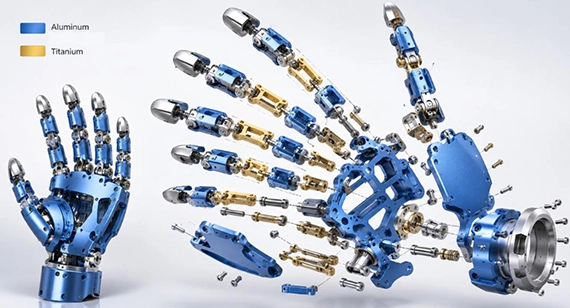
Aluminum alloys are generally better suited to lightweight dexterous hand structures where heat dissipation, machining efficiency, and cost are important considerations. Typical applications include finger skeletons, motor housings, and selected joint enclosures. Titanium alloys, on the other hand, are more suitable for miniature joints and connecting components that require high strength, fatigue resistance, wear resistance, and load-bearing capacity within limited space. But the final material selection should be based on the component's loading conditions, motion frequency, thermal management requirements, and machining considerations.
With the rapid development of Embodied AI and bio-inspired robotics, dexterous robotic hands have moved beyond laboratory prototypes and are progressing toward commercial production for industrial assembly, minimally invasive surgery, and humanoid robots. Compared with other relatively dense metal materials, such as steel and copper alloys, titanium and aluminum alloys are popular choices among robot manufacturers because of their high strength-to-weight ratios.
This article explores the differences between aluminum and titanium for custom CNC machined dexterous robotic hands and finger components. It covers material properties, surface finishing, micro CNC machining challenges, manufacturing costs, and material selection recommendations based on actual operating conditions. The final case study demonstrates how our factory provided a manufacturing solution using 7075/6061 aluminum alloys and Grade 5 titanium, achieving a 5 kg gripping payload, a success rate of over 98%, and a 62% reduction in CNC manufacturing costs.
Dexterous robotic hands and fingers typically incorporate miniature actuators (such as brushless coreless motors and frameless torque motors), miniature planetary gearboxes, tendon-driven pulleys, linkage mechanisms, and high-density tactile sensor arrays. These components create extremely limited internal space and impose several mechanical and physical constraints:
1. Low Rotational Inertia
Even a small increase in mass or a slight outward shift in the center of mass at the fingertip can significantly increase the torque demand on the drive motor during high-frequency micro-movements and rapid closed-loop grasping. This can lead to slower response times and increased heat generation.
Therefore, unless specific requirements dictate otherwise, aluminum and titanium alloys offer attractive material options due to their high strength-to-weight ratios. They help maintain fingertip rigidity while reducing rotational inertia for more responsive finger movements.
2. High Rigidity and Fatigue Resistance in Miniature Thin-Wall Structures
During pinching, gripping, and lateral grasping, finger segments and joint bearing seats are subjected to alternating bending moments and torsional shear stresses. Insufficient material stiffness can cause micrometer-level elastic deflection, affecting tactile feedback and visual alignment accuracy.
3. Heat Dissipation from High-Density Heat Sources
Miniature motors are densely integrated into the palm, particularly around the MCP joint base, and inside the proximal finger segments. With limited space for heat dissipation, structural components often also serve as heat-conducting bases.
The material properties of aluminum and titanium alloys affect finger dynamics and service life. 6061-T6 and 7075-T6 aluminum alloys are widely used in robotic components because of their machinability and mechanical performance. Grade 5 (Ti-6Al-4V) and Grade 9 (Ti-3Al-2.5V) titanium alloys represent two important options, offering high strength and, in the case of Grade 9, a balance of strength and formability.
The following comparison evaluates these four grades and their suitability for different dexterous robotic hand and finger components.
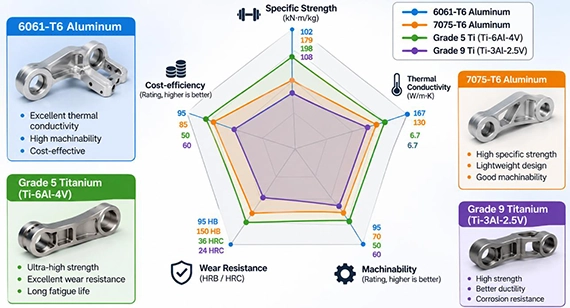
Material Grade Selection Guide for Dexterous Robotic Hands and Finger Components
| Material Grade | Key Engineering Advantages | Suitable Robotic Hand and Finger Applications |
| 6061-T6 Aluminum | Excellent thermal conductivity, high machining efficiency, consistent anodizing and coloring performance, and excellent cost-effectiveness | Palm base housings, integrated motor mounting brackets, external sensor covers, and non-critical load-bearing finger housings |
| 7075-T6 Aluminum | High specific strength, excellent tensile and yield strength, lightweight construction, and relatively good thermal conductivity | Main MCP joint structures, PIP load-bearing supports, and connecting frames subjected to relatively high bending moments |
| Grade 5 Titanium (Ti-6Al-4V) | Very high absolute strength, impact resistance, hardness, wear resistance, long fatigue life, and biocompatibility | Miniature drive pins, highly stressed miniature linkages, thin-wall connecting lugs with micro-holes, and load-bearing fingertip sensor supports |
| Grade 9 Titanium (Ti-3Al-2.5V) | High strength, better ductility and formability than Grade 5, fatigue resistance, and corrosion resistance | Ultra-thin-wall tubular finger structures, miniature transmission bushings, and complex hollow finger supports |
1. Strength for Robotic Hands and Fingers: Is Titanium Stronger Than Aluminum?
Titanium alloys are generally much stronger than aluminum alloys in terms of tensile and yield strength.
These differences affect the design safety margins of high-load miniature joints, hinge connection lugs, and load-bearing linkages in dexterous robotic hands.
In areas with extremely small cross-sections and potential stress concentrations, Grade 5 titanium can withstand greater instantaneous impact loads without permanent deformation, making it a preferred option in many cases.
However, material selection should also consider cross-sectional dimensions, loading direction, and overall structural stiffness. For example, when sufficient installation space is available, increasing the cross-sectional area of a 7075 aluminum component may also achieve the required load-bearing capacity.
2. Wear Resistance for Robotic Hands and Fingers: Is Titanium Harder Than Aluminum?
Titanium alloys also offer higher hardness than common aluminum alloys.
For miniature pin holes, interference-fit bearing seats, unlined direct-contact hinge surfaces, and sliding guides inside dexterous robotic fingers, hardness affects resistance to surface scoring and indentation over the component's service life.
Aluminum alloys are relatively more susceptible to fretting wear under repeated cyclic friction. Titanium alloys can help slow wear-related degradation in certain applications.
3. Strength-to-Weight Ratio for CNC Machined Robotic Hands and Finger Components
Titanium alloys have a density of approximately 4.43–4.48 g/cm³, while aluminum alloys have a much lower density of approximately 2.70–2.81 g/cm³.
When yield strength is divided by density to calculate specific strength, the approximate values are:
Grade 5 titanium therefore offers the highest specific strength, although 7075-T6 aluminum is not far behind.
In the design of robotic finger skeletons, distal interphalangeal (DIP) joints, and high-speed reciprocating joints, the main challenge is balancing fracture resistance with dynamic rotational inertia.
Using 7075 aluminum to create lightweight structures with its lower density, or incorporating small amounts of Grade 5 titanium only in extremely thin-wall, space-constrained load-bearing areas, can be an effective approach to balancing finger strength and dynamic responsiveness.
4. Aluminum vs. Titanium Heat Dissipation for CNC Machined Robotic Hands and Fingers
Aluminum alloys offer significantly better heat dissipation performance than titanium alloys.
Therefore, aluminum is an excellent choice for components such as drive module housings and motor flange enclosures that require efficient heat transfer.
Titanium, by contrast, is more suitable for load-bearing components that need to be thermally isolated from heat sources or must withstand high-temperature steam sterilization.
5. Other Properties: Corrosion Resistance and Appearance
Aluminum alloys naturally form a protective oxide layer when exposed to air. However, their durability may be limited in environments involving chloride ions, sweat, or repeated washing.
Titanium alloys offer excellent corrosion resistance, largely due to the chemical stability of titanium and its naturally formed passive oxide film.
For example, titanium alloys are worth considering for dexterous robotic hand and finger components used in chemical processing and medical surgical applications.
The two materials also offer different visual characteristics after surface treatments:
| Titanium or Aluminum | Natural Appearance | After Anodizing | After Coating or Surface Enhancement (PVD / Bead Blasting) | Recommendation |
| Aluminum Alloys (6061 / 7075) | Bright silver-white appearance with a relatively matte finish; machined surfaces can be highly reflective | Transparent to slightly gray oxide films; can be dyed in highly saturated colors such as black, titanium gray, red, and blue. 6061 generally provides more uniform coloring than 7075 | Bead blasting creates a fine, soft matte texture; hard anodizing produces a deeper dark gray or black appearance | Offers high color flexibility and a modern technical appearance, suitable for exposed robotic hand and finger components |
| Titanium Alloys (Grade 5 / Grade 9) | Dark silver-gray with a distinctive, subdued metallic luster | Anodic interference coloring can produce bronze, gold, purple, and blue tones without dyes, creating a subtle metallic appearance | PVD coatings such as DLC or TiN can produce deep gunmetal, black, or metallic gold finishes; micro-bead blasting creates a heavier, subdued matte appearance | Provides a precision-engineered mechanical appearance, suitable for exposed robotic skeletons and high-end articulated components |
Dexterous robotic finger components are typical miniature precision parts. Their internal structures often incorporate micro threading holes, thin-wall hollow skeletons, miniature bearing mounting steps, and precision transmission interfaces.
For example, some cable-routing holes may be smaller than φ0.8 mm, local wall thicknesses may be below 0.5 mm, and critical mating dimensions may require tolerances as tight as ±0.005 mm.
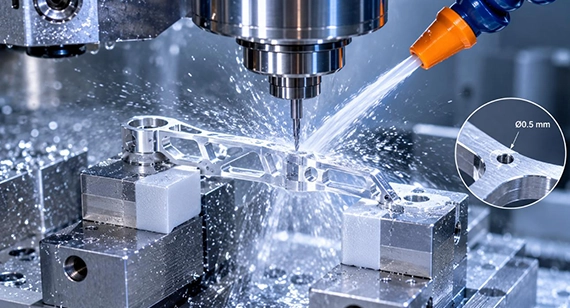
During CNC machining, the material affects not only cutting efficiency and tool life but also thin-wall deformation, micro-hole machining stability, and final dimensional consistency.
Aluminum and titanium alloys present different machining challenges. The process must be selected according to the component geometry and precision requirements.
1. Aluminum Machining Challenges: Thin-Wall Deformation and the Importance of Material Condition and Fixturing
6061-T6 offers good machinability and relatively high thermal conductivity, making it a common lightweight material for robotic finger skeletons and miniature housings.
However, when machining unsupported thin-wall structures with wall thicknesses of only 0.3–0.5 mm, machining stability is affected by the material's elastic modulus, component geometry, and fixture rigidity.
The lateral cutting forces generated by miniature tools can cause localized elastic deformation, resulting in dimensional deviations, thin-wall warping, or micro-hole position errors.
When a component combines high load-bearing requirements with complex thin-wall structures, 7075-T6 or 7075-T651 may also be considered.
Compared with 6061-T6, 7075 offers higher strength and hardness, but its elastic modulus is not significantly higher. Therefore, simply changing the material cannot solve every thin-wall deformation problem.
For certain high-load, space-constrained structures, Grade 5 titanium can also be evaluated.
Our CNC Machining Process Controls:
2. Titanium Machining Challenges: Concentrated Cutting Heat, Tool Wear, and Difficult Chip Evacuation
Titanium offers high strength and an excellent strength-to-weight ratio. However, its thermal conductivity is significantly lower than that of aluminum. During cutting, heat cannot be transferred away from the workpiece efficiently and tends to concentrate around the cutting edge and machining zone.
Titanium's tendency toward work hardening, chemical reactivity, and high cutting temperatures can also accelerate tool wear, adhesion, and the risk of micro-tool chipping.
For narrow cable-routing holes, miniature pin holes, and complex deep cavities inside dexterous robotic fingers, the available chip evacuation space is limited. Chips can easily accumulate inside the holes.
Insufficient cooling and chip evacuation can affect hole-wall surface quality and may even lead to tool breakage, out-of-tolerance holes, or scrapped components.
Therefore, titanium micro-machining requires stricter control over tool selection, cutting parameters, and cooling methods.
Process Controls:
3. DFM Recommendations for Dexterous Robotic Hand Prototyping
1. Do Not Rely Solely on Higher Material Strength to Prevent Thin-Wall Deformation
When the local wall thickness of a finger skeleton needs to be controlled within 0.3–0.5 mm, material condition, structural support, machining direction, and fixturing must all be considered.
6061, 7075, and Grade 5 titanium should be evaluated according to load requirements, geometric rigidity, and manufacturing feasibility. Higher material strength does not automatically make a component easier to machine.
2. Control the Aspect Ratio of Miniature Deep Holes
Cable-routing holes, pin holes, and miniature connecting holes inside titanium finger segments should avoid unnecessary depth wherever possible.
For micro-holes smaller than φ0.5 mm, the hole diameter, depth, chip evacuation space, and machining accessibility should be carefully evaluated during the design stage.
An L/D ratio of ≤4 can serve as an initial design reference for certain miniature drilling applications, although the actual limit depends on the tooling, material, and machining equipment.
3. Adopt a Hybrid Aluminum-Titanium Material Architecture
There is no need to manufacture an entire dexterous robotic hand or even a complete finger from titanium.
Materials can be assigned according to the function of each component. For example, 7075 aluminum can be used for lightweight finger skeletons and selected load-bearing housings because of its lower density and good machinability.
For miniature pins, connecting components, and transmission parts that are space-constrained, subject to high shear loads, or exposed to localized wear, Grade 5 titanium can be evaluated.
This hybrid material approach helps achieve a more reasonable balance between structural strength, rotational inertia, heat dissipation, machining yield, and BOM cost.
It is also important to consider galvanic corrosion between dissimilar metals, joint interface design, and differences in thermal expansion.
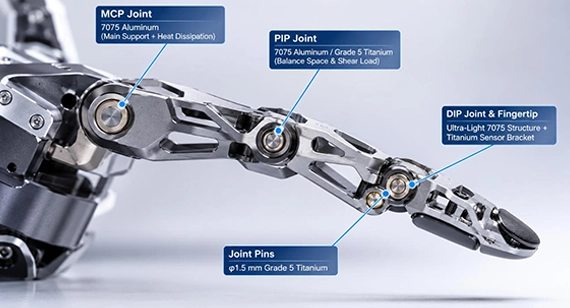
Recommendation: When aluminum alloys already meet the strength, rigidity, and fatigue life requirements of a finger component, switching to titanium solely to obtain higher material strength is generally unnecessary from a cost-effectiveness perspective. A more practical approach is to reserve titanium for localized components that genuinely require high load-bearing capacity, limited installation space, or special wear resistance. This helps control the overall manufacturing cost.
For dexterous robotic hand components with complex hollow structures, miniature channels, and precision mating surfaces, manufacturing costs are determined by several factors, including raw material procurement, CNC machining efficiency, tool consumption, post-processing, and quality control.
1. Raw Material Cost and Material Utilization
For lightweight finger bones that require extensive hollowing, deep-pocket machining, and complex contour cutting, the initial billet volume is often much larger than the final component volume. Material utilization may fall below 15%.
This means that a large amount of the purchased material eventually becomes machining chips. The higher procurement cost of titanium makes material waste an even more significant factor in the final unit cost.
2. CNC Machining Time and Tool Consumption
Compared with aluminum, titanium is generally machined at lower cutting speeds and requires greater attention to tool heat resistance, rigidity, and cutting parameter control.
For identical machining tasks involving miniature channels, thin-wall profiles, and complex surfaces, titanium often requires reduced cutting loads, optimized feed strategies, and additional machining stages. This increases machine occupancy time.
In addition, titanium's low thermal conductivity and work-hardening tendency increase the risk of tool wear and chipping. Tool replacement, broken-tool inspection, and additional dimensional checks can further increase manufacturing costs.
3. Surface Finishing and Quality Control Costs
Titanium components may require functional coatings such as PVD, while aluminum components commonly use anodizing or hard anodizing. The former is generally more expensive.
At the same time, miniature precision components require inspection of critical hole diameters, positional tolerances, concentricity, and surface quality.
The greater machining difficulty associated with titanium also increases the need for in-process inspection and nonconformance control.
Considering raw material waste, machine time, tool consumption, surface finishing, and quality control, the final unit cost of titanium precision finger components may reach approximately 2.5–4 times that of comparable aluminum components.
Balancing High-Speed Grasping Performance and Mass Production Costs for Commercial Humanoid Robotic Hands
A commercial humanoid robot developer was developing a new generation of high-dynamic dexterous robotic hands. The system needed to simulate human-like grasping, perform adaptive closed-loop gripping at frequencies above 20 Hz, and reliably handle objects of different shapes and sizes.
Challenges
The customer wanted to reduce the rotational inertia of the fingertips and finger joints while maintaining stable grasping during rapid opening and closing movements and coordinated multi-joint operations.
The design also needed to minimize object slippage and gripping deviation.
At the same time, six miniature coreless motors had to be integrated into the limited space inside the palm, while keeping manufacturing costs under control.
The main manufacturing challenge was balancing structural strength, motion responsiveness, gripping stability, motor heat dissipation, and overall cost.
Our CNC Manufacturing Solution
Testing and Results
After machining and assembly, the dexterous robotic hand passed its gripping performance tests. The complete hand achieved a maximum gripping payload of 5 kg, with a fingertip pinch force of approximately 10 N. During tests involving industrial components, everyday tools, and objects with different geometries, the overall adaptive dynamic grasping success rate exceeded 98%.
Furthermore, during a 20 Hz high-frequency reciprocating motion test, no significant increase in transmission backlash or joint looseness was observed. This verified the stability of the critical connecting structures under high-frequency operation.
By combining aluminum and titanium alloys, the solution balanced lightweight finger structures, joint connection strength, and motor heat dissipation while avoiding the high material and machining costs associated with an all-titanium design. According to the project's cost analysis, overall CNC manufacturing costs were reduced by approximately 62% compared with the all-titanium structural solution. This approach provided a manufacturing foundation that balances performance and cost for the subsequent mass production of dexterous robotic hands.
Lightweight design in titanium versus aluminum dexterous robotic hands is not simply about reducing overall weight. It also affects finger rotational inertia, joint response speed, drive load, and energy consumption. This article has compared aluminum and titanium alloys, including their typical grades, material properties, applications in robotic hands and finger components, and surface finishing requirements. It has also provided material selection recommendations that balance mechanical performance, system inertia, and manufacturing costs under different operating conditions. It is also important to understand that an entire dexterous robotic hand or its finger components do not need to be manufactured from a single material. For example, high-strength aluminum alloys can be used for heat-dissipating bases and load-bearing robotic hand structures, while precision titanium components can be incorporated into miniature, wear-prone moving mechanisms.
Are you facing material selection, manufacturing cost optimization, surface finishing compatibility, or thin-wall deformation challenges when developing custom CNC machined dexterous robotic hands and finger components? Contact our precision CNC machining engineering team for customized manufacturing solutions, a Design for Manufacturability (DFM) review, and a comparative evaluation of aluminum-titanium hybrid material options. [We support 2D Drawings (PDF files), 3D Drawings (IGS/STP/STEP files)].
Send your 2D drawings, 3D CAD models, candidate materials, load requirements, wall thicknesses, micro-hole features, heat-dissipation needs, surface finishes, critical tolerances, prototype quantity and production quantity. VMT will review aluminum-vs.-titanium material selection, DFM, micro-machining feasibility, thin-wall stability, coating compatibility, inspection and quotation requirements.
All information and uploaded files are secure and confidential.
1 Tell us what you need
2 Get solution & quote
3 Approve production
Email: inquiry@vimetal.com.cn
Q1: Why Might Proximal and Distal Finger Segments Use Different Materials in the Same Robotic Hand?
Q2: Why Are Aluminum Alloys More Commonly Considered for Motor Housings?
The main reason is their superior thermal conductivity.6061 aluminum has a thermal conductivity of approximately 167 W/m·K, compared with approximately 6.7 W/m·K for Grade 5 titanium. This is a difference of roughly 25 times.An aluminum housing can transfer heat generated by a miniature motor to the external structure more efficiently, helping reduce internal temperature rise.In comparison, titanium conducts heat much more slowly, making it less suitable when rapid heat transfer is required.Therefore, aluminum is generally a more economical and practical choice for miniature motor housings that need to provide both structural support and heat dissipation.
Q3: Why Are Titanium Alloys Worth Considering for Certain Miniature Joint Connectors?
Some miniature connecting components need to withstand relatively high forces within very limited space. For example, miniature hinges, transmission linkages, and pins may have dimensions smaller than 2 mm while being subjected to repeated loads during long-term operation. If material strength, surface wear resistance, or structural dimensions are not properly selected, problems such as hole wear, loose connections, or fatigue failure may occur. Titanium offers high strength and a good strength-to-weight ratio, making it suitable for selected high-load, space-constrained connecting components.
Q4: How Do You Choose Materials for MCP, PIP, and DIP Robotic Joints?
Q5: Which Material Is Easier to Machine for Miniature Robotic Components?
Aluminum alloys are generally easier to machine than titanium alloys in micro CNC machining applications.
Q6: What Is the Difference Between Heat Conductivity, Heat Dissipation, and Heat Resistance?
The technical information and manufacturing advice shared on the machining-custom.com website are for general guidance only. While we strive for accuracy, machining-custom.com does not guarantee that the processes, tolerances, or material properties mentioned are applicable to every specific project. Any reliance you place on such information is strictly at your own risk. It is the buyer's responsibility to provide definitive engineering specifications for any production orders. Final specifications and service terms shall be subject to the formal contract or quotation confirmed by both parties.


 +86 15099911516




 Read more