16 years one-stop China custom CNC machining parts factory

Hey there I’m VMT Sam!
With 25 years of CNC machining experience we are committed to helping clients overcome 10000 complex part-processing challenges all to contribute to a better life through intelligent manufacturing. Contact us now
 397 |
Published by VMT at Feb 09 2026 | Reading Time:About 2 minutes
397 |
Published by VMT at Feb 09 2026 | Reading Time:About 2 minutes


Of the many carbon and alloy steels available, both 5160 steel vs 1055 steel can be used to manufacture different sword or knife tools, general engineering parts like gears, sprockets, and couplings. But for medium carbon steel 1055(AISI 1055) with about 0.55% carbon content, it has high toughness and hardness with far better machinability while 5160 high-carbon alloy steel(AISI 5160) with about 0.6% carbon content and 0.8% chromium has higher toughness, hardness, and much better elasticity; and this is why 5160 steel also called spring steel. These "structural steel" or "steel for mechanical parts" are different from their chemical composition and then lead to properties, heat treatment, welding, machining differences although they share parts of same characteristics; and these are what this article is aiming at sharing.
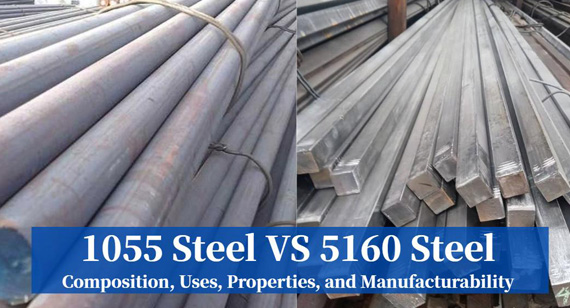
The biggest chemical differences between steel 1055 vs 5160 are carbon content which defines AISI 1055 as medium carbon steel and AISI 5160 as high carbon steel; Chromium content additionally adds to AISI 5160 making it also an alloy steel. And it’s the most significant difference that chromium element makes 5160 steel can achieve deeper and more uniform hardening(Hardenability is better );“spring” property is also caused by this. Below table details 1055 vs 5160 chemical composition:
Table 1: Chemical Composition of 1055 Steel vs 5160 Steel
| Element |
1055 Carbon Steel |
5160 Chromium Steel |
Impact on Properties |
| Carbon (C) |
0.50% – 0.60% | 0.56% – 0.64% | Increases hardness and tensile strength. |
| Chromium (Cr) |
— | 0.70% – 0.90% | Enhances toughness, wear resistance, and deep hardenability. |
| Manganese (Mn) |
0.60% – 0.90% | 0.75% – 1.00% | Improves hardenability and deoxidation during forging. |
| Silicon (Si) |
0.15% – 0.35% | 0.15% – 0.35% | Increases strength and heat resistance. |
| Phosphorus (P) |
≤ 0.040% | ≤ 0.035% | Impurity (kept low to prevent brittleness). |
| Sulfur (S) |
≤ 0.050% | ≤ 0.040% | Impurity (kept low to improve weldability). |
Elasticity Differences Between 1055 Steel vs. 5160 Steel
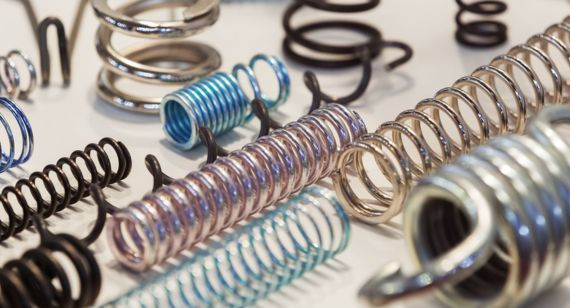
Elastic limit of 1055 steel vs 5160 steel is ~450 – 550 MPa and ~700 – 1200+ MPa respectively. This is the most significant mechanical distinction between the two grades.
(For a comprehensive properties data, you can check here: SAE-AISI 1055 Steel vs. SAE-AISI 5160 Steel)
Hardness Differences Between 1055 Steel vs. 5160 Steel
Hardness refers to a material's ability to resist surface indentation and abrasion.
Toughness Differences Between 1055 Steel vs. 5160 Steel
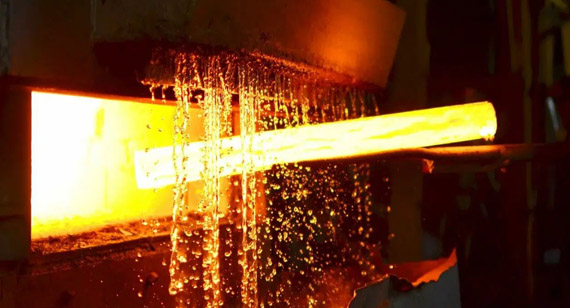
Toughness is the ability of the steel to absorb energy and resist fracturing under impact. Charpy V-Notch of 1055 steel vs. 5160 steel is ~15 – 25 J and ~30 – 50+ J respectively.
Strength Differences Between 1055 Steel vs. 5160 Steel
Tensile strength measures the resistance to being pulled apart, while yield strength is the point where deformation becomes permanent. Tensile strength of 1055 steel vs. 5160 steel is ~450– 550 MPa and ~1100–1250 MPa respectively. Yield strength of 1055 steel vs. 5160 steel is ~650 –750 MPa and ~1250–1400 MPa respectively.
Wear Resistance Differences Between 1055 Steel vs. 5160 Steel
Wear resistance determines how well a part stands up to friction and abrasive contact over time.
Fatigue Resistance Differences Between 1055 Steel vs. 5160 Steel
Fatigue resistance is the ability to withstand millions of cycles of loading and unloading without developing cracks.
From a production standpoint, the alloying elements—specifically the lack of alloys in 1055 versus the Chromium content in 5160—dictate significantly different handling requirements during CNC machining and thermal processing. Below tables shows matters needing attention of 1055 steel vs 5160 steel for your quick check:
Differences of Machinability and CNC Machining Performance
In their annealed state, 1055 vs 5160 steels respond differently to cutting tools. 1055 is generally more "user-friendly" for high-volume production in CNC machining(computer controlled process of cutting, milling, drilling a peice of material to the designed shape).
Table 2: Machinability and CNC Machining Performance of 1055 vs 5160 Steel
| Metric |
1055 Carbon Steel |
5160 Chromium Alloy Steel |
| Machinability Rating |
~60% (Based on AISI 1212) | ~55% |
| Cutting Characteristics |
Clean cutting with predictable chip formation. | Slightly "gummier" due to alloy content. |
| Tool Wear |
Low abrasion; extends the life of carbide inserts. | Higher; Chromium carbides accelerate tool edge wear. |
| Production Context |
Ideal for high-speed, cost-effective milling/turning. | Requires optimized feeds, speeds, and high-pressure cooling. |
Differences of Heat Treatment and Effects
Heat treatment (related to hardenability) is the most critical phase, as it transforms the soft annealed microstructure into a hardened state, defining the material's final Hardness, Yield Strength, and Elasticity.
Table 3: Heat Treatment and Effects of 1055 vs 5160 Steel
| Process Parameter |
1055 Carbon Steel |
5160 Chromium Alloy Steel |
| Quenching Media |
Highly Versatile: Can be quenched in water, brine, or oil. | Strictly Limited: Must be Oil-Quenched only. |
| Hardenability |
Shallow: Only the surface and near-surface layers harden fully. | Deep: Chromium ensures uniform hardness through thick sections. |
| Cracking Risk |
Low to Moderate (highest risk during water quenching). | High: Extremely prone to stress-cracking if quenched in water. |
| Primary Goal |
Maximizing surface hardness while maintaining a tough core. | Optimizing "Spring Memory" and high fatigue resistance. |
| Feature |
1055 After Heat Treat | 5160 After Heat Treat |
| Microstructure |
Hard surface / Tough core | Consistent Martensite throughout |
| Risk of Failure |
Higher risk of quench cracks in water | Lower risk; very stable in oil |
| Mechanical Goal |
Impact Resistance (absorbing hits) | Resilience (returning to shape) |
| CNC Precision |
Post-quench grinding often needed | Better dimensional accuracy retention |
Fabrication Differences: Forging and Welding
In terms of forging and welding performance, 1055 steel outperforms 5160 steel, primarily because the chromium in 5160 steel significantly increases its hardening tendency.
Table 3: Forging and Welding of 1055 vs 5160 Steel
| Processing |
1055 Carbon Steel |
5160 Chromium Alloy Steel |
| Forging |
Excellent; wide temperature range and easy to shape. | Good; requires tighter temperature control to prevent overheating. |
| Welding |
Fair; requires pre-heating to prevent localized brittleness. | Difficult; necessitates pre-heating and immediate post-weld stress relief. |
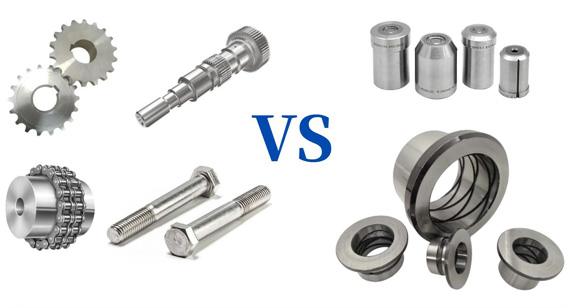
While both steels are famous in the cutlery world for blades and swords, their engineering value is found in heavy industry and precision machinery, for example:
AISI 1055 Applications
AISI 5160 Applications
Choosing between 1055 and 5160 usually comes down to the specific mechanical demands of the application and the production budget.
Choose 1055 Carbon Steel if:
Choose 5160 Spring Steel if:
In summary, 1055 steel is the ideal choice for high-impact, budget-friendly industrial components, while 5160 steel remains a better choice for applications requiring high fatigue limits and resilient elasticity. Understanding their properties, composition, manufacturing and uses’ differences ensures that your material selection aligns perfectly with your engineering goals.

Technical Challenges in Machining 1055 Steel
In this project for the agricultural machinery sector, VMT was tasked with producing 1,200 drive shaft sleeves using AISI 1055 medium carbon steel. The primary technical hurdle was achieving a surface roughness of Ra 0.8 μm on the outer diameter for bearing press-fitting, as the "gummy" nature of annealed 1055 often leads to surface tearing. Additionally, the process required strict concentricity of ±0.03mm even after induction hardening, a stage where 1055 is notoriously prone to thermal warping and volumetric expansion. Standard carbide tooling also faced rapid crater wear due to the high heat generated during high-volume cutting of this mid-carbon grade.
VMT Precision Solutions and Process Optimization
To address these challenges, VMT implemented a specialized two-stage machining strategy. We transitioned to TiAlN-coated cermet inserts at an optimized cutting speed of 180 m/min, which effectively eliminated built-up edge (BUE) and secured the required Ra 0.8 μm finish during the initial phase. Following induction hardening to HRC 52-55, we utilized Hard Turning with CBN (Cubic Boron Nitride) tools to correct a 0.5mm allowance, compensating for quench distortion to reach a final tolerance of ±0.01mm. A 70-bar high-pressure through-spindle cooling system was integrated to stabilize temperatures and prevent work-hardening throughout the production run.
Quantitative Production Results
The technical implementation yielded significant measurable improvements in both quality and cost-efficiency. VMT achieved a consistent surface finish of Ra 0.6 – 0.8 μm, eliminating secondary grinding and reducing total production costs by 15%. Final concentricity was maintained at 0.025mm, successfully exceeding the client's original tolerance requirements. By optimizing the cycle time from 8.5 to 6.2 minutes, we realized a 27% improvement in efficiency, while the total scrap rate was strictly controlled at 0.4% despite the complexities of the heat-treatment deformation.
What is 1055 steel good for?
AISI 1055 is a medium-to-high carbon steel valued for its balance of toughness and wear resistance. It is commonly used for heavy-duty tools that must withstand impact, such as hammers, axes, agricultural machinery parts, and large blades like machetes.
What steel is better than 5160?
"Better" depends on the specific requirement; however, 80CrV2 is often considered a superior modern alternative because it offers the extreme toughness of 5160 but with better edge retention. For even higher shock resistance in industrial applications, S7 tool steel is often preferred, though it is much more difficult to heat treat.
Is 1055 high carbon steel good for swords?
Yes, 1055 is an excellent choice for functional, "beater" swords because it is highly resistant to chipping and breaking under heavy impact. While it does not hold an edge as long as 1095, its superior flexibility and durability make it ideal for large blades that may strike hard targets.
Does 1055 and 5160 steel rust?
Yes, both 1055 and 5160 are not stainless steels and will rust or patina if exposed to moisture, sweat, or humid air. To prevent corrosion, blades made from these materials must be kept clean, dry, and coated with a thin layer of protective oil or protective coatings(Electropolishing, Powder Coating,Galvanizing, Black Oxide are the options).
What is equivalent to AISI 5160 steel?
Common international equivalents to AISI 1055 include the European C55 (1.0535), the Japanese S55C, the Chinese 55# steel, the British 070M55, the Russian GOST 55, and the German Ck55, all of which are functionally identical medium-high carbon steels with an approximate carbon content of 0.50% to 0.60%.
What is equivalent to AISI 1055 steel?
For AISI 5160, the most recognized global equivalents are the European 56Si7 (1.7176), the British En45A, the Chinese 60CrMn, the Japanese SUP9, the Russian 60KhG, and the French AFNOR 55C3, all classified as high-performance spring steels favored for their superior fatigue limit and shock-absorbing capabilities.


 +86 15099911516




 Read more