16 years one-stop China custom CNC machining parts factory

Hey there I’m VMT Sam!
With 25 years of CNC machining experience we are committed to helping clients overcome 10000 complex part-processing challenges all to contribute to a better life through intelligent manufacturing. Contact us now
 128 |
Published by VMT at Jun 02 2026 | Reading Time:About 3 minutes
128 |
Published by VMT at Jun 02 2026 | Reading Time:About 3 minutes


If you have a custom lens barrel that needs to be put into production, and the requirements for precision, geometric details, material, and appearance (black) have all been designed, how should you decide on the "blackening" matte treatment for the inner wall on the drawing? Visual blackness is not the key; "no reflection" is. This means that any faint stray light reflected on the inner wall or generated inside the lens barrel will not only cause image-destroying ghosting and flare and reduce image contrast, but will also cause the MTF curve of the edge imaging to slide down(MTF demonstrates the lens's ability to reproduce object resolution and contrast between light and dark areas; the flatter the curve, the closer it is to 1.0 at the top of the chart).
To avoid this stray light, the two most commonly used surface treatment processes in the industry are: Black Anodizing and Black Oxide.
From the appearance, both processes can give the metal surface a deep black color. However, for the inner wall of the lens barrel, which has strict requirements for light reflectance, the actual performance of the two differs in light absorption performance, dimensional change, and wear resistance, and they have different adaptability for lens barrels of different materials. In this guide, we will analyze the differences between the application of black anodizing and black oxide on the inner wall of the lens barrel, and help you determine which surface treatment process is best suited for your next optical CNC machining parts project.
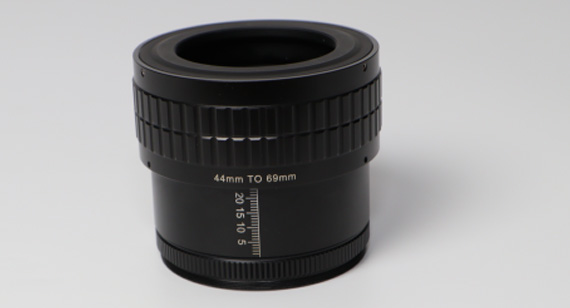
Black anodizing is not a coating that sits on top of the metal — it is an electrochemical process that converts the aluminum surface itself into a controlled, porous layer of aluminum oxide . Think of it as growing a hard, black ceramic-like skin outward from the original aluminum surface, rather than painting or plating something onto it.
The five-stage process:
Result: A hard, wear-resistant black layer 10–25 μm thick, integral to the metal. It will not peel, flake, or chip the way paint or plating can.
A standard glossy black anodized surface absorbs 97–99% of visible light at normal incidence (light hitting straight-on), meaning it still reflects 1–3%. For an external housing or mechanical bracket, that is a small number. For the internal bore of a lens barrel, it is not:
Light entering a lens barrel does not hit the inner wall head-on. It arrives at shallow, grazing angles — sometimes as low as 5–15 degrees from the wall surface. At these angles, the effective reflectance of any surface goes up. A photon glancing off the wall may bounce four, five, six times along the barrel before reaching the sensor or being absorbed. At 97% absorption per bounce, after six bounces roughly 83% of the stray light is still traveling. Some fraction of it inevitably reaches the sensor as veiling glare — a wash of light that lifts the black level and steals contrast from fine details.
This is what separates matte black anodizing from standard black anodizing:
Bead blasting before anodizing creates a controlled micro-roughness on the aluminum surface — breaking up the mirror-like plane so light scatters instead of reflecting specularly.
After dyeing, a matte seal (instead of a glossy seal) locks in the color without adding surface shine.
The combined result: reflectance drops to ≤0.5% across the visible spectrum, and critically, this performance holds at grazing incidence — not just straight-on.
Visual black vs. optical black: Matte instead of glossy, textured instead of smooth — that single process decision is the dividing line.
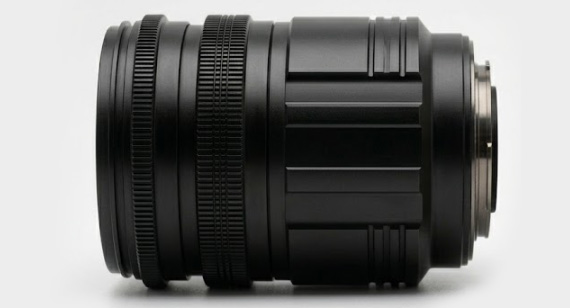
Black oxide is a chemical conversion coating — it chemically reacts with the metal's own surface atoms to form a surface compound, without building significant thickness. Unlike anodizing, it does not grow a new layer outward.
Compatible metals:
Ferrous metals (carbon steel, alloy steel, stainless steel) and copper-based alloys (brass, bronze). Not compatible with aluminum.
The process:
Black oxide produces a satin, semi-matte black — professional-looking for external mechanical components. But four inherent properties make it unsuitable for controlling stray light inside precision optical barrels:
| Feature |
How It Behaves |
Why It Fails Optics |
| No Independent Texture |
The chemical reaction is micro-thin 0.5–1 μm. It follows the existing machining marks exactly without smoothing them over. | Tool marks act like tiny mirrors. At shallow angles, these grooves create structured flare and bright lines on your image sensor. |
| High Reflectance |
It reflects 3–5% of visible light, and jumps to 5–10% in Near-Infrared (NIR) light. | This is 10 times higher than matte anodizing. It cannot absorb enough light to prevent ghosting, especially for infrared or night-vision lenses. |
| Required Oil/Wax Seal |
Black oxide requires an oil or wax post-treatment to prevent rust and look deep black. | These oils will gradually outgas over time inside a sealed lens. The vapor condenses on the glass lenses, creating a permanent, ruinous haze. |
| Too Thin to Submerge Flaws |
At less than 1 μm thick, it cannot hide any minor machining chatters or scratches. | Any tiny surface defect remains exposed and acts as a reflection point for stray light. (In comparison, anodizing is 10-25 μm thick and hides these flaws). |
Where black oxide does belong: Threaded adjustment rings, external focus helicals, aperture rings — mechanical surfaces where the priority is a professional satin-black appearance, dimensional neutrality, and low cost. It simply was never designed to solve sub-percent reflectance at grazing incidence inside an imaging system.
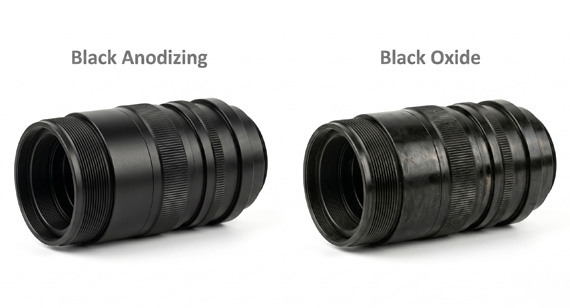
Measured data from production parts across eleven performance dimensions:
| Performance Dimension |
Matte Black Anodizing |
Black Oxide(Can’t Adjust Matte; Based on Metal) |
| Visible reflectance (450–700 nm) |
≤0.5% | 3–5% |
| NIR reflectance (850 nm) |
≤0.5% | 5–10% |
| Coating thickness |
10–25 μm (controllable) | 0.5–1 μm |
| Dimensional change per surface |
~7–8 μm outward growth (compensate at machining stage) | Negligible |
| Compatible base metals |
Aluminum alloys: eg. 6061, 6063, 7075*, 6082, most wrought Al grades | Carbon steel, alloy steel, stainless steel, brass, bronze |
| Surface texture control |
Full: bead-blast media, pressure, dwell time tune Ra from ~0.8 to ~3.0 μm | None: follows existing machined surface exactly |
| Wear resistance |
High — Al₂O₃ hardness 400–500 HV (comparable to hardened tool steel) | Low — depends entirely on oil/wax seal |
| Corrosion resistance |
Excellent — sealed ceramic barrier, chemically inert | Moderate — oil/wax seal degrades with thermal cycling and time |
| Outgassing risk |
Zero — entirely inorganic | Non-zero — post-process sealant contains volatile organics |
| Color uniformity (batch ΔE) |
Excellent — ΔE <1 with stable process control | Moderate — bath chemistry drift, sealant variability |
| Relative cost (prototype, ~10–50 pcs) |
Moderate | Lower |
| Relative cost (production, >1,000 pcs) |
Comparable (automated; cycle time dominates) | Comparable (lower chemical cost, more QC steps) |
7075: see material note above — charcoal tone, not true black.
The pattern is clear. Black anodizing dominates every optical and durability dimension. Black oxide wins on one dimension — dimensional change — and even that only matters when a design genuinely cannot absorb a predictable 7–8 μm of surface growth. For most lens barrels, that is a machining parameter, not a design constraint.
The selection between these two surface treatments depends on three primary engineering vectors: substrate material compatibility, optical performance requirements, and dimensional tolerances.
Choose Matte Black Anodizing When:
Choose Black Oxide When:
Technical Trade-Off: The Stainless Steel Lens Barrel
A specific engineering challenge arises when a lens barrel strictly requires stainless steel due to environmental constraints, such as CTE (Coefficient of Thermal Expansion) matching with low-expansion optical glass, vacuum compatibility, or repeated autoclave sterilization.
Because stainless steel cannot be anodized, black oxide is frequently considered the default alternative. However, black oxide on stainless steel typically yields a reflectance of 5% or higher, which is insufficient for stray light suppression within an optical cavity.
Recommended Engineering Workflow:
A machine vision integrator approached VMT in early 2025 with a problem that had already burned two months of their engineering team's time. Their inline inspection camera — used to detect sub-millimeter surface defects on polished metal parts — was producing images where the edges of the field were consistently soft.
The numbers: MTF at 80% image field radius was running 30% lower than at center. In defect detection, that means either missed defects (false negatives) or a reduced inspection area (slower throughput, killing the automation line's ROI).
The lens design had already been ruled out — the same prescription in a reference housing performed to spec. Sensor alignment and calibration were also cleared. The variable that remained was the barrel.
What they had been using: 6061 aluminum barrels from a general-precision CNC shop. Every dimensional tolerance met the drawing: bore diameters, concentricity, thread fit, surface roughness — all in spec. But the finish was called out simply as "black anodize" — no mention of matte, no reflectance spec, no post-anodizing optical verification. The shop delivered standard glossy black barrels that "looked black" to the eye.
What Changed — and Why Each Step Mattered
| Step |
Action |
Why It Mattered |
| 1. Bead blasting |
180-grit glass bead, 60 PSI, four orientations, 15s each. Internal bore Ra 1.2–1.6 μm. | The original shop only did an alkaline etch — it cleans but doesn't change surface texture. Controlled blasting creates the matte topography that scatters light. |
| 2. Matte anodizing |
Black dye + matte seal (no glossy nickel acetate). Target thickness 15 ± 3 μm, verified on a process coupon. | Standard glossy sealing adds surface shine. A matte seal locks the color without adding gloss — the difference between a barrel wall that scatters stray light and one that channels it. |
| 3. Reflectance verification |
Every barrel tested with a spectrophotometer at 660 nm, probe at 45° to the bore surface. Acceptance: ≤0.5%. | 45° incidence approximates grazing conditions inside an assembled lens. The original shop's visual check couldn't catch a 3% reflector. |
Result: MTF at 80% field radius recovered from 70% of center to 92% of center — a 22-percentage-point improvement in edge contrast. No change to the lens prescription, no tighter machining tolerances, no different alloy. The improvement came entirely from keeping stray photons from reaching the sensor.
Aluminum part + optical performance on the line → matte black anodizing. The process has depth — bead blasting parameters, dye bath chemistry, sealing agent selection — and when each variable is controlled, the barrel anti-reflection effectively disappears from the optical path.
Steel or brass part + thin, dimensionally neutral dark finish → black oxide. It fills that role well. Just do not ask it to solve a problem it was never built to solve( peformed less well for internal lens barrel anti-reflection).
For more technical inquiries or to request a quote for your custom optical components, feel free to contact VMT CNC Machining Factory. Our engineering team is ready to assist you and will respond within 24 hours.
【For learning about more comprehensive information about camera lens parts manufacturing, welcome to click and read our technical white paper: The Ultimate Guide to High-Precision Camera Lens Parts Manufacturing. 】

Can I use black anodizing on steel lens components?
No, anodizing is an electrochemical process exclusive to non-ferrous metals, primarily aluminum. For steel lens components, you must use treatments like black oxide, zinc plating, or specialized optical paintings.
Why does black oxide sometimes look oily or shiny?
Black oxide provides poor natural corrosion resistance, meaning it requires a post-treatment oil or wax seal to prevent rust. This oil layer creates a glossy sheen that increases surface reflectance and can cause outgassing inside a lens.
Can you make black anodizing completely matte for optical use?
Yes, by introducing mechanical sandblasting or bead blasting before the anodizing process, you create a micro-rough surface texture. This breaks up mirror-like reflections, resulting in a completely matte, diffuse "optical black" finish.
Can 7075 aluminum be anodized matte black?
7075 aluminum can be anodized, but it cannot achieve a true deep black. Its zinc content (5.1–6.1%) produces an oxide layer with a grayish-black tone. For optical systems where pure black matters, use 6061 aluminum or 6063 aluminum. If you're designing with 7075 for its strength, and optical appearance is secondary (e.g., a structural housing rather than an internal barrel), it's workable — just expect a charcoal tone, not jet black.
Does black anodizing wear off inside a lens barrel?
No — not under normal use. Black anodizing is an integral ceramic layer, not a coating. The dye sits inside sealed pores within the aluminum oxide. It won't peel, flake, or rub off. Threaded interfaces that see repeated assembly/disassembly can show some wear over hundreds of cycles, but for a lens barrel that's assembled once and stays assembled, anodizing is permanent.
How much does matte black anodizing cost compared to standard black anodizing?
Matte black anodizing typically adds 15–25% to the finishing cost over standard glossy black anodizing. The extra steps — bead blasting, chemical micro-etch, dual-component dye, matte sealant — account for this. For most optical projects, the cost difference is small compared to the performance gain. A barrel that causes a 30% MTF loss at the edge of frame costs far more in system performance than any finishing upgrade.
The technical information and manufacturing advice shared on the VMT website are for general guidance only. While we strive for accuracy, VMT does not guarantee that the processes, tolerances, or material properties mentioned are applicable to every specific project. Any reliance you place on such information is strictly at your own risk. It is the buyer's responsibility to provide definitive engineering specifications for any production orders. Final specifications and service terms shall be subject to the formal contract or quotation confirmed by both parties.


 +86 15099911516




 Read more