16 years one-stop China custom CNC machining parts factory

Hey there I’m VMT Sam!
With 25 years of CNC machining experience we are committed to helping clients overcome 10000 complex part-processing challenges all to contribute to a better life through intelligent manufacturing. Contact us now
 117 |
Published by VMT at Apr 06 2026 | Reading Time:About 2 minutes
117 |
Published by VMT at Apr 06 2026 | Reading Time:About 2 minutes


416 stainless steel is a free-machining steel with a machinability rating of 85%, making it ideal for CNC machining various parts such as fasteners, gears, and internal electromagnetic valve shafts. Its core characteristics are:
If you need to view the detailed characteristics of 416 stainless steel, you can check out our previous blog 416 stainless steel properties. If you also want to know its specific chemical composition, equivalent names, and a comparison with 316, you can check out this blog 416 vs 316 stainless steel.
This article will only list the most comprehensive CNC machined 416 stainless steel parts categorized by different industries for your quick review and selection.
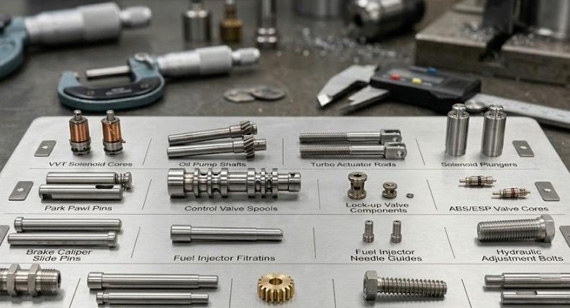
(Note: CNC machining is a process that produces various tool paths for a machine based on a custom part's drawing design, performing cutting, drilling, turning, milling, and grinding on a piece of stainless steel to ultimately obtain high-precision parts in the shape you need.)
In the automotive sector, AISI 416 is the preferred choice for high-volume CNC machined precision components that require a balance of high machinability, specific magnetic properties, and moderate corrosion resistance.
| System |
Components |
Technical Requirements & CNC Challenges |
| Engine & Powertrain |
VVT Solenoid Cores | High tolerances (±0.01mm), deep-hole drilling, and high surface finish. |
| Oil Pump Shafts | ||
| Tensioner Pins | ||
| Turbo Actuator Rods | ||
| Transmission System |
Solenoid Plungers | High-precision Swiss machining, mirror-finish grinding, and complex stepped surfaces. |
| Park Pawl Pins | ||
| Control Valve Spools | ||
| Lock-up Valve Components | ||
| Braking & Steering |
ABS/ESP Valve Cores | Mass production (millions of units), high thread strength, and extreme wear resistance. |
| Hydraulic Adjustment Bolts | ||
| Brake Caliper Slide Pins | ||
| Fuel & Induction |
Fuel Injector Needle Guides | Micro-hole drilling (<1mm), high-volume turning, and secondary milling. |
| Fuel Rail Connectors | ||
| Throttle Shafts | ||
| Motors & Actuators |
Seat Adjustment Worm Gears | High length-to-diameter ratios, smooth thread profiles, and atmospheric corrosion resistance. |
| Power Tailgate Screws | ||
| Wiper Motor Shafts |
Unless your design specifically requires unique magnetic properties, 416 stainless steel should be avoided for electronic components.
| Risk Factor |
Reason |
| Electromagnetic Interference (EMI) |
Due to its strong magnetic properties, 416 can interfere with sensors, electronic compasses, or high-frequency signal transmissions on a PCB. |
| Chemical Instability |
In standard Salt Spray Tests common in the electronics industry, 416’s rust resistance is far inferior to 304 or 316. This often leads to unsightly "yellow spots" (corrosion) on aesthetic parts. |
| Surface Treatment Limitations |
The high sulfur content in 416 makes it problematic for electroplating (such as gold or nickel plating, which is usually for electronics). It is highly prone to "pinholes" or plating peeling/delamination. |
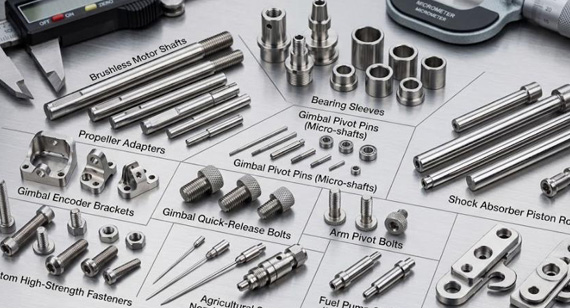
In the drone and UAV sector, AISI 416 is an excellent metal for CNC machining, particularly for components that require high-precision machining, excellent surface finish, and dynamic balance, such as high-RPM brushless motors and gimbal stabilization systems.
| Category |
Components |
Technical Requirements & CNC Challenges |
| Propulsion & Motor Systems |
Brushless Motor Shafts | Highest possible high-speed (RPM), straightness (<0.01mm), surface roughness (Ra 0.4), dynamic balance, and thin-wall stability. |
| Propeller Adapters | ||
| Bearing Sleeves | ||
| Gimbal Pivot Pins (Micro-shafts) | ||
| Gimbal & Camera Systems |
Gimbal Encoder Brackets | Micro-turning (1.5mm - 3mm diameter), complex geometries with thin walls, multi-hole side milling, and high thread wear resistance. |
| Gimbal Quick-Release Bolts | ||
| Arm Pivot Bolts | ||
| Airframe & Folding Mechanisms |
Shock Absorber Piston Rods | High shear stress, instantaneous impact force during takeoff/landing, precision outside diameter (OD) grinding, and massive production volumes. |
| Custom High-Strength Fasteners | ||
| Agricultural Spray Nozzle Needle Valves | ||
| Industrial & Specialized UAV Parts |
Fuel Pump Shafts (for gas drones) | Precision flow control for chemical liquids, complex oil passage machining, and frequent loading/unloading operations. |
| Payload Hook Sliders | ||
| Brushless Motor Shafts |
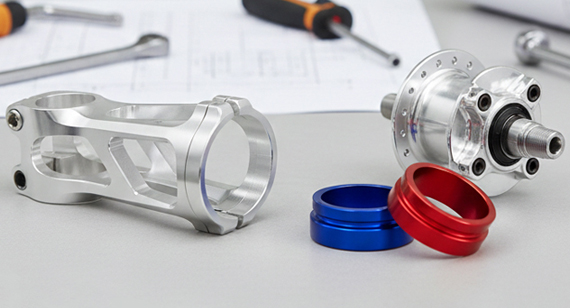
In the bicycle sectors, 416 stainless steel is favored for drivetrain and shifting components where high strength and clean thread cutting are vital for performance.
| Category |
Components |
Technical Requirements & CNC Challenges |
| Drivetrain & Hubs |
Freehub Spindles | Requires high concentricity (±0.01mm) to ensure smooth rotation; 416 allows for high-speed Swiss turning of complex internal steps. |
| Pedal Spindles | Needs to withstand high cyclical fatigue; 416 can be heat-treated to HRC 35-40 to prevent bending under heavy rider weight. | |
| Shifting Systems |
Derailleur Linkage Pins | Micro-diameter turning (2mm - 4mm); 416’s superior chip breaking ensures no tool entanglement during 24/7 automated production. |
| Cable Tensioner Screws | Precision threading (M4/M5); the free-machining nature of 416 prevents "galling" which is common in 304/316 alloys. | |
| Suspension |
Shock Absorber Internal Valve Shims | Requires extreme flatness and burr-free edges after CNC milling to ensure precise oil flow control. |
| Suspension Pivot Bolts | High shear strength requirements; 416’s ability to be hardened and tempered provides the perfect balance of stiffness and impact resistance. | |
| Braking Systems |
Hydraulic Brake Piston Actuators | Demands a high surface finish (Ra 0.4) to prevent O-ring wear and ensure a perfect hydraulic seal. |
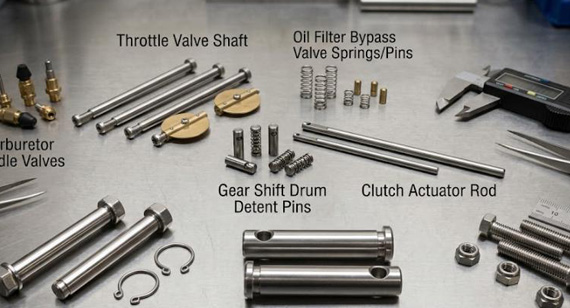
Motorcycles operate in a high-vibration, high-heat environment. 416 SS is used where carbon steel would fail due to corrosion and where 304 SS or 316SS is too soft for mechanical wear.
| System |
Components |
Technical Requirements & CNC Challenges |
| Fuel & Engine |
Carburetor Needle Valves | Requires a mirror finish (Ra 0.4) via CNC grinding to ensure perfect fuel atomization and zero leakage. |
| Throttle Valve Shafts | Thin-walled sections with milled flats; 416 maintains its straightness better than carbon steel during aggressive milling. | |
| Oil Filter Bypass Valve Springs/Pins | 416 offers moderate heat resistance and maintains its spring-like tension after specific tempering cycles. | |
| Transmission |
Gear Shift Drum Detent Pins | Subjected to constant mechanical clicking/impact; 416’s high surface hardness after quenching (HRC 42+) prevents "mushrooming." |
| Clutch Actuator Rods | Long-ratio turning (L/D > 15); 416's 85% machinability rating reduces vibration-induced chatter marks on the shaft. | |
| Chassis & Braking |
Brake Caliper Sliding Pins | High surface hardness is required to resist wear; 416 is ideal for induction hardening to reach HRC 40+. |
| Chain Adjuster Bolts | High torque resistance; 416 provides significantly better corrosion resistance than zinc-plated steel in "dry" outdoor conditions. | |
| Footpeg Pivot Pins | Requires high shear strength to support rider weight during maneuvers; 416's toughness is optimized via high-temperature tempering. |
416 SS is the go-to for parts that interact with magnets or require the high level of dimensional stability over time.
| Category |
Components |
Requirements & CNC Challenges |
| Actuators & Gears |
Servo Motor Output Shafts | 416 offers 85% machinability, allowing for high-speed hobbing of gears and splines with minimal tool wear. |
| Linear Guide Slider Pins | Needs high surface smoothness; 416 is easily ground to high precision to reduce friction in robotic sliding mechanisms. | |
| Ball Screw End Supports | Requires precise bearing fit tolerances; 416's low internal stress ensures holes don't "shrink" after machining. | |
| Sensors & Feedback |
Magnetic Encoder Discs | 416 is ferromagnetic, making it an excellent material for target wheels in speed and position sensors. |
| Magnetic Sensor Housings | Utilizes 416’s magnetic properties to shield or interact with Hall-effect sensors while providing structural protection. | |
| End-Effectors (EOAT) |
Pneumatic Gripper Fingers | Complex 5-axis milling; the material’s stable internal stress ensures the fingers don't warp after heavy material removal. |
| Quick-Change Tooling Locking Pins | Must resist deformation under repeated locking cycles; 416 can be hardened to HRC 45 for maximum wear life. | |
| Structural Joints |
Robotic Arm Linkage Bushings | Provides a hard-wearing interface for high-frequency rotational movement without the need for frequent lubrication. |
416 stainless steel should generally be avoided for any components directly exposed to saltwater or high-chloride environments.
| Risk |
Reason |
| Pitting Corrosion |
The high sulfur content (manganese sulfide inclusions) acts as a focal point for pitting. In seawater, 416 can show visible rust in less than 48 hours. |
| Stress Corrosion Cracking |
Under high-load marine conditions, 416’s martensitic structure is susceptible to brittle failure when exposed to chloride ions. |
| Alternative |
For marine uses, stainless steel AISI 316L or Duplex 2205, Super Duplex 2507 are better for your products |
416 stainless steel is considered a “difficult to weld" grade.
| Risk Factor |
Reason |
| Hot Cracking |
The sulfur added for machinability creates low-melting-point eutectics at the grain boundaries, causing the weld to crack as it cools. |
| Extreme Brittleness |
Rapid cooling in the Heat Affected Zone (HAZ) creates an untempered martensite structure, leading to "glass-like" brittle fractures under minimal stress. |
| Cost Implication |
Welding 416 requires intense pre-heating and post-weld heat treatment (PWHT), which often negates any cost savings gained from its easy machinability. |
The choice of 416 stainless steel for CNC machining is a clear decision for high-efficiency precision products manufacturing. If your project requires high-volume production, adjustable hardness and strength after heat treatment, and magnetic functionality, 416 SS offers cost- friendly than many other stainless alloys. However, always consider 304, 316 if your parts are submerged in mild corrosive conditions or require extensive welding.
Request for a Quote— Your Custom 416 Stainless Steel CNC Machined Parts
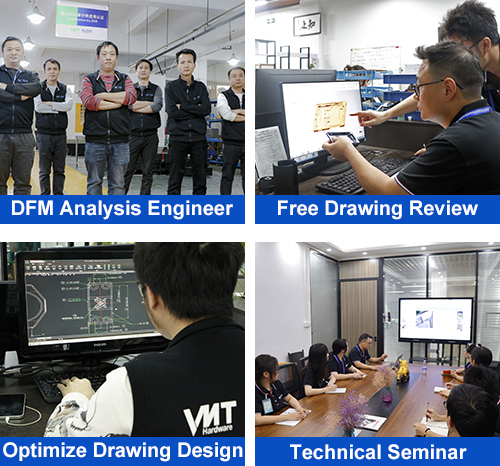
Do you have a project requiring the high-speed precision of 416 Stainless Steel? Whether it is for automotive solenoid valves, high-RPM drone motor shafts, or industrial robotic actuators, welcome to contact us VMT CNC Machining Factory. Our engineering team provides a technical review and will reply to you within 24 hours.



 +86 15099911516




 Read more