16 years one-stop China custom CNC machining parts factory

Hey there I’m VMT Sam!
With 25 years of CNC machining experience we are committed to helping clients overcome 10000 complex part-processing challenges all to contribute to a better life through intelligent manufacturing. Contact us now
 222 |
Published by VMT at Apr 04 2026 | Reading Time:About 2 minutes
222 |
Published by VMT at Apr 04 2026 | Reading Time:About 2 minutes


Thanks to aluminum' lightweight and good strength property (some grades), it is widely popular for electronic, motorcycle, automotive, UAV, and even aerospace precision components. While commercial grade like 2024 aluminum, which is highly recommended for its high-cycle fatigue, or 7075 aluminum for its max strength under high pressure, these aluminums have more advanced versions to their iron or silicon content for better aerospace performance. This is where AMS (Aerospace Material Specification) comes into play.
Originally established and currently maintained by SAE International (formerly the Society of Automotive Engineers), AMS standards are quite important for materials' purity, consistency, and reliability. But for this article, we only discuss the AMS standards for aluminum, and how these metal plays a role in CNC machining applications.
1.AMS 4037 ——Iron (Fe) is restricted to <0.30% (vs 0.50% in Common)
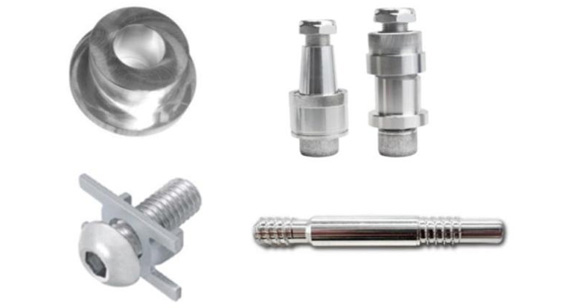
This is specifically for gaining 2024 aluminum plates' better fatigue-resistant property. Change of the chemical is Iron (Fe) is strictly restricted to <0.30% (compared to 0.50% in standard ASTM B209)——high iron content creates coarse "intermetallic" particles that act as internal stress concentrators. By lowering the Iron, AMS 4037 2024-T3 significantly improves fatigue crack growth resistance.
aircraft skins, wing tension members, and fuselage structures where the metal must survive millions of vibration cycles without cracking, and small CNC machined precision parts like small brackets, stress joints and bushings, miniature supports, these are what you can use AMS 4037 2024 aluminum plates made into.
2.AMS 4027 —— Magnesium (Mg) and Silicon (Si) Control
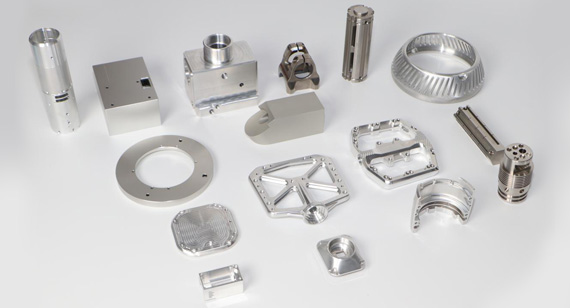
This is specifically for gaining 6061-T6 aluminum's better process consistency and predictable strength. AMS 4027 tightens the allowable range for Magnesium (0.8–1.2%) and Silicon (0.4–0.8%) compared to the wider ranges in ASTM B221(commercial 6061). It also limits Titanium (Ti) to lower 0.15%.
Standard 6061-t6 can vary in strength between batches while AMS 4027 can definitely avoid this——limited composition allows the metal to form hardening phase perfectly, ensuring predictable spring-back and dimensional stability during high-speed cutting. You can use AMS 4027 6061 aluminum for hydraulic manifolds, internal brackets, and manifold blocks where consistent thread strength and leak-proof surfaces are important.
3.AMS 4045——Chromium (Cr) and Zinc (Zn) Control
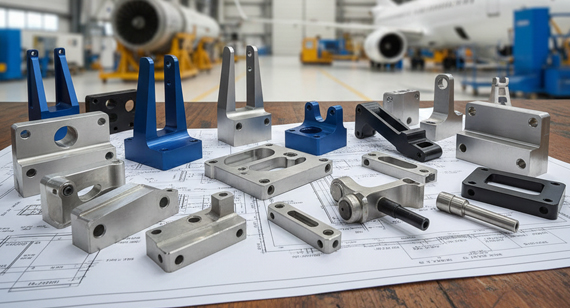
This is specifically for gaining 7075-T6 aluminum's maximum structural strength and fracture toughness——Chromium (Cr) is strictly locked between 0.18% - 0.28%, and Zinc is held to a tighter 5.1% - 6.1% range (narrower than ASTM B247).
In 7075 aluminum, Chromium is closely connected with resisting Stress Corrosion Cracking (SCC). If Cr is too low, the part fails in humid air; if too high, the metal becomes brittle. AMS 4045 ensures the alloy hits the best point of being incredibly strong without becoming prone to sudden, brittle fractures. You can use it for structural bulkheads, landing gear components, wing spars, and high-stress aerospace fasteners hinge assemblies and load-bearing ribs.
4.AMS 4108 —— Trace Zirconium (Zr) Addition
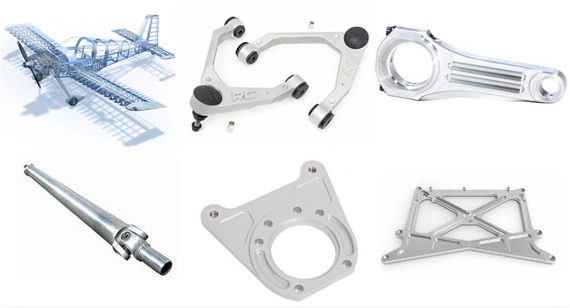
This is specifically for gaining 7050-T7451 aluminum's superior performance in thick sections (quench sensitivity)——AMS 4108 requires a specific addition of Zirconium (Zr) (0.08% - 0.15%) while keeping Iron and Silicon extremely low.
Zirconium creates a much finer grain structure than Chromium. This allows thick blocks of 7050 to maintain high strength all the way to the core of the material. It prevents the "inner softness" often found in thick 7075 plates, making it much safer for large, deep-pocketed parts.
Therefore, if you are manufacturing a large part out of a thick billet, AMS 4108 is the standard you need to ensure the center of the part is as strong as the surface——crucial for large structural frames, wing attachment fittings, and main spar caps.
5.AMS 4015 —— Beryllium (Be) Control
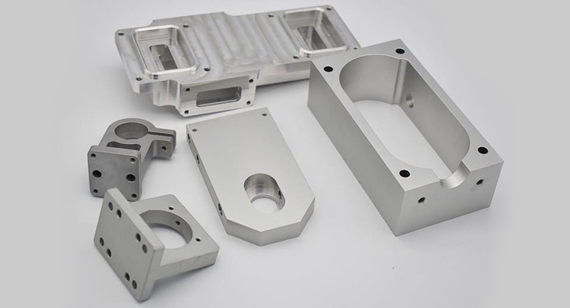
This is specifically for gaining 5052 aluminum's high corrosion resistance for fluid systems——strictly limits Beryllium (Be) to < 0.0008% and mandates a clean microstructure free of Magnesium "clumping" (segregation) at the grain boundaries.
Magnesium segregation in 5000-series alloys can lead to intergranular corrosion, where the metal literally crumbles from the inside out. AMS 4015 ensures the Magnesium is evenly distributed, making the alloy highly resistant to saltwater and aviation fuels.
Therefore, you can use AMS 4015 5052 aluminum for CNC machined fuel line connectors, hydraulic tubing manifolds, fuel tank flanges, and internal oil reservoir fittings. These are parts that require excellent corrosion resistance, high precision and zero risk of chemical leakage.
(If you are designing a precision component and are unsure whether AMS 4027 or AMS 4045 is the right choice for your CNC project, VMT is here to help. We provide 24-hour quote responses and technical feedback to ensure your aerospace project takes off without a hitch.
Challenges and Solutions for CNC Machining
In our experience at VMT CNC Machining Factory, we have identified specific hurdles when working with AMS materials and developed rigorous protocols to overcome them for our clients.
Minimizing Deformation in Thin-Walled Components
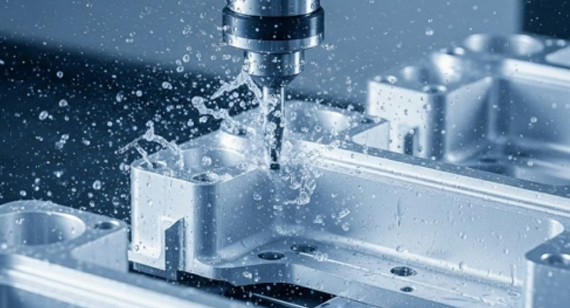
Maintaining Fatigue Integrity in Stress Joints
Application Examples for Precision Aluminum Parts
The following table outlines how different AMS-certified aluminum alloys are used for specific, flight-critical components.
| Material Spec (AMS) |
Base Alloy |
Key Properties |
Typical Precision CNC Parts |
| AMS 4037 |
2024 | High-cycle fatigue resistance; low impurity. | Stress joints, fuselage bushings, miniature brackets. |
| AMS 4045 |
7075 | Maximum tensile strength; SCC resistance. | Actuator housings, and high-load fasteners. |
| AMS 4108 |
7050 | Thick-section strength; low quench sensitivity. | Heavy-duty attachment fittings. |
| AMS 4027 |
6061 | Process consistency; corrosion resistance. | Sensor enclosures, hydraulic manifolds, internal instrument frames, and cooling blocks. |
| AMS 4015 |
5052 | Fuel compatibility; zero intergranular corrosion. | Fuel tank flanges, hydraulic line connectors, oil reservoir fittings, and miniature fluid manifolds. |

Which other materials are used in the AMS (Aerospace Material Specification)?
Beyond the AMS 4xxx series for aluminum and magnesium, the aerospace industry utilizes a wide range of high-performance materials:
What is Aerospace Material Specification (AMS)?
AMS is a set of technical standards developed by SAE International to define the chemical composition, mechanical properties, and manufacturing processes for materials used in the aerospace industry. These standards ensure that every batch of metal or non-metal material meets the extreme safety requirements necessary for flight.
What is the difference between ASTM and AMS?
While ASTM (American Society for Testing and Materials) provides general-purpose standards for commercial and industrial construction, AMS (Aerospace Material Specification) is much more rigorous. AMS includes tighter chemical tolerances, mandatory non-destructive testing (like Ultrasonic or Eddy Current), and strict heat-treatment uniformity (AMS 2750) to mitigate risk in high-stress environments.
What are the 4 types of specifications in aerospace?
In the aerospace ecosystem, technical requirements are generally categorized into four pillars:
What is the best aluminum for aerospace uses?
You can consider 7075-T6 aluminum to be the most standard high-strength alloy used for critical structural parts, while 7050 aluminum is preferred for superior corrosion resistance and strength, and 7475 aluminum for high fracture toughness.
What are AS9100 quality standards?
AS9100 is the international Quality Management System (QMS) standard specifically for the Aviation, Space, and Defense industry. It builds upon ISO 9001 by adding extra requirements for traceability, risk management, and configuration control, ensuring that a factory like VMT CNC maintains a "paper trail" from the raw ore to the final flight-ready part.


 +86 15099911516




 Read more