16 years one-stop China custom CNC machining parts factory

Hey there I’m VMT Sam!
With 25 years of CNC machining experience we are committed to helping clients overcome 10000 complex part-processing challenges all to contribute to a better life through intelligent manufacturing. Contact us now
 172 |
Published by VMT at Jun 17 2026 | Reading Time:About 3 minutes
172 |
Published by VMT at Jun 17 2026 | Reading Time:About 3 minutes


Perhaps you are facing this tradeoff when specifying stainless steel for precision CNC parts: austenitic grades like 304 and 316 offer strong corrosion resistance, but their work-hardening behavior and low thermal conductivity make them slow and tool-intensive to machine. On the other end, free-machining grades like 303 sacrifice some corrosion performance and mechanical strength for easier chip breaking.
410 stainless steel (UNS S41000, 1.4006) is a martensitic grade offering machinability roughly 54% of B1112 in the annealed condition—better than 304 and 316 austenitic grades. Recommended CNC cutting speeds range from 100–180 SFM with carbide tooling in the annealed condition, dropping to 60–100 SFM for heat-treated material above 35 HRC. 410 is magnetic, hardenable by heat treatment, and provides moderate corrosion resistance suited to pump shafts, valve components, fasteners, and surgical instruments.
410 stainless steel occupies a distinct position between these situations. As a martensitic grade, it can be hardened by heat treatment to meet specific strength and wear requirements—something 304 and 316 cannot do. It also machines more readily than austenitic stainless steels in the annealed condition. And its moderate corrosion resistance is sufficient for a broad range of industrial, automotive, and medical applications.
This guide covers the properties, machinability, cutting parameters, and practical trade-offs about 410SS machining. Stick around until the end to see how our facility tackled premature seal wear on 410 stainless steel pump shafts.
410 stainless steel is a martensitic chromium stainless steel with a nominal composition of 11.5–13.5% chromium and 0.08–0.15% carbon. It is designated UNS S41000 under the unified numbering system, 1.4006 under the EN standard, SUS410 under JIS, and 12Cr13 under the Chinese GB standard.
410 belongs to the heat-treatable martensitic family, unlike the 304 and 316 grades which are austenitic and cannot be hardened by heat treatment. When heated above its critical temperature (approximately 815–900°C) and quenched, 410 forms martensite: a hard, strong, and magnetic microstructure. Adjusting the tempering temperature fine-tunes the material's hardness and toughness. This versatility enables 410SS to serve diverse applications, ranging from light-duty structural brackets (annealed, ~20–25 HRC) to wear-resistant pump shafts and valve seats (hardened and tempered, ~35–45 HRC).
Key properties of 410 stainless steel in the annealed condition:
The combination of hardenability, magnetic response, and adequate corrosion resistance for non-marine environments makes 410 a practical choice for parts that need more strength than 304 can provide, but do not require the full corrosion protection of 316.
Machinability ratings are measured against B1112 free-cutting steel as the 100% baseline. In the annealed condition, 410 stainless steel scores approximately 54%, meaning it runs at about half the cutting speed of B1112 for equivalent tool life. For comparison, 304 stainless rates at 45–50%, and 316 drops to 35–40%.
This rating gap highlights a key practical fact: 410 is measurably easier to machine than 304, and significantly easier than 316.
The main reason for this difference lies in their microstructures:
Three characteristics of 410 define the machining approach:
Chip control is generally manageable. 410 produces chips that are more brittle and easier to break than the gummy, continuous chips of 304. This reduces the risk of chip entanglement around the tool or workpiece and allows higher metal removal rates in turning operations. However, at very low feeds in the annealed condition, 410 can still produce stringy chips that require careful chip-breaker selection.
Work hardening occurs but is less severe than with 304. All stainless steels work-harden to some degree. 410's work-hardening rate is lower than that of 304, meaning the material behind the cut remains closer to its original hardness. This reduces the progressive tool loading that occurs when a tool re-enters a previously work-hardened surface on subsequent passes.
Built-up edge (BUE) is the primary tool wear mechanism. 410's tendency to adhere to the cutting edge under heat and pressure causes built-up edge—a deposit of workpiece material that welds itself to the tool, altering the effective cutting geometry and degrading surface finish. This is best managed through appropriate cutting speed (fast enough to avoid the BUE-prone speed range), sharp cutting edges with positive rake geometry, and effective coolant delivery to control temperature at the tool-chip interface.
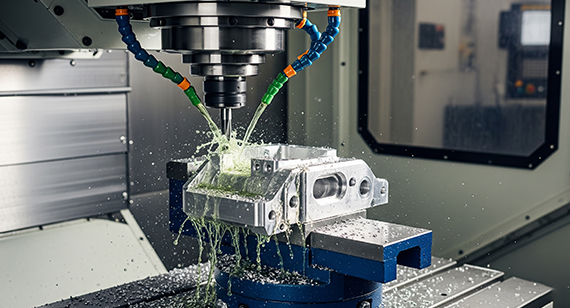
The cutting parameters below represent starting-point recommendations for 410 stainless steel in the annealed condition (20–25 HRC) using carbide tooling. Actual optimal parameters depend on the specific setup rigidity, toolholder, coolant strategy, and part geometry.
| Parameter |
Roughing |
Finishing |
| Cutting speed (SFM) |
120–180 | 150–200 |
| Feed rate (IPR) |
0.004–0.012 | 0.002–0.005 |
| Depth of cut (in) |
0.050–0.150 | 0.010–0.030 |
| Insert geometry |
C-style, negative rake with chip breaker | Positive rake, sharp edge |
| Parameter |
Roughing |
Finishing |
| Cutting speed (SFM) |
100–150 | 130–180 |
| Feed per tooth (IPT) |
0.003–0.006 | 0.001–0.003 |
| Radial engagement |
30–70% | 5–15% |
| Coolant |
Through-spindle or flood | Through-spindle or flood |
CNC Drilling
| Parameter |
HSS-Co |
Solid Carbide |
| Cutting speed (SFM) |
40–70 | 80–130 |
| Feed rate (IPR) |
0.003–0.008 | 0.004–0.010 |
| Point angle |
135–140° | 135–140° |
| Peck cycle |
Recommended for depths > 3× diameter | Recommended for depths > 5× diameter |
Tooling Recommendations for 410SS Machining
Carbide grades with PVD coatings (TiAlN, AlTiN) are the standard choice for 410 stainless machining. The coating provides a thermal barrier that reduces heat transfer into the tool substrate and a low coefficient of friction that discourages built-up edge formation. Uncoated carbide can be used for short runs in the annealed condition but will exhibit faster flank wear.
Sharp cutting edges are mandatory. A honed or lightly chamfered edge increases cutting forces and the tendency for built-up edge. Positive rake angles (5–12° for turning, 5–10° for milling) reduce cutting pressure and improve surface finish.
Coolant is non-negotiable. 410's thermal conductivity is roughly 25 W/m·K—higher than 304 (~15 W/m·K) but still far below aluminum (~150 W/m·K for 6061). Heat concentrates at the cutting zone rather than dissipating through the workpiece. Through-spindle coolant provides the most effective heat evacuation for drilling and deep milling operations. Flood coolant is adequate for general turning and shallow milling, provided the nozzles are aimed at the tool-chip interface, not simply flooding the general area.
One of 410's defining capabilities is its response to heat treatment, and one of the most common machining challenges is processing 410 after it has been hardened. The machinability of 410 drops noticeably above approximately 35 HRC, and the cutting strategy must adjust accordingly.
In the hardened condition (35–45 HRC), cutting speeds should be reduced by roughly 30–50% from the annealed-condition parameters. A part that machines comfortably at 150 SFM in the annealed state may require 80–100 SFM after hardening. Feed rates should be reduced slightly (10–20% lower than annealed-condition feeds), while depth of cut should be kept light and consistent to avoid sudden tool loading.
Tool selection shifts toward harder substrates and higher-temperature coatings. CBN (cubic boron nitride) and ceramic inserts become viable for turning operations above 40 HRC, though they are more brittle and require rigid setups. For milling, AlTiN-coated carbide with a high cobalt content in the substrate (10–12%) provides the hot hardness needed to resist deformation at the elevated cutting temperatures generated by machining hardened material.
The preferred manufacturing sequence for parts requiring both tight tolerances and high hardness is to rough-machine in the annealed condition (leaving 0.2–0.5 mm of stock on critical surfaces), heat-treat to the target hardness, and then finish-machine to final dimensions. This approach avoids the difficulty of removing large volumes of hardened material and reduces the risk of dimensional change from heat-treatment distortion. The finish pass removes only enough material to clean up any heat-treatment scale and geometric shift, minimizing tool wear and cycle time on the harder material.
When 410 appears on a material specification, it is often as an alternative to 304 or 316. Understanding where 410 differs from these more common grades determines whether it is the right choice for a given part.
| Feature |
410 (Annealed) |
304 |
316 |
| Family |
Martensitic | Austenitic | Austenitic |
| Machinability rating |
~54% | ~45–50% | ~35–40% |
| Hardenable by heat treatment |
Yes | No | No |
| Magnetic |
Yes | No (annealed) | No (annealed) |
| Corrosion resistance |
Moderate | Good | Excellent (chloride-resistant) |
| Tensile strength (annealed) |
~450–550 MPa | ~515–690 MPa | ~515–690 MPa |
| Work-hardening rate |
Low–moderate | High | High |
| Typical cutting speed (SFM, carbide turning) |
120–180 | 80–150 | 60–120 |
410 vs 304: 410 machines more easily and can be hardened, but provides less corrosion resistance. Choose 410 when the part requires hardness or strength that 304 cannot achieve through work hardening alone, and when the service environment is mild (indoor, non-marine, low chloride exposure). Choose 304 when corrosion resistance is the primary requirement and the part can function in the annealed condition.
410 vs 316: 316 contains 2–3% molybdenum, which provides resistance to pitting corrosion in chloride environments that 410 cannot match. The machinability gap is significant: 316 is roughly 30–40% slower to machine than 410 in comparable operations. Choose 410 when the part needs moderate corrosion resistance plus hardenability, and the molybdenum premium in both material cost and machining time cannot be justified. Choose 316 when the part will see salt spray, chemical processing, or marine atmospheres.
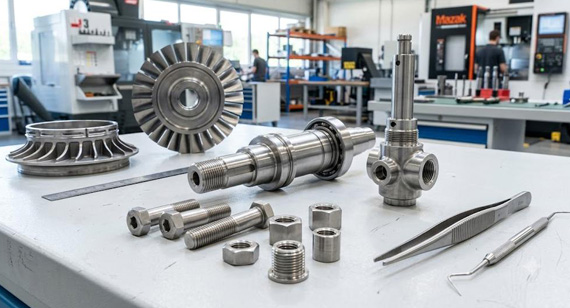
410 stainless steel is specified across industries where a specific combination of moderate corrosion resistance, magnetic response, and hardenability is required.
Pump shafts and valve components: 410 provides the hardness needed for wear resistance at seal and bearing surfaces, with enough corrosion resistance for freshwater, low-pressure steam, and mild chemical streams. Pump shafts are often machined from 410 bar stock, hardened, and finish-ground at bearing journals. Valve stems and seats use 410's hardenability to resist galling and seat wear over extended cycle counts.
Fasteners and threaded components: 410 stainless steel screws, bolts, and threaded inserts combine the corrosion resistance of stainless with strength levels that austenitic grades cannot reach without work hardening—which is not uniform through the thread cross-section. Heat-treated 410 fasteners achieve tensile strengths above 1,200 MPa (175 ksi) in higher-hardness conditions.
Surgical and dental instruments: 410 is used for forceps, scalpels, chisels, and dental hand instruments where the cutting edge must hold sharpness—a requirement that depends on hardenability—and the corrosion environment is limited to brief contact with body fluids followed by sterilization. For implantable devices or instruments exposed to body fluids for extended periods, 316 or titanium is the appropriate choice.
Steam turbine and power generation components: 410's resistance to oxidation and scaling at elevated temperatures (up to approximately 650°C / 1,200°F in continuous service) makes it suitable for turbine blades, valve bodies, and steam handling components. Blades are typically machined from forged 410 blanks, then hardened and tempered to the specific hardness range required by the turbine operating conditions.
An industrial pump manufacturer needed replacement shafts in 410 stainless steel for a line of centrifugal pumps used in low-pressure steam condensate return systems. The shafts required a bearing journal hardness of 38–42 HRC and a surface finish of Ra 0.8 µm or better at the seal interface. The previous supplier's shafts were experiencing premature seal wear traced to inconsistent journal hardness and surface finish variation.
The Challenge
The shaft geometry included a 25 mm diameter bearing journal with a tolerance of +0.000/−0.013 mm, an M16 threaded end for the impeller nut, and a keyway for impeller drive. The shaft was specified in 410 stainless steel, hardened and tempered to 38–42 HRC. The tight journal tolerance had to hold after heat treatment, meaning the pre-heat-treat machining allowance and the post-heat-treat distortion had to be predicted and compensated.
VMT's Approach
The shafts were rough-machined from annealed 410 bar stock on a CNC turning center with live tooling, leaving 0.3 mm of stock on the bearing journal and seal surface. The rough-machined shafts were vacuum heat-treated to 40 HRC (mid-range) and tempered. Post-heat-treat, the bearing journals and seal surfaces were finish-turned with CBN inserts at 90 SFM, 0.003 IPR feed, and 0.15 mm depth of cut, holding the +0.000/−0.013 mm tolerance. The keyway was milled after hardening using a solid carbide end mill with AlTiN coating. Each shaft was inspected for journal diameter, roundness, and surface finish before shipment.
The Result
All shafts in the first production batch of 50 units met the journal tolerance and surface finish specification. The manufacturer reported a 60% reduction in seal replacement frequency over six months of field service compared to the previous supplier's shafts. The consistent post-heat-treat hardness and surface finish at the seal interface were identified as the primary factors behind the improvement.
410 stainless steel is not the right material for every stainless application, and that is precisely its value. Where 304 would be too soft in the annealed condition and 316 would be too slow and expensive to machine, 410 offers a practical middle ground: better machinability than either, hardenability that neither can match, and adequate corrosion resistance for the large class of applications that do not involve chloride exposure.
The key to successfully machining 410 stainless steel lies in adapting your approach to its heat-treatment condition.
Consequently, the ideal workflow is rough machining in the annealed state, followed by heat treatment, and finishing after hardening.
If you are now evaluating 410 for a CNC-machined component, contact VMT's engineering team for a free DFM assessment and one-stop parts manufacturing solution.

Is 410 stainless steel easier to machine than 304?
Yes. In the annealed condition, 410's machinability rating is approximately 54% compared to 304's 45–50%. The practical difference is that 410 can be run at higher cutting speeds—typically 120–180 SFM for turning with carbide versus 80–150 SFM for 304—and produces chips that are more brittle and easier to control.
How does heat treatment affect 410 stainless steel machinability?
Heat treatment reduces machinability substantially. In the annealed condition (20–25 HRC), 410 machines with moderate cutting forces and good chip control. Above 35 HRC, cutting forces increase, tool life shortens, and the risk of chatter rises—particularly on slender or thin-walled features. At 40–45 HRC, cutting speeds must be reduced by 30–50% compared to annealed-condition parameters, and harder tool substrates (higher-cobalt carbide, CBN) become necessary for production volumes.
What are the key 410 stainless steel material properties for engineering design?
In the annealed condition, 410 offers tensile strength of 450–550 MPa and yield strength of 275–350 MPa at approximately 20–25 HRC. After hardening and tempering, tensile strength can exceed 1,200 MPa (175 ksi) at higher hardness levels. 410 is magnetic in all conditions, with a density of approximately 7.75 g/cm³. Its corrosion resistance is moderate: adequate for fresh water, low-pressure steam, mild atmospheres, and many organic chemicals, but not sufficient for chloride-rich or marine environments.
Can 410 stainless steel be used as a lower-cost alternative to 316?
It depends on the corrosion environment. If the part requires 316's molybdenum-enhanced pitting resistance—for example, in marine atmospheres, chemical processing equipment—410 cannot substitute because its chromium-only passive layer will not withstand chloride attack. If the primary requirement is moderate corrosion resistance plus the ability to be hardened (which 316 cannot do), 410 is the better choice.
What types of custom 410 stainless steel parts are commonly CNC machined?
Common CNC-machined 410 stainless parts include pump shafts, valve stems and seats, fasteners (screws, bolts, threaded inserts), surgical and dental instruments, steam turbine blades and valve components, solenoid and magnetic sensor housings, and firearm components. The common thread across these applications is a requirement for moderate corrosion resistance combined with hardenability for wear resistance, edge retention, or strength.
Is 410 stainless steel magnetic?
Yes. Unlike 304 and 316, which are non-magnetic in the annealed condition, 410 is ferromagnetic in all conditions—annealed, hardened, or tempered. This property is often the reason 410 is specified for solenoid components, magnetic sensor housings, and parts that must be detectable by magnetic separation equipment in food or pharmaceutical processing lines.
The technical information and manufacturing advice shared on the VMT website are for general guidance only. While we strive for accuracy, VMT does not guarantee that the processes, tolerances, or material properties mentioned are applicable to every specific project. Any reliance you place on such information is strictly at your own risk. It is the buyer's responsibility to provide definitive engineering specifications for any production orders. Final specifications and service terms shall be subject to the formal contract or quotation confirmed by both parties.


 +86 15099911516




 Read more