16 years one-stop China custom CNC machining parts factory

Hey there I’m VMT Sam!
With 25 years of CNC machining experience we are committed to helping clients overcome 10000 complex part-processing challenges all to contribute to a better life through intelligent manufacturing. Contact us now
 175 |
Published by VMT at Mar 31 2026 | Reading Time:About 2 minutes
175 |
Published by VMT at Mar 31 2026 | Reading Time:About 2 minutes


With its high magnesium content, 5056 aluminum alloy is naturally resistant to marine corrosion and exhibits exceptional strength and hardness after cold working—even surpassing 6061, the most common alloy for structural applications.
So, when comparing the extreme hardness and superior salt-spray resistance of 5056 against the balanced mechanical properties, excellent weldability, and machining adaptability of 6061, how do their mechanical properties stack up across different aluminum tempers? Which is better suited for CNC machining versus forming processes, and how do their applications differ?
Quickly browse this article to understand these key points, helping you master the engineering design differences between 5056 aluminum vs. 6061 and align them with your specific manufacturing requirements.
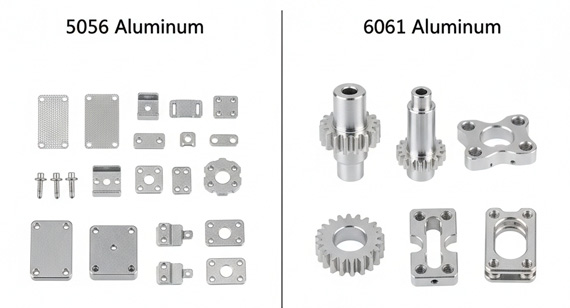
According to Aluminum Association (AA) standards, the 5xxx series consists of non-heat-treatable alloys (hardened only through cold work like rolling, drawing), while the 6xxx series is heat-treatable.
The fundamental difference lies in their strengthening mechanisms: 5056 aluminum relies on work hardening ——indicated by "H" + digits, increasing mechanical strength through physical deformation. In contrast, 6061 utilizes precipitation hardening ——indicated by "T" + digits, where thermal aging optimizes the internal crystalline structure. This distinction leads to a massive divergence in how they perform under stress and tools.
Table of 5056 H vs. 6061 T: Common Tempers
| Temper |
Tensile Strength (MPa) |
Yield Strength (MPa) |
Hardness (HBW) |
Recommended Processing |
Primary Applications |
| 5056-H32 |
310 - 340 | ~180 | ~80 | Cold Stamping(Belongs to Cold Forming) | Marine parts, electronic enclosures(when strict non-magnetism and strict corrosion-resistance is asked) |
| 5056-H34 |
350 - 380 | ~280 | ~90 | Cold Forming | Marine hardware, industrial rivets |
| 5056-H38 |
410 - 430 | ~350 | ~100 | Cold Drawing(Belongs to Cold Forming) | High-strength wire, spring clips |
| 5056-H18 |
~400 | ~340 | ~95 | Wire Drawing(Belongs to Cold Forming) | Zipper teeth, high-tension mesh |
| 5056-H19 |
> 430 | > 380 | > 100 | Extreme Cold Work(Extreme Cold Forming) | High-strength foil, specialty wire |
| 6061-T6 |
~310 | ~270 | ~95 | CNC Machining | Structural frames, aircraft parts, general electronic enclosures |
| 6061-T651 |
~310 | ~270 | ~95 | Precision CNC Machining | Higher-stability machined components(6061 t6 vs t651) |
Is 5056 Actually "Stronger" Than 6061?
At first glance, the data :tensile strength of 5056-H38 (~420 MPa) outperforms 6061-T6 (~310 MPa). But, high strength does not always mean 5056 a better structural fit, the truth is ——while 5056 offers superior raw hardness and salt-spray resistance, it is rarely the first choice for complex load-bearing structures.
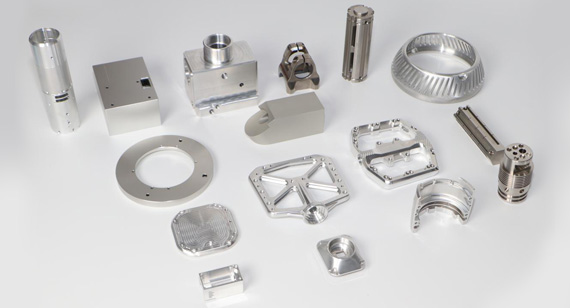
Does 5056 Aluminum Ever Appear in CNC Machined Parts?
The short answer: 5056 is not the standard "go-to" for CNC machining, but it is irreplaceable in niche applications.
In most industries, 5056 is utilized as wire, foil, or extruded shapes—processes that favor cold forming. However, as a specialized CNC facility, we recommend 5056 for machining in these specific scenarios:
Why is 6061 Better for CNC Machining than 5056?
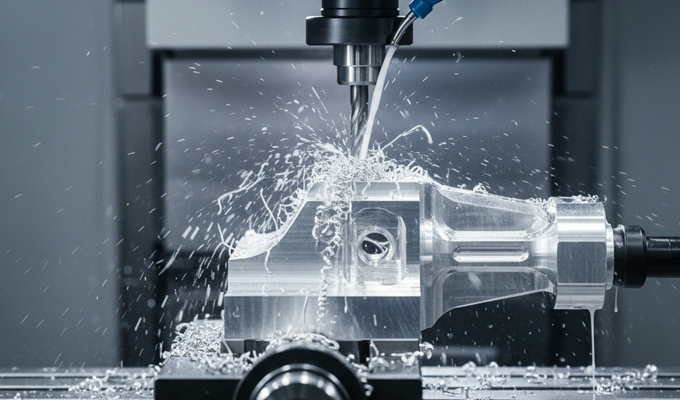
Unlike the "gummy" nature of 5056, 6061 aluminum produces brittle, predictable chips that clear the tool instantly, ensuring a superior surface finish and significantly extending tool life.
While 5056's strength is derived from cold work—which often leaves high internal residual stresses that can cause a part to warp or "move" during machining—6061 maintains its dimensions perfectly.
Why is 5056 Better for Cold Forming than 6061?
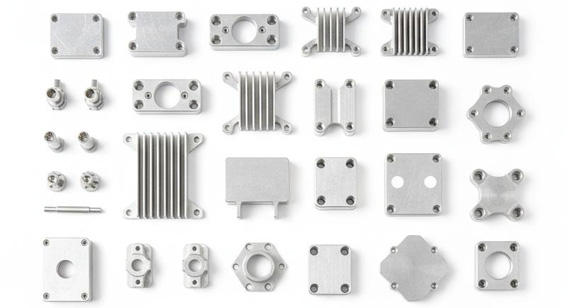
5056 aluminum is highly suitable for applications like high-strength rivets, wire mesh, and cable cladding because of its exceptional ductility in its annealed or softer H-tempers. It can undergo severe mechanical deformation without the risk of cracking—a common failure point for the more rigid 6061.
This ability to gain high strength purely through cold drawing or rolling makes 5056 the most efficient and reliable alloy for high-tension wire and hardware that must survive both physical stress and harsh marine environments.
Table of Applications of 5056 vs 6061
| Industry |
5056 Aluminum |
6061 Aluminum |
| Marine |
Saltwater-exposed rivets, marine wire mesh, underwater sensor housings, coastal hardware. | Boat hulls, deck fittings, mast steps, and marine engine components (requires coating, and basically not immersion in seawater). |
| Electronics |
Cable sheathing, EMI/RFI shielding mesh, high-end decorative enclosures with superior anodizing. | Heat sinks, server chassis, connector housings, and mounting brackets for electronics. |
| Aerospace |
High-strength rivets, aircraft fasteners, anti-fragmentation screens, and specialty cold-drawn wire. | Hydraulic manifolds, and internal structural brackets. |
| Industrial |
Industrial zippers, nails, filter screens, and specialized cold-headed fasteners. | Automated machine frames, assembly fixtures, piping, and structural supports. |
| Medical |
Precision surgical wire, bright-anodized aesthetic trim, and non-magnetic components. | Medical device frames, diagnostic equipment bases, and orthopedic structural supports. |
Choosing between 5056 and 6061 depends on your primary manufacturing method and environmental exposure. If your design calls for high-volume CNC production with high structural integrity, 6061 is the logical choice. However, if you need a part that can survive years in the ocean or requires a flawless decorative finish, 5056 is worth the extra machining effort.
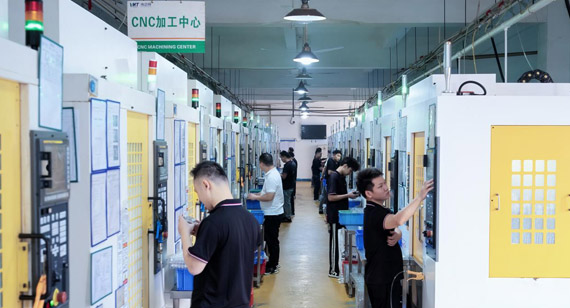
From high-precision electronic enclosures and optical components to high-performance automotive parts and subsea ROV components designed for the harshest marine environments, VMT CNC Machining Factory provides end-to-end support—from material selection to advanced 5-axis simultaneous machining.
Ready to bring your project to life?
Explore more on our capabilities: CNC Prototyping Machining Services, Precision CNC Machining Services ,and contact us for a professional consultant with 24 hours.

What are 6061 vs. 5056 thermal conductivity?
6061-T6 has significantly higher thermal conductivity (approx. 167 W/m·K) compared to 5056 (approx. 120 W/m·K). This makes 6061 the preferred choice for heat sinks and thermal management components.
What are 6061 vs. 5056 composition differences?
The primary difference lies in their alloying elements: 6061 is a magnesium-silicon alloy (Al-Mg-Si), making it heat-treatable, while 5056 is a high-magnesium alloy (Al-Mg) containing about 5% Magnesium, which provides its superior corrosion resistance and work-hardening capabilities.
6061 vs. 5056 aluminum properties: what are the key differences?
The key divide is in their strengthening mechanism: 6061 achieves its strength through heat treatment (precipitation hardening), offering high structural rigidity, whereas 5056 gains strength through cold working (strain hardening), offering much higher ductility. Another key difference is that 5056 aluminum is better resistance to saltwater corrosion.
What are 5056 aluminum equivalents?
Depending on the international standard, 5056 is equivalent to: ISO: AlMg5, Germany (DIN): AlMg5 (Material No. 3.3555), Japan (JIS): A5056, UK (BS): 5056A / N6, China (GB): 5A05 (similar properties).
What is 5056 aluminum wire usually used for?
Due to its high ductility and excellent finish, 5056 wire is primarily used for high-strength rivets, high-quality zippers, fly screens, insect mesh, and cable cladding in marine or aerospace applications.
Is 6061 or 5056 stronger in tensile strength?
5056 is capable of much higher tensile strength. When cold-worked to an H38 or H19 temper, 5056 can reach 400-435+ MPa, whereas 6061-T6 typically peaks at 310 MPa. However, 6061-T6 is considered "stronger" in terms of its overall structural balance, offering a better combination of good machining ability, structural integrity, and fatigue resistance for load-bearing frames.


 +86 15099911516




 Read more