16 years one-stop China custom CNC machining parts factory

Hey there I’m VMT Sam!
With 25 years of CNC machining experience we are committed to helping clients overcome 10000 complex part-processing challenges all to contribute to a better life through intelligent manufacturing. Contact us now
 84 |
Published by VMT at May 19 2026 | Reading Time:About 2 minutes
84 |
Published by VMT at May 19 2026 | Reading Time:About 2 minutes


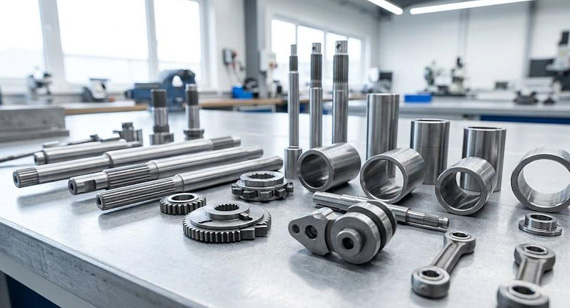
If there’s a metal that not only provides excellent impact resistance and toughness but also outstanding wear resistance and durability—yeah, we say the 1075 high carbon spring steel. Would you like to use it for mechanical components that must withstand high loads and frequent impacts, and perform with an exceptionally long fatigue life? If you search for 1075 steel, the web will most likely lead you to springs or knives. However, it can also be used for precision CNC machining to make parts like transmission shafts, ratchets, sleeves, or liners—only when high impact toughness and high elasticity are required. Otherwise, alloy steels like 4140 or 4340 might be more popular choices.
This blog will introduce this SAE 1075 carbon steel, mainly focusing on its properties, uses, and comparisons to some common steels. At the very end, we will also share a case study of how our factory produced satisfying 1075 shafts used under frequent impact environments and helped our clients save on production costs.
Since 1075 high carbon steel may be named differently in your region, below table lists the equivalent grades in various countries for your quick reference:
| Region |
Equivalent Grade |
| USA (AISI/SAE) |
1075 / G10750 |
| Germany (DIN/EN) |
1.0605 / C75W / C75S |
| Japan (JIS) |
S75C / SK85 |
| United Kingdom (BS) |
060A78 / En44 |
| China (GB) |
75 / 75Mn |
| Russia (GOST) |
75 / 80 (75 ГОСТ) |
| Australia (AS) |
AS 1448-1075 |
| France (AFNOR) |
XC75 / C75RR |
| Italy (UNI) |
C75 / C70 |
| Sweden (SS) |
1770 / 1778 |
| International (ISO) |
C75S |
You might be confused by 1075 and 1095 steel due to both are "high carbon" steel with similar excellent wear resistance and toughness. However, the slight difference in carbon content (approx. 0.75% vs. 0.95%) leads to distinct mechanical behaviors. Below is a clear table for their differences in mechanical properties:
| Property |
1075 High Carbon Steel |
1095 High Carbon Steel |
| Tensile Strength (MPa) |
700 - 900 | 800 - 1100 |
| Yield Strength (MPa) |
450 - 600 | 500 - 750 |
| Hardness (Typical) |
50 - 55 HRC | 55 - 62 HRC |
| Wear Resistance |
Good | Excellent |
| Charpy Impact (J) |
~20 - 35 J (@20°C) | ~8 - 15 J (@20°C) |
| Charpy Impact Toughness |
Excellent (Higher) | Fair (Brittle) |
| Fatigue Life (Cycle) |
Very High (Excellent Spring) | Moderate |
| Fatigue Limit (MPa) |
~340 - 420 | ~380 - 480 (but sensitive to surface scratches) |
| Machinability Rating(AISI 1212 as the 100%) |
~65% - 70% | ~45% - 50% |
| Production Cost |
Fair | Relatively Higher |
For strength or hardness, etc., you can just refer to the data for 1075 vs 1095 limits. Only one most important difference is that 1075 can be tougher for impact resistant application, and this is for safety reasons. Thus, If your part is thicker than 6mm (1/4 inch) and requires high toughness throughout, choose 1075. 1095 is "shallow hardening" and may become too brittle if not quenched with extreme precision.
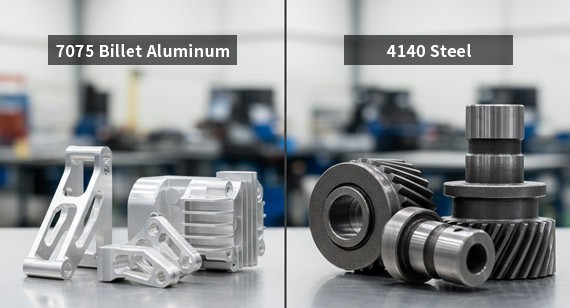
When your project requires high strength and impact resistance, you might find yourself choosing between 1075 high carbon steel and popular alloys like 4140 or 4340. While their applications sometimes overlap—especially in shafts and heavy-duty brackets—the decision usually comes down to cross-sectional thickness and total budget.
Part Thickness and Hardenability
Impact and Toughness Requirements
Cost Comparison
Quick Table for 1075 Carbon Steel vs. 4140 vs. 4340 Alloy Steel
| Feature |
1075 Carbon Steel |
4140 Alloy Steel |
4340 Alloy Steel |
| Cost for Parts Production |
Lowest (Budget Friendly) | Moderate | High |
| Hardenability |
Shallow (Thin parts only) | Moderate | Deep (Thick parts) |
| Best Application |
Springs, Clips, Thin Shafts | Gears, Bolts, Mid-size Shafts | Heavy-duty Crankshafts, Large Shafts |
| Machinability |
Good | Moderate | Fair |
1075 high carbon steel is an excellent candidate for CNC machining when your application demands a balance of high elasticity and impact resistance on a budget.
Here are four classic examples of where 1075 excels in precision engineering:
1. Precision Drive Shafts, Eccentric Shafts, and Linkages
Its high fatigue limit ensures these shafts won't crack under repetitive stress, while its elasticity handles eccentric loads without permanent deformation.
2. High-Load Precision Ratchets and Pawls
It is less brittle than 1095, preventing the teeth from chipping or shattering during heavy-duty engagement.
3. Precision Wear-Resistant Sleeves and Bushings
When heat-treated, it achieves a durable 50-55 HRC surface that resists abrasion, making it a cost-effective alternative to expensive tool steels for thin-walled liners.
4. Precision Cams and Connecting Rods
Its exceptional elasticity and fatigue resistance allow these components to operate through millions of cycles while maintaining their exact geometry.
Is Your Project a Match for 1075?
We recommend using 1075 when your project meets these three basic conditions:
Optimizing Drive Shaft Reliability—Solve the Fatigue Failure in High-Impact Environments
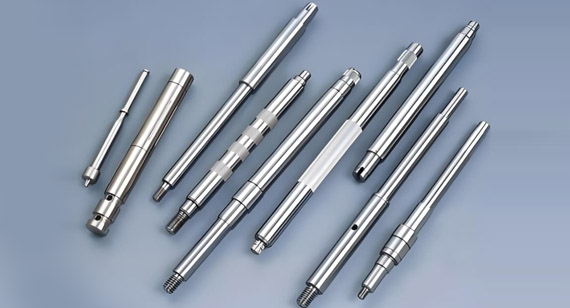
One of our clients faced a recurring issue with their precision drive shafts, which were originally manufactured using 1095 high carbon steel. Despite the material's high hardness, the shafts consistently suffered from brittle fractures under frequent, high-velocity impact conditions. The extreme hardness of 1095 made the components a little brittle, leading to premature fatigue failure.
After analyzing the failure points, our engineering team suggested transitioning from 1095 to 1075 high carbon steel to leverage its superior toughness and elasticity. During the CNC machining process, we maintained strict tolerances for eccentricity to ensure smooth high-speed rotation. Crucially, we optimized the heat treatment process by precisely controlling the tempering cycles to eliminate temper embrittlement. This specialized thermal management allowed the 1075 steel to reach its best state—maintaining a wear-resistant surface while retaining a highly elastic core.
By switching to 1075, the drive shafts achieved a 40% increase in service life, effectively ending the brittle fracture issues. Furthermore, because 1075 is more economical to source and easier to machine than 1095, we helped the client reduce their production costs by 15%.
In this guide, we have explored the versatile nature of 1075 high carbon steel—from its international equivalents and mechanical advantages over 1095 to its strategic use in precision CNC machining. As we’ve seen, 1075 is quite a excellent steel for its impact toughness, high elasticity, and cost-efficiency. When making your final decision, you should prioritize 1075 if your design features thin cross-sections and requires a material that can absorb frequent shocks without fracturing for shafts, ratchets, and wear-resistant components. Ready to optimize your next project with precision 1075 steel components? Contact our team today for a professional technical consultation and a fast quote.

Is 1075 steel weldable?
Yes, but it is difficult; because of the high carbon content, you must preheat the material to 250°C–350°C and perform post-weld heat treatment to prevent martensitic cracking in the heat-affected zone.
What is the best surface finish for 1075 parts?
Black oxide is the most common for maintaining precision and a classic look, but electroless nickel plating is the best choice if you require superior wear resistance and better corrosion protection for CNC parts.
Can 1075 steel be laser cut before CNC machining?
Yes, but be aware that laser cutting creates a heat-affected zone along the edges that can become extremely hard and brittle; you may need to grind the edges or anneal the part before proceeding with precision CNC milling.
What is the typical hardness of 1075 after quenching?
Immediately after an oil quench, 1075 typically reaches a hardness of 60–64 HRC, which is then usually tempered down to 45–55 HRC depending on whether you prioritize toughness or wear resistance.
Does 1075 steel rust easily?
Yes, like most carbon steels, it will rust quickly in humid environments; you should always apply a rust-preventative oil, coating or plating to protect the surface after machining.
How does 1075 steel handle cryogenic temperatures?
It performs poorly in a low-temperature environment; 1075 becomes increasingly brittle at cryogenic temperatures, losing its impact toughness and becoming prone to sudden catastrophic failure compared to stainless or nickel-alloy steels.
The technical information and manufacturing advice shared on the VMT website are for general guidance only. While we strive for accuracy, VMT does not guarantee that the processes, tolerances, or material properties mentioned are applicable to every specific project. Any reliance you place on such information is strictly at your own risk. It is the buyer's responsibility to provide definitive engineering specifications for any production orders. Final specifications and service terms shall be subject to the formal contract or quotation confirmed by both parties.


 +86 15099911516




 Read more