16 years one-stop China custom CNC machining parts factory

Hey there I’m VMT Sam!
With 25 years of CNC machining experience we are committed to helping clients overcome 10000 complex part-processing challenges all to contribute to a better life through intelligent manufacturing. Contact us now
 651 |
Published by VMT at Apr 11 2026 | Reading Time:About 2 minutes
651 |
Published by VMT at Apr 11 2026 | Reading Time:About 2 minutes


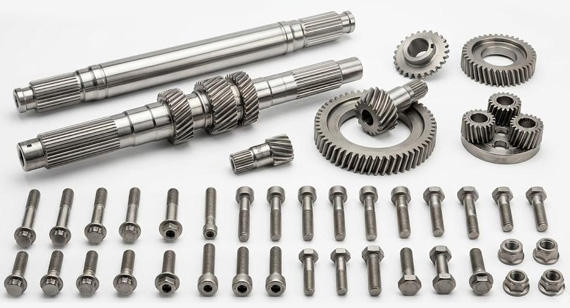
Maraging steel is a material that combines ultra-high strength with exceptional toughness, making it ideal for CNC machining into various components for aerospace and precision engineering.
However, when machining this material, you may face challenges such as maintaining micron-level dimensional accuracy—due to the slight volumetric shrinkage after heat treatment—or achieving efficient processing owing to its high toughness.
In this article, you will learn about the properties, popular grades, and applications of maraging steel. At the end, we will also share how we help our clients by accurately calculating shrinkage compensation for age hardening and employing efficient machining techniques to ensure that the delivered parts achieve both ultra-high strength and precision.
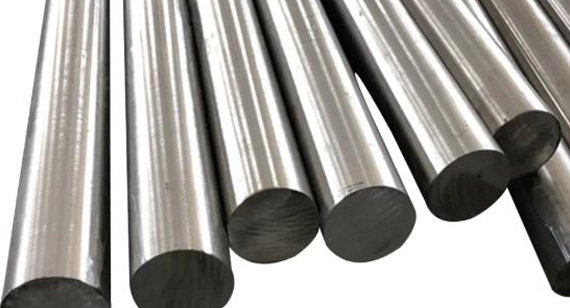
Maraging steels are a special class of low-carbon, ultra-high-strength steels. The name is derived from its unique strengthening mechanism during heat treatment: the hardening of the Martensite structure through an Aging process.
Unlike medium-to-high carbon steels or martensitic stainless steels, its hardness does not come from carbon. Instead, it originates from the precipitation of intermetallic compounds—a process known as age hardening—involving alloying elements such as nickel (typically 18%), cobalt, molybdenum, and titanium.
(medium-to-high carbon steels or martensitic stainless steels primarily achieve higher tensile strength, toughness, and hardness through quenching and tempering, where carbon content is the dominant factor in final performance).
Key characteristics of maraging steel include:
Different grades of maraging steel balance strength and toughness by adjusting the alloy proportions. Popular grades include C250 (offering a balance of toughness and strength), C300 (ultra-high strength with good toughness), and C350 (specifically formulated for maximum strength, albeit with slightly lower toughness).
| Grade |
Nickel (Ni) % |
Cobalt (Co) % |
Molybdenum (Mo) % |
Titanium (Ti) % |
Aluminum (Al) % |
| Maraging 250 |
17.0 - 19.0 | 7.0 - 8.5 | 4.6 - 5.2 | 0.3 - 0.5 | 0.05 - 0.15 |
| Maraging 300 |
18.0 - 19.0 | 8.5 - 9.5 | 4.7 - 5.2 | 0.5 - 0.8 | 0.05 - 0.15 |
| Maraging 350 |
18.0 - 19.0 | 11.5 - 12.5 | 4.7 - 5.2 | 1.3 - 1.6 | 0.05 - 0.15 |
| Role |
Provides toughness | Catalyzes strengthening | Strengthening | Auxiliary strengthening | Auxiliary strengthening |
Understanding the physical properties of maraging steel is crucial for your parts’ thermal design and precision fits.
In particular, its coefficient of thermal expansion is significantly lower than that of standard stainless steels (which are typically 16–18). Consequently, after CNC machining your desired parts from annealed maraging steel and then applying heat treatment (age hardening) to achieve strength and hardness, the dimensional changes are minimal. By pre-calculating the expansion/contraction allowance, you can largely reduce the costs and extra steps of post-treatment precision grinding.
| Property |
Value (Typical) |
| Density |
8.0 - 8.1 g/cm³ |
| Melting Point |
1413 °C (2575 °F) |
| Coefficient of Thermal Expansion |
10.1 - 10.3 (10⁻⁶/°C) |
| Thermal Conductivity |
21.0 - 25.5 W/m·K |
| Modulus of Elasticity |
190 GPa |
It is essential to understand the changes in mechanical properties following maraging 300 steel heat treatment( age hardening) to select the most suitable grade. This choice primarily depends on your part design requirements for yield strength, toughness, and hardness.
| Grade |
Condition |
Yield Strength (MPa) |
Tensile Strength (MPa) |
Hardness (HRC) |
Elongation (%) |
| C250 |
Annealed | 800 | 1000 | 30 - 32 | 15 - 18 |
| C250 |
After Aging | 1720 | 1760 | 48 - 50 | 6 - 10 |
| C300 |
Annealed | 820 | 1050 | 32 - 34 | 15 - 18 |
| C300 |
After Aging | 2050 | 2080 | 52 - 54 | 6 - 10 |
| C350 |
Annealed | 850 | 1100 | 34 - 36 | 12 - 15 |
| C350 |
After Aging | 2415 | 2450 | 56 - 60 | 5 - 8 |
Despite its excellent properties—such as stability at high and low temperatures and the balance of high strength and toughness across different grades—maraging steel is not as smooth or fast to cut, drill, turn, or mill as free-machining steels (e.g., AISI 12L14 or SS303). Machining maraging steel, especially when manufacturing small-to-medium precision parts, requires mastering several essential techniques.
1. Machinability of Maraging Steel
Maraging 300 steel machinability is relatively good in its annealed state (with a hardness of approximately 30–35 HRC). At this stage, the machining difficulty is similar to that of AISI 4340 or high-performance stainless steels. Its machinability rating is roughly 35% to 45% (compared to easy-to-be-machined 12L14, which is rated at 100%).
But once the material undergoes age hardening and reaches a hardness of over 50 HRC, machining becomes extremely difficult. So if you are seeking a facility to manufacture your maraging steel parts, it is standard practice to machine the steel in its annealed state——Better machinability in annealed state means a significant reduction in tool wear and processing time, making the manufacturing cost more favorable.
Furthermore, due to its low thermal expansion, parts machined in the annealed state and then heat-treated will maintain high precision—provided the proper allowances are made—saving both time and costs.
2.Essential Tips for CNC Machining Maraging Steel
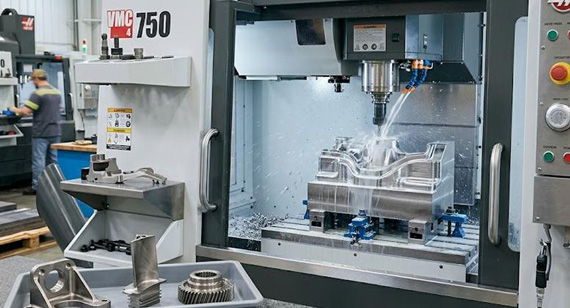
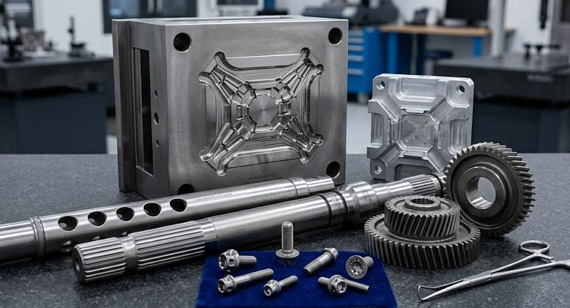
Due to its ultra-high strength-to-weight ratio, ability to withstand extreme loads and impacts, excellent polishability, thermal fatigue resistance, and moderate corrosion resistance, maraging steel is a preferred choice for critical components.
Generally, larger parts are forged first and then precision ground and polished, while smaller components are directly CNC machined. Below are a few listed examples of maraging steel applications across various industries:
With its ultra-high strength-to-weight ratio, ability to withstand extreme loads and impacts, excellent polishability, thermal fatigue resistance, and reliable corrosion resistance, maraging steel has become a favored material in aerospace and high-end automotive industries. Popular grades such as C300 and C350 offer a versatile range of options to meet specific engineering needs.
While material and processing costs are relatively high, its superior performance and machining stability make it a compelling choice for CNC-machined precision parts and high-performance applications. If you are unsure whether maraging steel is the right fit for your manufacturing requirements, or if you have drawings for custom steel parts, feel free to consult us for professional, rapid assistance and a free quote.

A racing engineering team required a batch of custom high-performance drive shafts for their drivetrain system. The specifications demanded that the components withstand extreme torque while maintaining a lightweight profile. Maraging 300 (C300) was selected as the material.
The drive shaft drawings provided by the client featured a high length-to-diameter ratio. Due to the high toughness of maraging steel, high-speed turning is prone to resonance and built-up edge (BUE), which can compromise surface finish. Furthermore, the client required a finished hardness of 52–54 HRC and a runout tolerance on the journals within 0.01 mm. Machining the material in its hardened state would have pushed tool costs over budget, while heat-treating after machining required meticulous deformation control.
VMT technical team developed a phased machining strategy:
The delivered drive shafts not only passed extreme torque performance tests but also met the micron-level requirements for runout and diameter tolerances. By implementing this "compensation calculation followed by heat treatment" strategy, we saved the client the costs associated with extensive hard-material grinding and reduced the delivery lead time by 20%.
1. What is the density of maraging steel?
The density of maraging steel is approximately 8.0 to 8.1 g/cm³ (0.289 lb/in³), which is slightly higher than that of standard carbon steel. However, due to its exceptional strength and reliable rigidity, it is ideal for thin-walled or hollowed-out designs to reduce weight. This makes it an excellent choice for applications requiring a high strength-to-weight ratio (lightweight yet ultra-strong).
2. How is maraging steel made?
It is typically produced through Vacuum Induction Melting (VIM) for the initial melt, followed by Vacuum Arc Remelting (VAR) for further purification. This ensures the removal of impurities and the uniformity of the microstructure. This complex and precise manufacturing process is one of the reasons for the high price of maraging steel (the other primary reason being the high cost of nickel and cobalt).
3. What is the melting point of maraging steel?
Its melting point generally falls between 1410°C and 1440°C. You may need to consider this thermal limit when designing for tooling or mold applications.
4. Is maraging steel magnetic?
Yes. Due to its martensitic microstructure, maraging steel is naturally strongly magnetic in all conditions.
5. What are the disadvantages of maraging steel?
The primary disadvantages include: high cost (Maraging steel price), limited resistance to strong acids (while its corrosion resistance is better than standard tool steels, it is inferior to stainless steel), and a dependence on strategic resources due to high cobalt content. Approximately 70% of the world's cobalt is produced in the Democratic Republic of the Congo (DRC); during periods of international instability, lead times for high-cobalt grades like Maraging 350 can extend from weeks to months, accompanied by significant price volatility in nickel and cobalt.
6. Why is maraging steel cost so high?
The high cost is primarily driven by:


 +86 15099911516




 Read more