16 years one-stop China custom CNC machining parts factory

Hey there I’m VMT Sam!
With 25 years of CNC machining experience we are committed to helping clients overcome 10000 complex part-processing challenges all to contribute to a better life through intelligent manufacturing. Contact us now
 156 |
Published by VMT at Apr 28 2026 | Reading Time:About 2 minutes
156 |
Published by VMT at Apr 28 2026 | Reading Time:About 2 minutes


As we all know, if a designed part is going to be used in high wear and abrasion environment, it couldn't’t be made of soft steel. While D2 steel is one of the famous “ hard steel” that can meet the high wear and abrasion uses perfectly—this outstanding wear-resistant, edge-retaining, and reputed as “ semi-stainless” steel is what we will dive deep into today.
How this D2—cold work class of D-series tool steels— can benefit your application? How can you tell if the D2 vs A2 vs 440C vs M2 vs 4140 is suitable for your project or not? These are the common questions we often see from our client—as the professional CNC machining factory, we will help you figure these issues out and share a case how we reduce downtime with D2 CNC parts for one of our clients in the end.
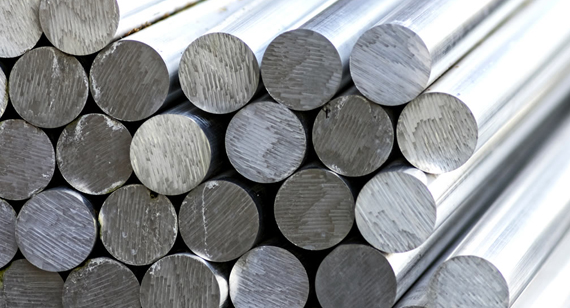
D2 steel belongs to the D-series of tool steels, a specific "cold work" class engineered to stay stable and perform under high-pressure conditions.
From its character “D”, which represents “ Die”, you can see this steel is tough and strong enough for the die uses. This characteristic is caused by its air-hardening to gain exceptional wear resistance — as it has a high carbon content of 1.55%.
Another advantage is that D2 steel has chromium content of 12%— gives it better corrosion resistance than other tool steels. So, if you plan to use d2 steel to manufacture CNC parts such as guides, bushings, rollers, this feature gives parts better rust-resistant capability, reducing maintenance costs under long-term storage and precision operation environments.
Global Equivalents of D2 Tool Steel
For a more convenient check, it is important to recognize D2 by its common regional equivalents:
As we have learnt, the most important composition of D2 steel is — high carbon content can make your D2 steel parts highly wear-resistant, and high chromium content can make your D2 steel parts restore for a longer time and costs less maintenance money. Here is a clear D2 composition breakdown:
| Element |
Symbol |
Content (%) |
| Carbon |
C | 1.40 – 1.60 |
| Chromium |
Cr | 11.00 – 13.00 |
| Molybdenum |
Mo | 0.70 – 1.20 |
| Vanadium |
V | 0.50 – 1.10 |
| Manganese |
Mn | 0.10 – 0.60 |
| Silicon |
Si | 0.10 – 0.60 |
| Phosphorus |
P | ≤ 0.03 |
| Sulfur |
S | ≤ 0.03 |
| Iron |
Fe | Balance |
To help you with quick calculations, here is a comprehensive look at the physical and mechanical properties of D2 steel:
Physical and Thermal Properties of D2
| Property |
Value (Metric) |
Value (Imperial) |
| Density |
7.70 g/cm3 | 0.278 lb/in3 |
| Melting Point |
1425∘C | 2597∘F |
| Modulus of Elasticity |
210 GPa | 30.5×10⁶ psi |
| Thermal Conductivity |
20 W/m⋅K | 139 BTU-in/hr-ft2-∘F |
| Coefficient of Thermal Expansion |
10.4×10⁻⁶/∘C | 5.8×10⁻⁶/∘F |
| Specific Heat |
460 J/kg⋅K | 0.11 BTU/lb-∘F |
Mechanical Properties of D2: Annealed vs. Hardened
| Mechanical Property |
Annealed State |
Hardened & Tempered (typical) |
| Hardness |
200−255 HB (Brinell) | 58−62 HRC (Rockwell C) |
| Yield Strength |
≈450 MPa (65 ksi) | 1,500−2,200 MPa (215−320 ksi) |
| Tensile Strength |
≈650 MPa (94 ksi) | 1,700−2,400 MPa (250−350 ksi) |
| Poisson's Ratio |
0.27−0.30 | 0.27−0.30 |
| Impact Strength (Charpy C-Notch) |
N/A | 20−27 Joules (15−20 ft-lb) |
| Machinability |
20−30% of B1112 Steel | Very Poor (Grinding only) |
If you are sourcing D2 parts for automotive dies, high-wear drone components, or precision industrial equipment—D2 tool steel is not that easy to process.
Why Your D2 Parts Require Longer Lead Times— Low Machinability
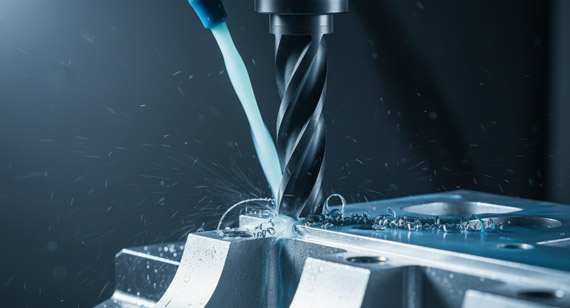
When the factory gets your order and they start manufacturing D2 parts by CNC machining. You may find this process takes a longer time, and a higher processing cost than standard carbon steels, which is quoted higher as the cost counts on CNC machining operation minutes—low machinability pushes a hard and slow machining time.
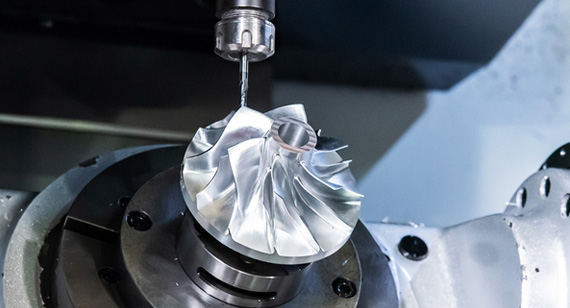
To avoid "work hardening"—where the surface becomes brittle and unworkable—your partner factory must adhere to strict, controlled cutting speeds. These deliberate speeds ensure your parts are free from micro-cracks and internal stress and be patient for this necessary.
Pro-Tips for Optimizing Your Project Costs
If your D2 parts have deep internal cavities or sharp 90-degree internal corners, please consider changing these. D2 is so difficult to cut, drill, mill or turn, so keeping these futures can cause longer machining time and cost—especially if these futures are not necessary. And don't worry if you are not sure about your drawings, ask a professional factory and engineers can help you evaluate and optimize the design.
As you may hear about, many people prefer D2 tool steel for stamping dies, industrial saws, and outdoor knives. These are indeed famous for D2 applications, but these are not all. Its utility in custom CNC machining is vast, and, if your project demands extreme longevity under friction, you should consider D2 for:
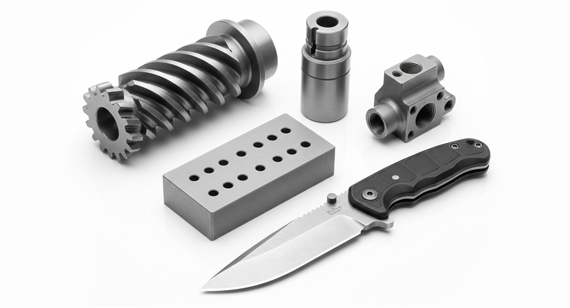
Thanks to its exceptionally low coefficient of thermal expansion, your gauges will maintain perfect dimensional stability despite temperature fluctuations on the shop floor.
For your automated assembly lines where metal-on-metal contact is constant, D2 prevents premature equipment failure and slashes your maintenance downtime.
In machinery where lubrication might be sparse or inconsistent, D2’s high chromium content provides a level of built-in durability that standard steels simply can’t match.
When holding parts under extreme hydraulic or mechanical pressure, D2 blocks won’t deform, ensuring your manufacturing repeatability remains flawless.
Where high surface hardness is critical to prevent galling and metal transfer, D2 provides a glass-hard surface that keeps your timing and motion smooth.
A2 tool steel is a preferred choice if your component faces heavy impact, such as hammers or heavy-duty punches— A2 is significantly tougher has a lower carbon content than D2.
And you can choose D2 for components like shears or high-volume stamping dies where the primary goal is to maintain a sharp edge against constant abrasion for as long as possible—D2 contains a much higher volume of chromium carbides, giving it the edge in sliding wear resistance.
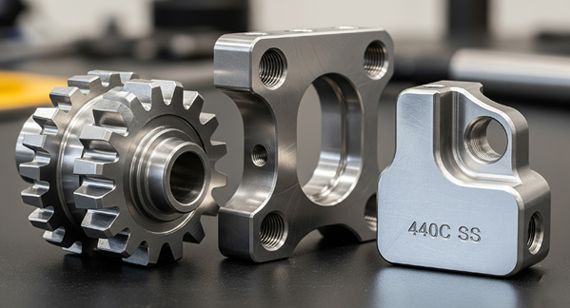
If your parts operate in medical, marine, or food-processing environments where hygiene and rust-prevention are non-negotiable, 440C is the better one— It is a true stainless steel that offers excellent resistance to rust and chemical attack.
If the environment is dry and industrial, D2 offers a better usage life due to its excellent wear resistance— Although it is often called "semi-stainless" because it has high chromium, it will still be prone to rust than stainless steel as it can't form a passive layer.
Specify M2 is a must for high-speed cutting tools or parts subjected to intense, constant friction heat— it is designed to stay hard even when friction generates extreme heat (up to 540℃).
And you may choose D2 for most other high-wear industrial components that operate at room temperature— this is when the cold-work steel provides the best balance of performance and budget.
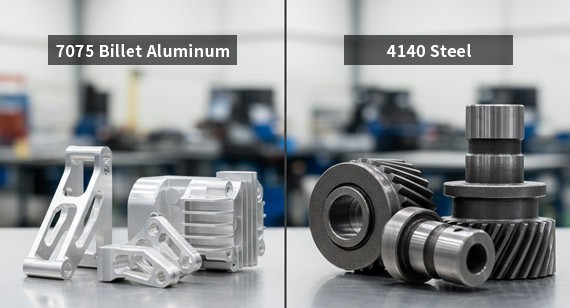
It's a good choice for you to use 4140 alloy steel for structural parts, shafts, or bolts where extreme wear isn't the key factor— it is tough, versatile, and easy to machine, but it lacks the specialized carbides found in D2.
And making the leap to D2 if your current 4140 parts are failing prematurely due to surface wear—although higher machining cost but higher wear resistance due to carbides in D2.
A client in the packaging sector faced frequent production bottlenecks due to the rapid degradation of their conveyor guide rails. Originally fabricated from 440C stainless steel, the components were unable to withstand the constant abrasion from high-speed packaging lines. This resulted in significant wear within a few months, forcing repeated maintenance shutdowns and disrupting the factory's overall output consistency.
After analyzing the situation, we—VMT CNC machining factory team—recommended a transition from stainless steel to D2 tool steel, finished with a protective black oxide coating. After managing the entire process from soft-state CNC machining to precision heat treatment, bringing the components to a consistent 60 HRC— This shift was designed to replace a "disposable" part mindset with a long-term engineering solution.
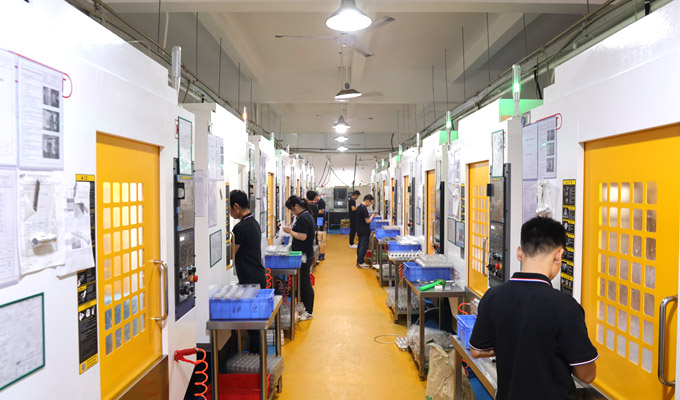
While the initial manufacturing cost of D2 was approximately 30% higher than stainless steel, the components have now exceeded 18 months of continuous operation without visible signs of wear. The client won't need to do the quarterly replacement cycles later, and they were satisfied with this result.
D2 tool steel remains a premier choice for industrial applications where abrasion resistance and dimensional stability are non-negotiable. While it presents challenges in the CNC machining process, the long-term commercial value—reduced maintenance, fewer replacements, and higher precision—makes it a more practical and suitable choice.
At our CNC machining factory, we have decades of experience taming "difficult" materials like D2. If you are designing a part that needs to be used for highly wear resistant and durable, contact us today for a free DFM analysis or a quote on your D2 project.

How good is D2 steel for CNC machining?
Yes, it can be down to the perfect parts of an experienced CNC shop —just account for the 20-30% machinability and use specialized tooling to ensure accuracy.
Is D2 steel expensive?
In terms of raw material, it is moderately priced—more expensive than 4140 or A2, but cheaper than high-end steels like M2. The main cost comes from machining time and tooling wear.
Can D2 steel be polished?
Yes. D2 can be polished to a high finish, though it often retains a "fine orange peel" texture due to its large chromium carbides. It is not as "mirror-like" as 440C.
Can D2 tool steel be welded?
Yes, but it is challenging. D2 is highly prone to cracking due to its high carbon content. If welding is unavoidable, it requires extensive pre-heating and post-weld annealing.
Can D2 be forged?
Yes, but it is difficult. It must be forged within a strict range of 1050°C - 1150°C. And it requires careful control with slow cooling (such as furnace cooling) to prevent the material from shattering.
What is the standard heat treatment for D2?
This includes a 4-step process:


 +86 15099911516




 Read more